A carefully timed pair of light pulses can amplify the motion of atomic layers in a quantum material
Splitting a laser pulse into two precisely timed weaker bursts lets electrons relax between hits, amplifying the sliding motion of atomic layers in WTe₂ beyond the limits of a single strong pulse.
Introduction
Controlling the atomic arrangement of quantum materials with light is a fast‑growing frontier in condensed‑matter physics. A recent study on the layered semimetal WTe₂ shows that a pair of carefully timed ultrafast laser pulses can drive the sliding motion of its atomic sheets far more efficiently than a single, more energetic pulse. By exploiting the natural relaxation dynamics of excited electrons, the researchers demonstrated a simple yet powerful way to amplify coherent phonon amplitudes without resorting to higher laser powers.
How Light Moves Atoms
When an ultrashort laser pulse strikes a crystal, it first excites electrons to higher energy states. These excited electrons modify the forces acting on the nuclei, setting the atoms into motion on femtosecond timescales. In a sliding ferroelectric such as WTe₂, adjacent layers can glide past one another, a motion that directly influences ferroelectric polarization, electronic topology, and other functional properties.
The Saturation Problem
Increasing the pulse energy does not linearly increase the layer displacement. Beyond a certain intensity, electrons populate high‑energy states that generate forces opposing the desired sliding direction. The net result is a saturation—or even a reduction—of the atomic motion despite the added energy. This limitation makes it impractical to simply crank up laser power for stronger control.
Two‑Pulse Strategy: A Swing Analogy
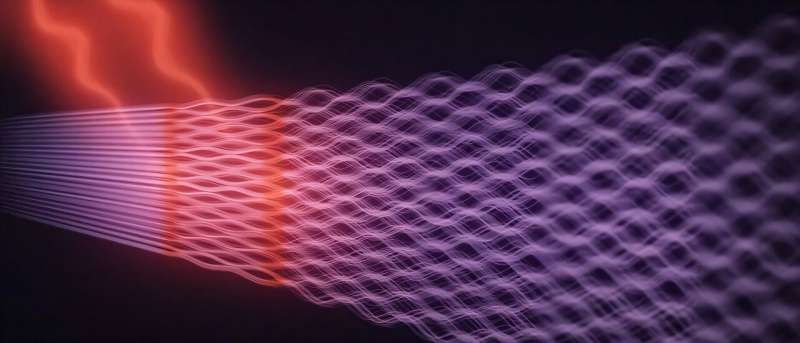
The breakthrough comes from splitting the total energy into two weaker pulses separated by a carefully chosen delay. After the first pulse, the electronic system begins to relax, partially returning toward equilibrium. When the second pulse arrives at the right moment, it reinforces the already‑moving lattice rather than fighting against a freshly excited electron cloud. The effect is analogous to pushing a child on a swing: timed pushes add energy efficiently, whereas a single hard shove can be mistimed and wasteful.
Key elements of the approach:
- Pulse Energy: Each pulse is kept below the saturation threshold, avoiding the counter‑productive high‑energy electronic states.
- Delay Optimization: The inter‑pulse delay matches the characteristic relaxation time of the excited electrons, typically a few hundred femtoseconds for WTe₂.
- Coherent Amplification: The second pulse constructively interferes with the phonon oscillation set up by the first, boosting the amplitude of the sliding mode.
Implications for Quantum‑Material Engineering
The ability to amplify layer sliding with modest laser fluence opens several practical avenues:
- Energy‑Efficient Switching: Ferroelectric polarization and related topological states could be toggled with far less heat load, an advantage for low‑power electronics.
- Ultrathin Device Integration: Because WTe₂ can be exfoliated down to a few layers, the technique is compatible with nanoscale device architectures where precise control is essential.
- Generalizable Protocol: The principle of timed multi‑pulse excitation should apply to other layered or low‑dimensional systems where electron‑phonon coupling governs functional behavior.
Closing Thoughts
The study underscores a broader lesson in light‑matter interaction: more energy is not always the answer. By aligning the temporal structure of the excitation with the intrinsic dynamics of the material, researchers can achieve stronger, more selective control over quantum phenomena. As ultrafast laser technology becomes increasingly accessible, such timing‑based strategies are likely to become a staple in the toolbox for designing next‑generation electronic and photonic devices.
Source
Read original sourceWhy we picked this
Accepted from curated QuantumUnzipped source (relevance scoring disabled).