A new gate encodes qubit states into superpositions of squeezed light
Researchers demonstrate a high‑fidelity conditional‑squeezing gate that maps arbitrary qubit states onto superpositions of squeezed‑light modes.
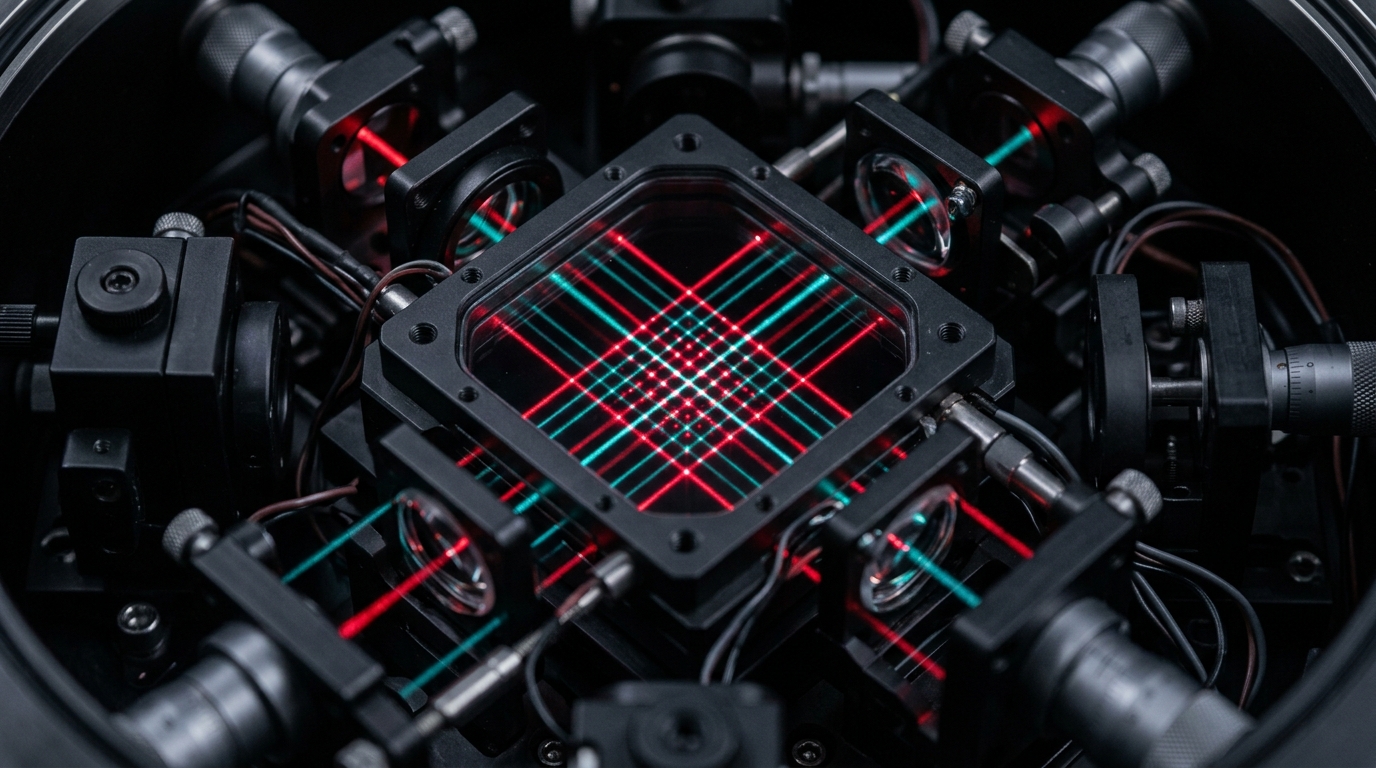
Encoding Qubits into Squeezed‑Light Superpositions
A recent study introduces a conditional‑squeezing gate that can transfer the quantum information of a superconducting qubit into non‑Gaussian superpositions of single‑ and two‑mode squeezed states of a resonator. By applying a refocusing protocol that cancels slowly varying Hamiltonian errors, the authors achieve encoding fidelities above 0.99 for any input qubit state, bringing bosonic‑code‑based error detection a step closer to practical use.
Refocusing Suppresses Time‑Dependent Errors
The gate relies on a bichromatic drive that creates a qubit‑state‑dependent parametric resonance in a SQUID‑terminated resonator. Unwanted phase errors accumulate from slowly varying terms in the Hamiltonian; the new protocol inserts a π‑pulse at the midpoint of a 250 ns evolution, effectively inverting the Hamiltonian and retracing the system’s trajectory. Simulations show the induced phase error drops to 1.8 × 10⁻⁸ rad, a dramatic improvement over an uncompensated gate.
Conditional‑Squeezing Extends Controlled‑Squeezing
Building on the authors’ earlier controlled‑squeezing operation (Phys. Rev. A 111, 042606 2025), the conditional gate squeezes the resonator along a direction set by the qubit’s logical state. This creates a superposition of squeezed‑vacuum components that can be used as logical basis states for rotation‑symmetric bosonic codes. Because photon loss flips the parity of the resonator state, a simple parity measurement instantly flags an error, enabling error‑detectable encoding without additional ancilla qubits.
High‑Fidelity Encoding Across the Bloch Sphere
Numerical analysis across cardinal points on the Bloch sphere reveals a uniform fidelity loss of roughly 0.17 % (minimum fidelity 0.9977 at the equator). The dominant source of infidelity is resonator photon loss, yet the two‑mode scheme outperforms the single‑mode version in both fidelity and gate duration. The authors also outline extensions to multi‑mode rotation‑symmetric codes using a control qudit and more elaborate refocusing sequences.
Outlook
The demonstrated gate provides a practical pathway to bosonic‑code quantum memories and error‑detectable processors. Future work will explore experimental validation, integration with surface‑code architectures, and scaling to larger bosonic‑code families. If realized in hardware, such high‑fidelity encodings could reduce the overhead required for fault‑tolerant quantum computation.
--- For the full paper, see “High‑fidelity conditional‑squeezing gate in superconducting circuits via refocusing” (Roman Schiaffino, Fernando C. Lombardo, Juan Pablo Paz).
Hype check
RealThe paper provides peer‑reviewed evidence of a new conditional‑squeezing gate with >0.99 fidelity, backed by simulations and detailed protocol description.
- Peer-reviewed paper, or press release only?Paper — Published in Phys. Rev. A 111, 042606 (2025)
- Error-corrected (logical) qubits, or physical qubits only?Logical / not a qubit claim — Claim is not about qubit count; it concerns encoding fidelity
- A new milestone, or a rebrand / restatement?New — Introduces a novel gate and refocusing technique
- Independent confirmation?Unclear — No external replication mentioned in the input
- Does the headline claim match what the source shows?Matches — Headline accurately reflects the paper’s result
An editorial assessment of the claim as reported, not a judgment of the company or researchers. How we rate hype →
Source
Read original sourceWhy we picked this
Accepted from curated QuantumUnzipped source (relevance scoring disabled).