A new method visualizes the fields inside compact quantum resonators
EPFL researchers demonstrated a combined laser‑scanning and NV‑center technique to map microwave fields inside a 33‑resonator honeycomb array.
Visualizing Microwave Fields in Compact Superconducting Resonators
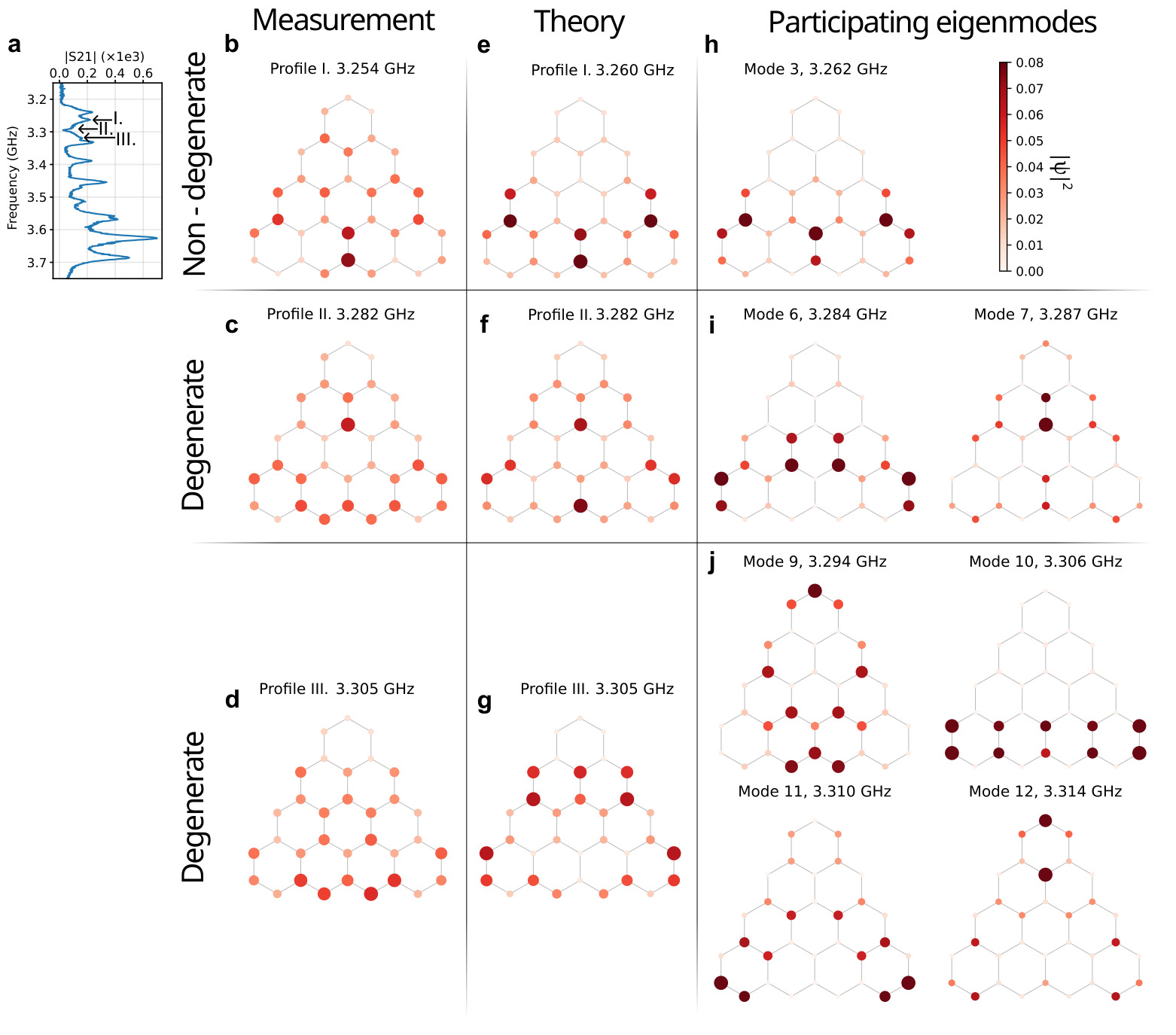
A team at the École Polytechnique Fédérale de Lausanne (EPFL) has introduced a dual‑imaging approach that reveals the internal electromagnetic landscape of a dense superconducting resonator lattice. By pairing laser‑scanning microscopy (LSM) with nitrogen‑vacancy (NV) center magnetometry, the group captured both the eigenmode amplitudes and the local microwave magnetic‑field distribution of a 33‑site honeycomb array made from high‑kinetic‑inductance NbTiN.
Why Spatial Characterization Matters
Superconducting resonator arrays are emerging platforms for quantum information processing, especially when coupled to spin systems or used to emulate topological lattices. Traditional spectroscopy provides only global frequency information, leaving designers blind to local imperfections that can degrade coherence or mask edge‑state physics. The EPFL method fills this gap by delivering site‑resolved maps while the device operates under realistic, driven‑dissipative conditions.
Two Complementary Probes
- Laser Scanning Microscopy (LSM) – A weak, focused laser locally heats the resonator surface, inducing a tiny increase in loss. The resulting change in transmission is proportional to the squared eigenmode amplitude at that point. Scanning the laser across the lattice yields a high‑resolution picture of how each resonator contributes to a given mode.
- NV‑Center Magnetometry – A diamond slab containing shallow NV centers is rastered over the array. The spin‑dependent fluorescence of the NV defects senses the microwave magnetic field generated by the resonators, producing nanoscale maps of field amplitude without perturbing the device.
Together, these techniques confirm the intended honeycomb geometry, identify topological edge states, and quantify disorder.
Key Findings
- Mode Imaging – Fourteen port‑coupled modes were resolved across the 33‑resonator system. The LSM maps reproduced the expected bulk and edge‑state patterns, including a sublattice‑polarized edge mode localized on the zigzag boundary.
- Disorder Quantification – By comparing measured mode asymmetries and participation ratios with simulations, the team placed an upper bound of ≈0.3 % on relative on‑site frequency disorder, indicating highly uniform fabrication.
- Field Amplitude Mapping – NV magnetometry revealed the microwave magnetic‑field distribution with nanoscale resolution, confirming the simulated field profiles and the sublattice polarization (~0.75) of the edge mode.
- Non‑Perturbative Measurement – Unlike earlier perturbative methods, the combined approach leaves the resonator dynamics essentially unchanged, making it suitable for studying driven quantum systems.
Implications for Quantum Technologies
Accurate spatial knowledge of resonator fields enables tighter control over qubit‑resonator coupling, improves coherence times, and supports the engineering of exotic Hamiltonians such as artificial graphene. The method also offers a pathway to integrate spin ensembles or other quantum emitters with superconducting circuits, a crucial step toward hybrid quantum processors.
Looking Ahead
Future work will aim to reduce the residual 11 MHz detuning observed in the edge‑state measurement—currently limited by the permanent‑magnet bias field—and to scale the technique to larger lattices. Extending the approach to three‑dimensional architectures and incorporating real‑time feedback could further accelerate the design‑build‑test cycle for quantum hardware.
In short, the EPFL team’s dual‑imaging strategy provides a practical toolbox for diagnosing and optimizing compact superconducting resonator arrays, bringing us closer to reliable, large‑scale quantum devices.
Hype check
PartlyThe method is demonstrated and described in detail, but the claim lacks a peer‑reviewed publication, so verification is limited.
- Peer-reviewed paper, or press release only?Press release only — No paper or preprint is cited in the input.
- Error-corrected (logical) qubits, or physical qubits only?Logical / not a qubit claim — The story does not involve qubit‑count claims.
- A new milestone, or a rebrand / restatement?New — Introduces a novel combined imaging technique for resonator arrays.
- Independent confirmation?Not yet — No external confirmation or replication is mentioned.
- Does the headline claim match what the source shows?Matches — Headline accurately reflects the described method.
An editorial assessment of the claim as reported, not a judgment of the company or researchers. How we rate hype →
Source
Read original sourceWhy we picked this
Accepted from curated QuantumUnzipped source (relevance scoring disabled).