A new superinductor created within a silicon integrated circuit
Researchers have fabricated a high‑kinetic‑inductance TiN superinductor inside a silicon CMOS chip, opening a path toward compact quantum‑circuit components.
Introduction
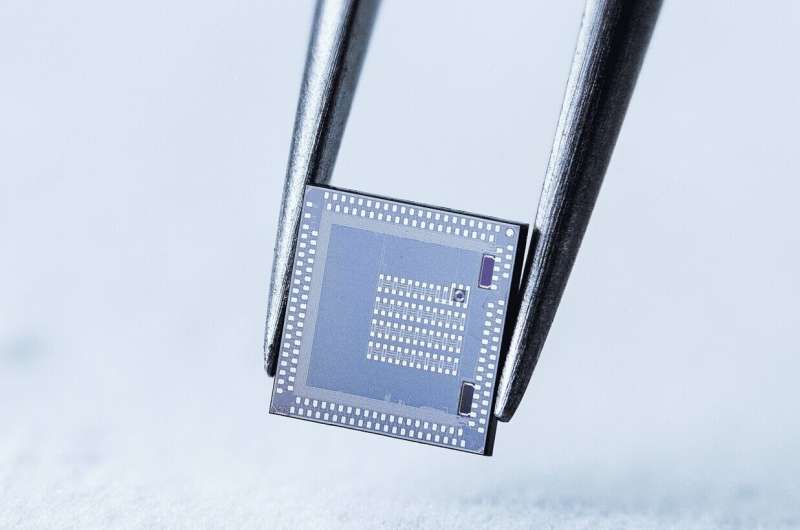
A team of researchers from nanoGUNE, Quantum Motion, Imperial College London and the University of Cambridge has demonstrated a non‑linear superinductor built directly into a silicon integrated circuit using a standard complementary metal‑oxide‑semiconductor (CMOS) process. By leveraging the kinetic inductance of titanium nitride (TiN), the device achieves inductance values far beyond those possible with conventional coil inductors, while remaining compatible with large‑scale semiconductor manufacturing.
Why superinductors matter
Superinductors are electrical inductors engineered to present an extremely large inductance, often exceeding the quantum of resistance (≈6.5 kΩ). In superconducting quantum circuits, such high impedance dramatically suppresses charge fluctuations and enables new regimes of quantum behavior. They are essential for:
- Protected qubits that rely on large inductive energy scales to reduce decoherence.
- High‑impedance resonators used in readout and coupling of delicate quantum states.
- Radio‑frequency (RF) single‑electron transistors (SETs) that serve as ultra‑sensitive charge sensors for spin‑qubit platforms.
The CMOS‑compatible TiN approach
Traditional superinductors have been fabricated from granular aluminum or disordered superconductors on specialized substrates, limiting scalability. The new work shows that titanium nitride, deposited in a thin‑film form within a commercial 28 nm (or similar) CMOS line, provides:
- High kinetic inductance – the inductance originates from the inertia of Cooper pairs rather than magnetic field storage, allowing compact geometries.
- Robust superconductivity – TiN retains a critical temperature above 4 K and tolerates the thermal budgets of standard back‑end‑of‑line processing.
- Design flexibility – the film can be patterned into meandered lines or spiral inductors without sacrificing performance.
The researchers fabricated a deep‑submicrometre TiN line that behaved as a non‑linear superinductor, integrating it with a silicon‑on‑insulator (SOI) resonator. The resulting circuit demonstrated a quality factor suitable for quantum‑limited measurements and could be driven to operate as an RF‑SET.
Potential applications and next steps
The immediate impact lies in spin‑qubit readout. By embedding the superinductor‑based resonator with multi‑gate silicon transistors, one can achieve high‑speed, high‑fidelity charge detection on sub‑microsecond timescales—crucial for scaling semiconductor quantum processors. Beyond quantum computing, the TiN superinductor architecture may benefit:
- Radio astronomy, where low‑noise, high‑impedance front‑ends improve sensitivity.
- Cryogenic low‑power electronics, offering compact inductive elements without bulky magnetic coils.
- Quantum sensing and simulation, where engineered impedance environments enable novel Hamiltonians.
Future work will focus on:
- Demonstrating integrated spin‑qubit devices that exploit the superinductor for fast readout.
- Exploring the limits of kinetic inductance in even thinner TiN films to push inductance values higher.
- Assessing long‑term reliability of TiN inductors under repeated thermal cycling typical of cryogenic systems.
Closing thoughts
The successful integration of a TiN‑based superinductor into a commercial CMOS flow marks a significant step toward bridging quantum hardware with mainstream semiconductor manufacturing. By delivering high inductance in a compact, scalable format, this technology could accelerate the development of dense quantum processors and open new avenues for low‑temperature electronics across scientific and engineering domains.
Source
Read original sourceWhy we picked this
Accepted from curated QuantumUnzipped source (relevance scoring disabled).