A Symmetry-Enabled Direct Quantum Protocol for Many-Body Green’s Functions
A parity‑symmetry‑based quantum protocol enables direct measurement of many‑body Green’s functions and related correlators using only native time evolution and simple measurements.
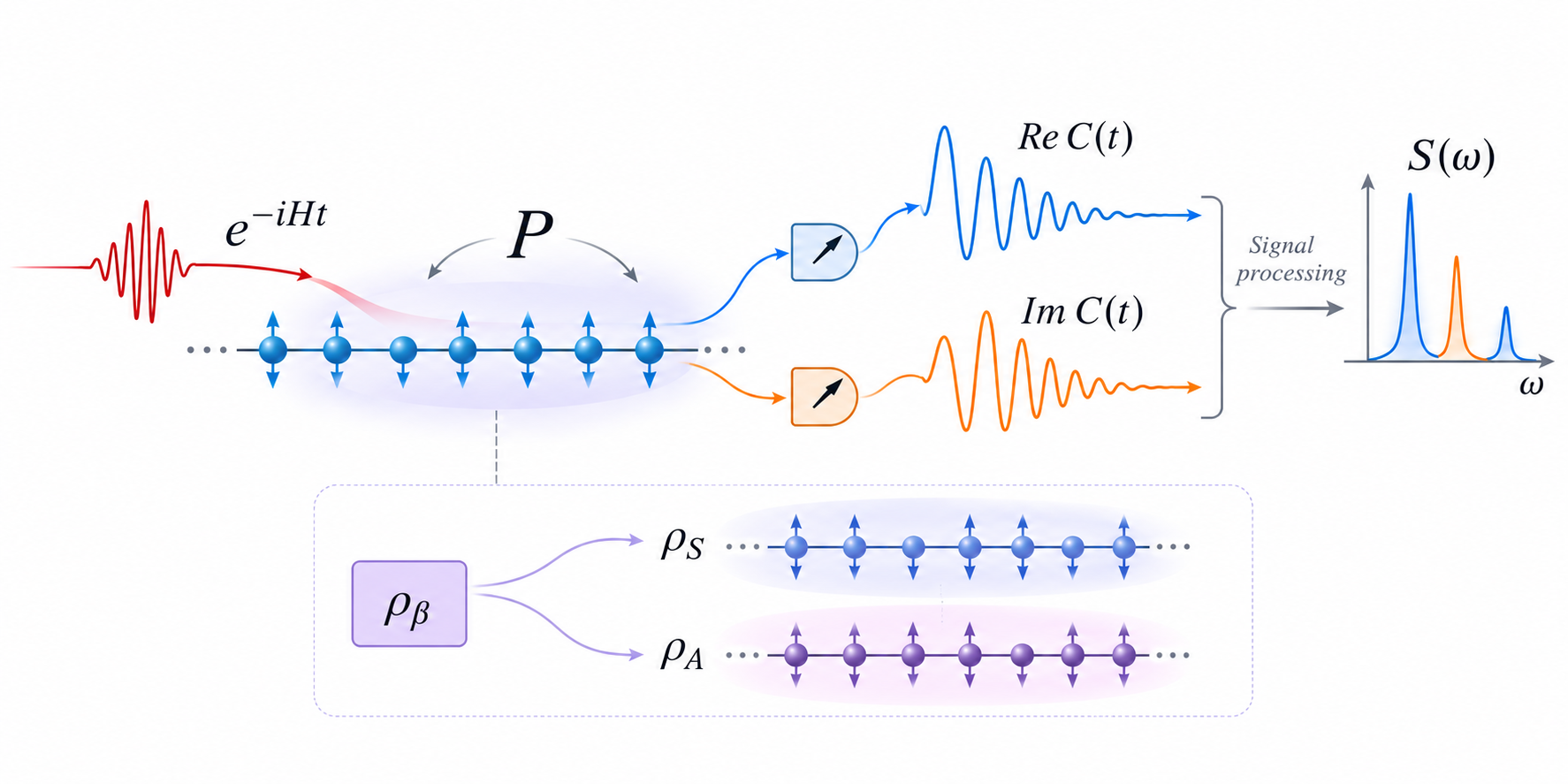
Symmetry‑Enabled Direct Quantum Protocol for Many‑Body Green’s Functions
Introduction
Computing many‑body Green’s functions is essential for probing the excitation spectra and transport properties of strongly correlated quantum materials. Classical methods quickly become intractable as system size grows, motivating quantum‑computational approaches. Existing quantum algorithms often rely on ancillary qubits, controlled time‑evolution gates, or elaborate measurement schemes that exceed the capabilities of near‑term hardware. The recent work by Yi and Zhou introduces a streamlined protocol that leverages parity symmetry—common to models such as the Fermi–Hubbard and Heisenberg Hamiltonians—to extract both real and imaginary parts of two‑point time correlators directly from native dynamics. The method combines a tailored quench spectroscopy routine with classical signal‑processing, and it naturally extends to finite‑temperature and out‑of‑time‑ordered correlators (OTOCs).
1. Parity‑Symmetry‑Guided Quench Spectroscopy
The protocol begins by preparing an initial state that respects the parity symmetry of the target Hamiltonian. A small, symmetry‑preserving perturbation (the "quench") is then applied, after which the system evolves under the native Hamiltonian for a variable time \(t\). Because the Hamiltonian commutes with the parity operator, the evolution remains confined to either the symmetric or antisymmetric subspace. By measuring simple observables—typically local occupation or spin operators—at each time step, one obtains expectation values that encode the real part of the correlator \(\langle A(t)B(0)\rangle\). Repeating the experiment with a phase‑shifted version of the perturbation yields the imaginary component. Crucially, no controlled‑unitary or ancilla‑based interferometry is required; the measurement circuit consists only of the native time‑evolution and a final projective readout.
2. Classical Reconstruction of Green’s Functions
The time‑domain data collected from the quench spectroscopy are processed using Fourier‑type techniques that respect the Kubo‑Martin‑Schwinger (KMS) relations. By applying a windowed discrete Fourier transform and employing regularization methods to mitigate noise, the spectral function \(A(\omega)\) is reconstructed. The retarded Green’s function follows from the Hilbert transform of the spectral function, while the lesser and greater Green’s functions are obtained by combining the symmetric and antisymmetric components of the measured correlators. This classical post‑processing step is efficient, scaling polynomially with the number of time samples, and it avoids the need for quantum phase estimation.
3. Symmetry‑Resolved Thermal State Preparation
To access finite‑temperature Green’s functions, the authors introduce a parity‑resolved quantum Gibbs sampler. The sampler prepares thermal states projected onto the symmetric and antisymmetric sectors by iterating a Lindbladian‑inspired channel that respects detailed balance within each subspace. Because the channel operates using only the native Hamiltonian and simple dissipative steps (e.g., measurement‑based resets), it is compatible with early fault‑tolerant devices. Once the parity‑resolved thermal state is prepared, the same quench‑spectroscopy routine yields temperature‑dependent correlators without additional overhead.
4. Extending to Out‑of‑Time‑Ordered Correlators
The measurement primitive also accommodates OTOCs, which diagnose quantum information scrambling. By inserting a second perturbation after a waiting period and exploiting the same parity decomposition, the protocol captures the non‑commutative ordering of operators. This extension demonstrates the versatility of the symmetry‑based approach: a single hardware‑friendly routine can probe both linear response functions and higher‑order dynamical quantities.
Practical Outlook
Numerical simulations on representative electron and spin models (e.g., 1‑D Hubbard chains and 2‑D Heisenberg lattices) show that the protocol tolerates realistic gate errors and measurement noise, delivering Green’s functions with fidelity comparable to state‑of‑the‑art classical approximations. The reliance on parity symmetry means the method applies broadly to Hamiltonians that conserve particle number parity or spin inversion, covering many condensed‑matter and quantum‑chemical systems of interest.
Conclusion
Yi and Zhou’s symmetry‑enabled direct quantum protocol offers a pragmatic pathway to measuring many‑body Green’s functions on near‑term and early fault‑tolerant quantum processors. By eliminating ancillary qubits and controlled evolutions, and by integrating a straightforward classical reconstruction pipeline, the approach aligns with current hardware constraints while opening doors to finite‑temperature dynamics and scrambling diagnostics. As quantum devices scale, this protocol could become a standard tool for quantum simulation of dynamical response functions in strongly correlated matter.
Source
Read original sourceWhy we picked this
Accepted from curated QuantumUnzipped source (relevance scoring disabled).