A tiny supercurrent could unlock quantum information without destroying it
A novel readout scheme uses the tiny, self‑generated supercurrent of an Andreev qubit to infer its quantum state with ~99.9% accuracy while minimally disturbing it.
Introduction
One of the most stubborn hurdles in building practical quantum computers is measurement. Unlike classical bits, a qubit’s state collapses when probed, often erasing the very information we wish to extract. A recent theoretical proposal offers a fresh route: instead of attaching an auxiliary "ancilla" qubit, the researchers read the qubit directly by monitoring a minute supercurrent that the qubit itself emits. Simulations suggest the method can reconstruct the qubit’s state with 99.85 % fidelity while introducing only negligible back‑action.
How the Andreev qubit generates a readable signal
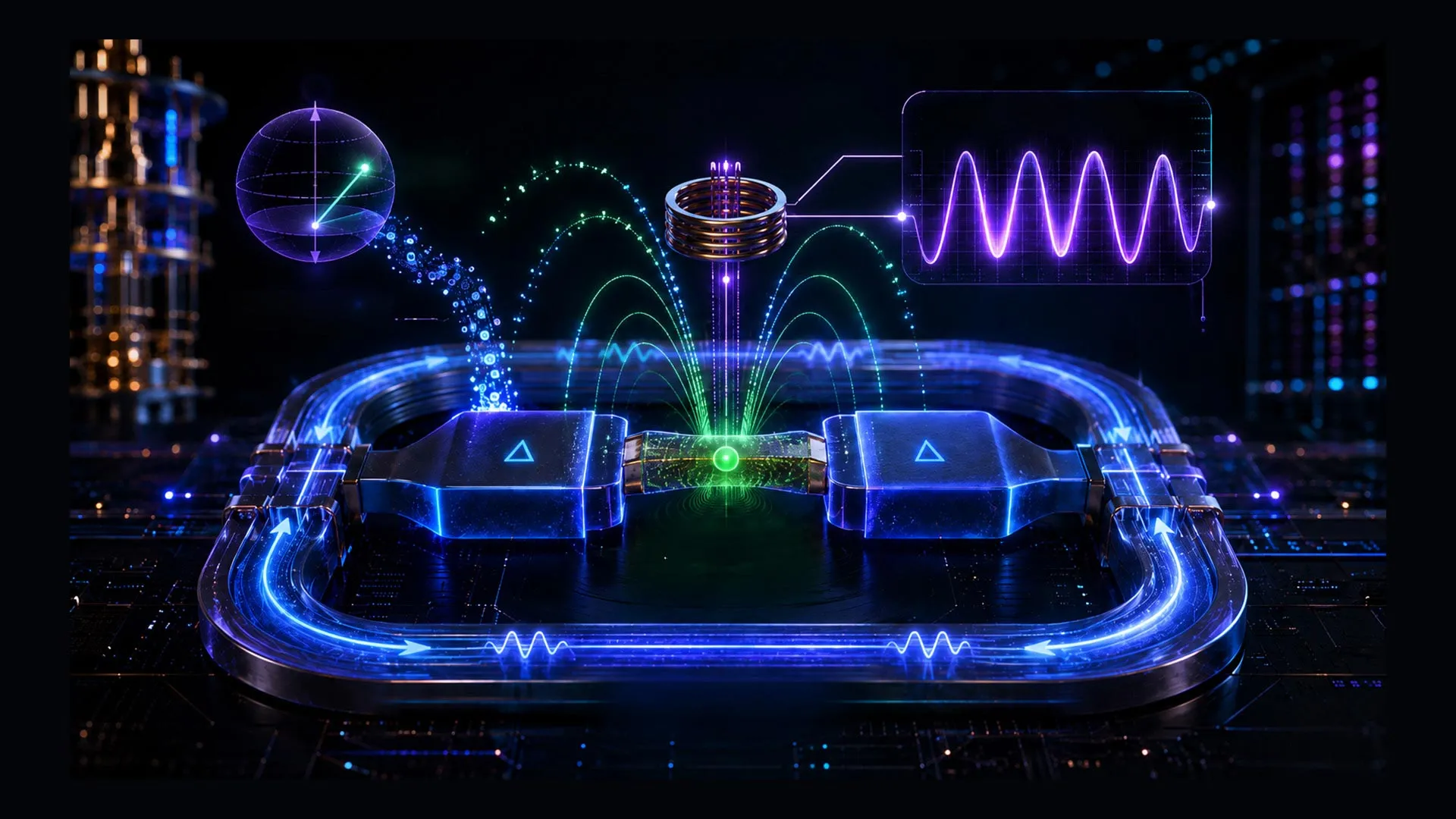
The scheme relies on an Andreev qubit, a quantum dot formed in an InAs nanowire sandwiched between two superconductors. At the superconductor‑normal interfaces, Andreev bound states arise; these discrete energy levels can encode the logical 0 and 1 as well as their superpositions. When the qubit occupies a superposition, the resulting wavefunction produces a supercurrent that contains two components:
- A constant part reflecting the average occupation of the two basis states.
- An oscillatory part whose amplitude encodes the relative weight of the states and whose phase tracks the quantum‑mechanical phase between them.
Crucially, these oscillations occur without any applied voltage—they are a direct manifestation of the qubit’s internal dynamics, analogous to the AC Josephson effect but driven internally rather than by an external bias.
Turning a tiny magnetic field into a readout
A supercurrent, even a tiny one, creates a magnetic field. The authors propose embedding the Andreev qubit in a closed superconducting loop and placing a SQUID (superconducting quantum interference device) nearby. The SQUID’s extraordinary flux sensitivity can detect the minute, time‑varying magnetic field generated by the oscillating current. By recording the SQUID’s response, one can extract:
- The steady‑state flux → proportion of |0⟩ vs. |1⟩.
- The oscillation amplitude → coherence between the two states.
- The oscillation timing → relative phase.
Because the SQUID couples only weakly to the loop, the measurement back‑action is dramatically reduced compared with conventional ancilla‑based protocols that require additional qubits, control pulses, and repeated swaps of information.
Advantages and practical outlook
| Feature | Traditional ancilla‑based QND | Supercurrent‑SQUID readout | |---|---|---| | Hardware overhead | Requires extra qubits, couplers, and control lines | No ancillary qubits; only a SQUID sensor | | Measurement fidelity (simulated) | 95–98 % typical | Up to 99.85 % | | Disturbance to the qubit | Significant due to state transfer operations | Minimal; back‑action limited to weak magnetic coupling | | Scalability | Complexity grows with qubit count | Simpler wiring; many loops could share a common SQUID array |
If experimental work confirms these predictions, the technique could simplify quantum processor architectures, especially for platforms that already employ hybrid superconductor‑semiconductor devices.
Closing thoughts
Reading a qubit without destroying it has long been a paradox at the heart of quantum information science. By exploiting a self‑generated supercurrent—an electrical signature that naturally carries the qubit’s amplitude and phase—the proposed method sidesteps the need for ancillary measurement qubits and pushes nondestructive readout toward its theoretical limit. The next step will be an experimental demonstration, likely involving high‑Q superconducting loops and state‑of‑the‑art SQUID magnetometers. Success would mark a significant stride toward more compact, less error‑prone quantum processors, bringing us closer to the era of scalable quantum computing.
Source
Read original sourceWhy we picked this
Accepted from curated QuantumUnzipped source (relevance scoring disabled).