Algorithmiq and IBM Quantum Execute 40-Qubit Discrete-Time Quantum Walks on Biological Networks
Algorithmiq and IBM Quantum demonstrated 40‑qubit discrete‑time quantum walks on protein‑protein interaction networks, publishing the results in npj Quantum Information.
Quantum Walks Meet Biology: 40‑Qubit Experiments on IBM Hardware
Researchers from Algorithmiq and IBM Quantum have shown that gate‑based superconducting processors can run discrete‑time quantum walks (DTQWs) on realistic, irregular biological networks. Using up to 40 physical qubits on IBM’s Heron devices, the team encoded protein‑protein interaction (PPI) graphs from the BioPlex 3.0 dataset and reported high‑fidelity results, marking a concrete step toward quantum‑enhanced analysis of complex biomedical data.
Sparse Encoding Cuts Depth on Heavy‑Hex Topologies
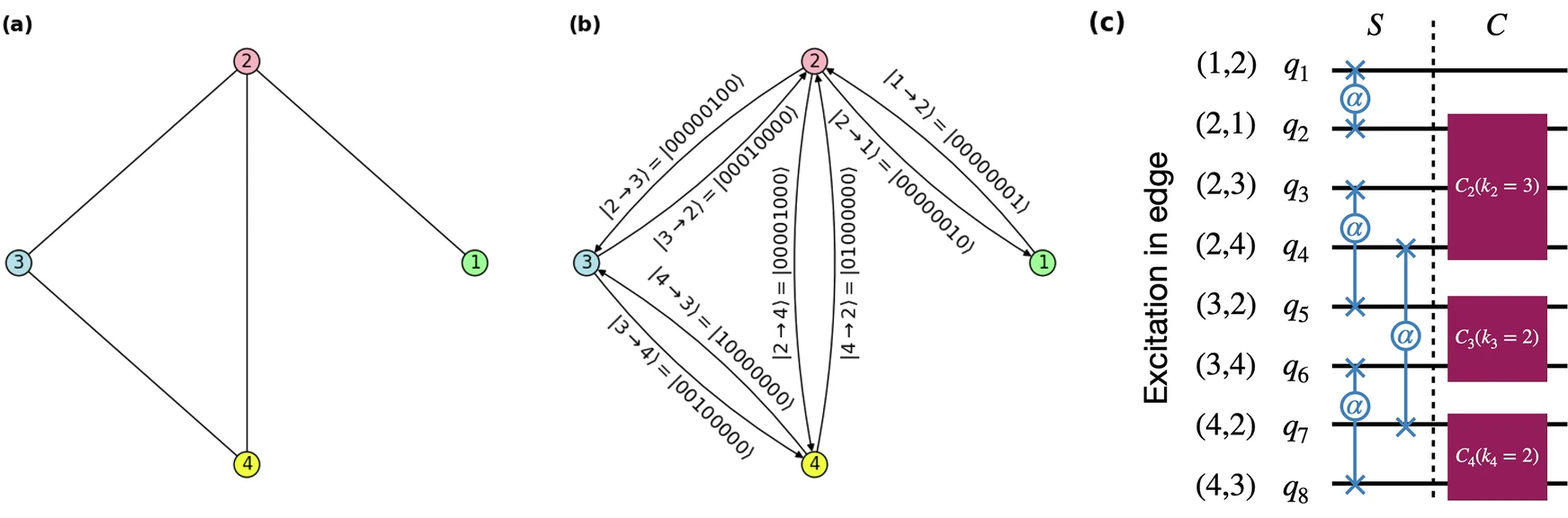
Traditional DTQW algorithms rely on dense binary encodings that require deep multi‑controlled gates, quickly exhausting the coherence budget of pre‑fault‑tolerant machines. The authors instead adopted a single‑excitation (Hamming‑weight‑1) encoding, allocating one qubit per edge rather than per node. This “2|E|‑qubit” scheme doubles the qubit count relative to the number of undirected edges but dramatically reduces circuit depth. By combining domain‑wall basis rotations for Grover‑coin operators with √iSWAP‑based shift gates, the per‑step depth dropped by roughly two orders of magnitude on IBM’s heavy‑hex lattice.
Experimental Benchmarks Across Three Graph Sizes
| Graph | Nodes | Edges | Qubits | Device | CZ gates/step | Fidelity (post‑selected) | |-------|-------|-------|--------|--------|---------------|--------------------------| | BioPlex 3.0 motif 1 | 11 | 12 | 24 | IBM Heron R2 (ibmkingston) | 165 | FH ≥ 0.95, FHBC ≥ 0.71 | | BioPlex 3.0 motif 2 | 15 | 18 | 36 | IBM Heron R3 (ibmpittsburgh) | 286 | FH ≥ 0.90, FHBC ≥ 0.46 | | BioPlex 3.0 motif 3 | 17 | 20 | 40 | IBM Heron R2 (ibmkingston) | 322 | FH ≥ 0.87, F_HBC ≥ 0.54 |
Each experiment ran a seven‑step walk, with symmetry‑respecting post‑selection discarding measurement outcomes outside the single‑excitation sector. The reported Hellinger fidelities (≥ 0.87) demonstrate that the quantum walk dynamics remain distinguishable from noise even at the 40‑qubit scale.
A Proof‑of‑Principle Biomedical Application
To illustrate practical relevance, the authors seeded a nine‑step walk at the asthma‑associated gene HLA‑DQA1. The resulting Quantum Interference Index highlighted the non‑adjacent gene FLVCR1 as the fourth‑ranked asthma risk candidate, outperforming classical baselines such as PageRank (7th) and DIAMOnD (9th). This suggests that quantum interference can surface biologically meaningful relationships that are muted in traditional network analyses.
Outlook and Implications
The work validates a scalable encoding strategy for DTQWs on near‑term hardware and opens a path toward quantum‑assisted network biology. While the experiments remain proof‑of‑concept and rely on post‑selection, they show that biologically relevant graph sizes can be tackled without exceeding coherence limits. Future efforts will need to address error mitigation, logical‑qubit extensions, and integration with larger biomedical pipelines.
The open‑access paper is available in npj Quantum Information, and the accompanying code has been deposited on Figshare.
Hype check
RealThe headline accurately reflects a peer‑reviewed paper that reports a concrete 40‑qubit DTQW experiment; the result is documented and not overstated.
- Peer-reviewed paper, or press release only?Paper — Published in npj Quantum Information
- Error-corrected (logical) qubits, or physical qubits only?Physical only — Counts refer to physical qubits only
- A new milestone, or a rebrand / restatement?New — First demonstration of 40‑qubit DTQWs on biological networks
- Independent confirmation?Not yet — No external replication mentioned
- Does the headline claim match what the source shows?Matches — Headline matches the paper's reported experiment
An editorial assessment of the claim as reported, not a judgment of the company or researchers. How we rate hype →
Source
Read original sourceWhy we picked this
Accepted from curated QuantumUnzipped source (relevance scoring disabled).