Alice & Bob put breaking RSA-2048 at 23,000 cat qubits and three days
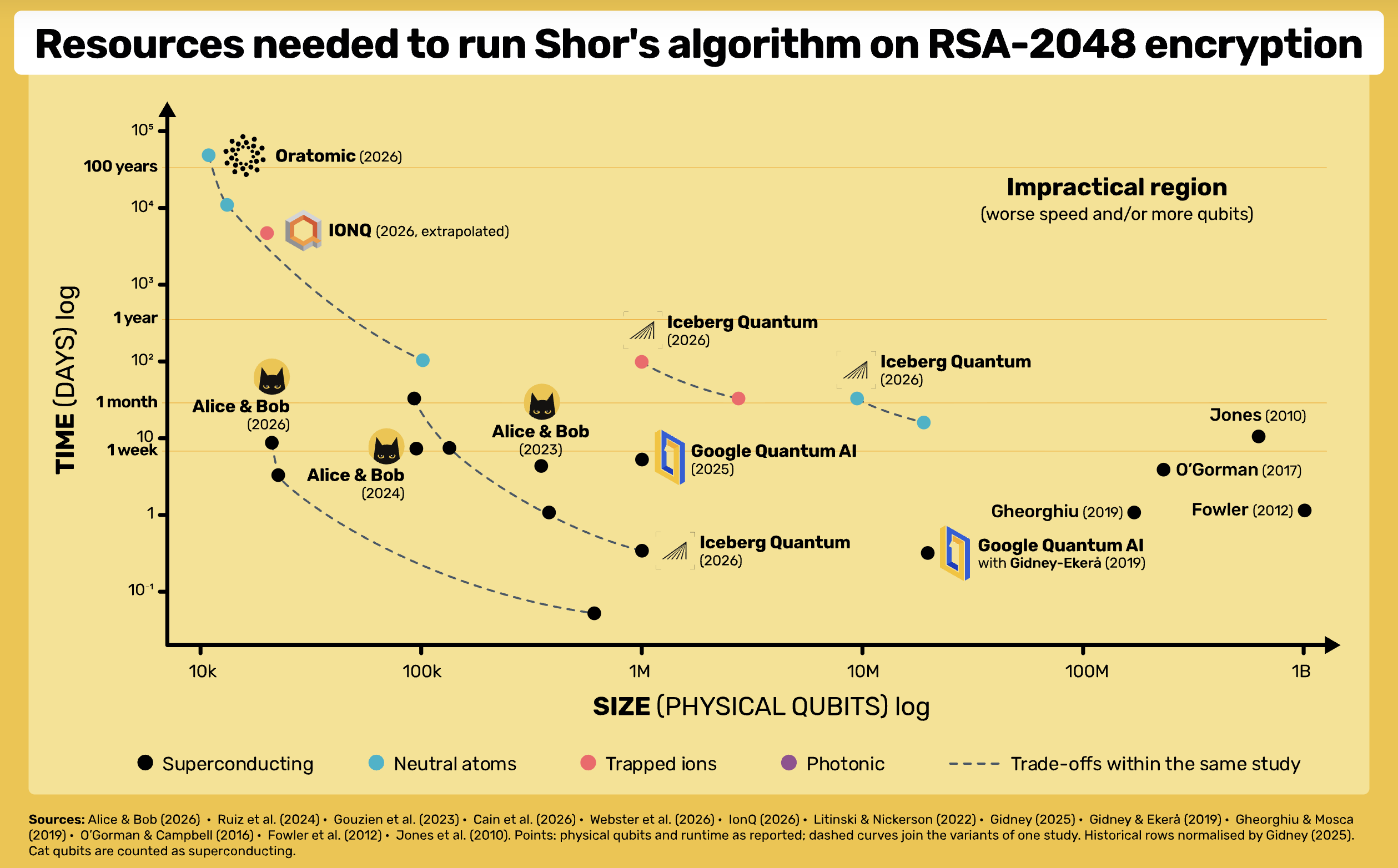
Alice & Bob claim a cat‑qubit quantum computer could factor RSA‑2048 in three days using about 23,000 physical qubits, highlighting rapid progress in hardware, algorithms, and error‑correction.
Introduction
In a recent blog post, Alice & Bob announced a new estimate for breaking RSA‑2048: a cat‑qubit quantum processor with roughly 23,000 physical qubits could run Shor’s algorithm and output the factorisation in about three days. This marks a dramatic reduction from the company’s own 2024 estimate (just under 100 k qubits) and from earlier industry projections that required millions of qubits. The claim underscores two converging trends—improved quantum algorithms/compilation and advances in hardware error correction—that together shrink both the size and runtime of the benchmark.
How the Numbers Were Arrived At
Alice & Bob’s estimate rests on a detailed compilation of the full RSA‑2048 factoring circuit onto a concrete cat‑qubit layout. The authors cite three key ingredients:
- Algorithmic efficiency – modern optimisations of Shor’s algorithm reduce the total gate count and depth, cutting the number of logical operations needed.
- Error‑correction overhead – the cat‑qubit architecture promises lower physical‑to‑logical qubit ratios, meaning fewer physical qubits are required to achieve fault‑tolerant operation.
- Hardware assumptions – the paper references recent milestones such as Google’s Willow chip (demonstrating a logical qubit below the error‑threshold) and Quantinuum’s post‑selection‑enhanced encoded qubits, suggesting that the error rates needed for large‑scale error correction are within reach.
By combining these factors, the team arrives at a runtime of ~72 hours for the full factorisation, assuming continuous operation of a single machine. They also note that the same design can trade qubits for time—for example, spreading the workload across ten identical machines could finish in roughly an hour, albeit with a ten‑fold increase in hardware resources.
Why This Matters Beyond Cryptography
The authors argue that RSA‑2048 is a useful proxy for the broader class of problems that will drive early quantum advantage:
- Long‑duration, high‑fidelity computation – Shor’s algorithm requires billions of logical gates executed over hours to days, mirroring the demands of quantum chemistry and materials‑science simulations.
- Scalable error correction – Demonstrating a fault‑tolerant run of this length validates the error‑correction stack needed for practical applications.
- Hardware‑software co‑design – By designing a machine around a specific algorithm, Alice & Bob illustrate a shift from generic qubit development to purpose‑built quantum processors.
These points suggest that the RSA‑2048 benchmark is not merely a cryptographic threat indicator but also a blueprint for the first truly useful quantum computers.
Implications for Security and Industry
Even if the three‑day estimate proves optimistic, the trajectory is clear: the window for safe RSA‑2048 usage is narrowing. Alice & Bob urge organisations to begin migrating to post‑quantum cryptography (PQC) now, emphasizing that:
- Existing PQC standards exist but lack extensive real‑world testing.
- The talent pool for implementing and analysing PQC is still limited.
- Early investment in migration and algorithm resilience will avoid a scramble when large‑scale quantum hardware finally arrives.
For quantum‑focused companies, the announcement highlights the importance of integrated hardware‑software roadmaps and the value of demonstrating end‑to‑end fault‑tolerant runs, not just isolated qubit improvements.
Closing Thoughts
Alice & Bob’s 23 k‑qubit, three‑day RSA‑2048 estimate signals a notable step forward in the quantum race. While the exact timeline for a production‑grade machine remains uncertain, the convergence of better algorithms, tighter error correction, and more capable qubit technologies suggests that the era of practical quantum advantage—and the associated security challenges—may be closer than many anticipate. Stakeholders across cryptography, hardware, and application domains should treat this as a call to accelerate PQC adoption, deepen collaboration on error‑correction research, and explore purpose‑built quantum architectures for real‑world problems.
Source
Read original sourceWhy we picked this
Accepted from curated QuantumUnzipped source (relevance scoring disabled).