Altera, OQC, and NVIDIA Demonstrate Direct-RF FPGA Quantum System Controller Reference Design at SC26
Altera, OQC, and NVIDIA showcased a new FPGA‑based quantum system controller reference design at SC26.
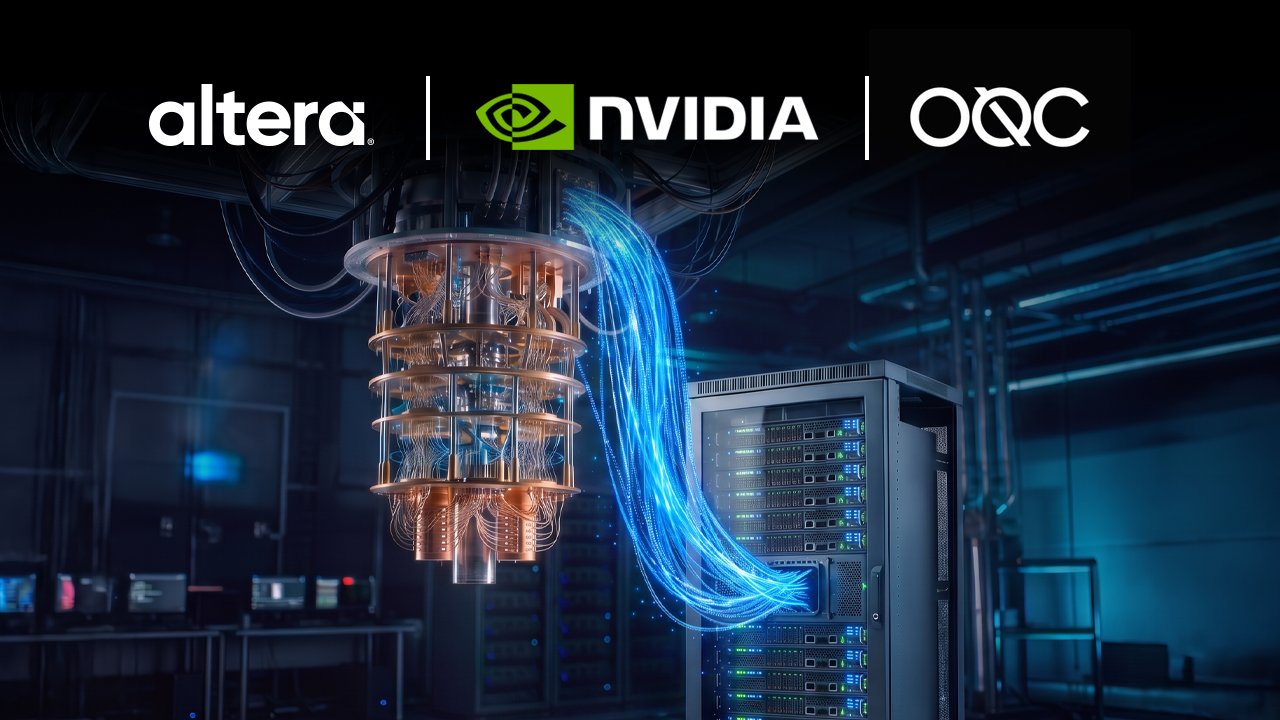
A New FPGA‑Based Quantum Controller Demo at SC26
Altera (Intel’s FPGA business), Oxford Quantum Circuits (OQC), and NVIDIA demonstrated an end‑to‑end quantum system controller reference design during the SC26 supercomputing conference in Chicago. The design centers on Altera’s Agilex 9 Direct‑RF FPGA, which integrates real‑time pulse synthesis, scheduling, and readout functions that traditionally require bulky racks of discrete analog hardware.
Integrated Direct‑RF Architecture
The Agilex 9 Direct‑RF FPGA hosts on‑chip data converters and multi‑channel frequency‑multiplexing blocks. By moving digital‑to‑analog conversion and mixing onto the FPGA, the architecture eliminates external mixers, local oscillators, and DAC/ADC chains. This integration promises a more compact, scalable control stack that can keep pace with the growing qubit counts of superconducting processors.
Tight Coupling with OQC’s Superconducting Processor
OQC supplied a next‑generation superconducting quantum processor that interfaces directly with the FPGA’s RF conditioning hardware. The FPGA handles qubit initialization, resonator spectroscopy, and pulse generation, while the processor’s cryogenic readout signals are digitized and processed on‑chip.
GPU‑Accelerated Calibration via NVQLink
The reference design also incorporates NVIDIA’s NVQLink interconnect, linking the FPGA to NVIDIA GPUs. CUDA‑driven kernels offload compute‑intensive calibration tasks—such as machine‑learning‑based readout classification—from the real‑time control loop. This hybrid FPGA‑GPU approach aims to reduce latency in adaptive error‑mitigation and parameter‑tuning workflows.
Software Stack and Emulation Path
A companion software package provides a controller‑emulation mode, allowing developers to test firmware and hybrid algorithms before hardware is available. The team announced a general‑release schedule for January 2027, positioning the design as a reusable reference for labs and vendors building superconducting quantum systems.
Why This Matters
Current superconducting control stacks rely on multi‑chassis racks that become unwieldy as qubit numbers rise. By consolidating RF front‑end functions onto a programmable FPGA and leveraging GPU acceleration for calibration, the Altera‑OQC‑NVIDIA design could lower system cost, simplify integration, and improve scalability. While performance metrics (e.g., latency, jitter, or error rates) were not disclosed, the live demonstration at SC26 suggests the prototype is functional and ready for broader adoption.
Looking Ahead
The reference design is positioned as a starting point for the community rather than a finished product. Future work will likely focus on quantifying timing precision, noise performance, and the impact of GPU‑assisted calibration on overall system fidelity. If the design lives up to its promise, it could become a cornerstone for next‑generation superconducting quantum computers that need tighter, more efficient control infrastructure.
For more details, see Altera’s official announcement (link provided in the original article).
Hype check
Not a research claimThe story reports a demonstration of a new reference design; there is no performance claim to evaluate, so the headline accurately reflects the content.
We rate research and technical results only. How we rate hype →
Source
Read original sourceWhy we picked this
Accepted from curated QuantumUnzipped source (relevance scoring disabled).