Anyon Technologies and Q-CTRL Partner on Self-Calibrating Hybrid Quantum Supercomputers
Anyon Technologies and Q-CTRL have teamed up to embed autonomous calibration software into Anyon's modular superconducting quantum systems.
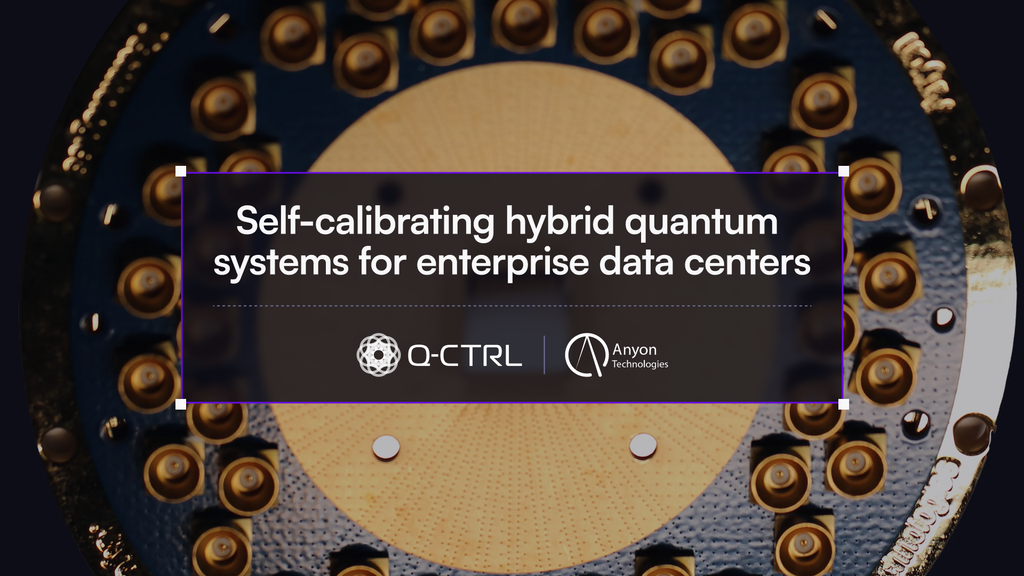
Anyon & Q‑CTRL Join Forces on Self‑Calibrating Hybrid Quantum Supercomputers
Anyon Technologies, a developer of modular superconducting quantum processors, announced a strategic partnership with Q‑CTRL, a provider of quantum‑control software. The collaboration aims to fuse Q‑CTRL’s Boulder Opal autonomous calibration platform with Anyon’s GPU‑coupled quantum modules, creating a hybrid system that can be operated with minimal manual tuning.
Why Automation Matters
Running superconducting qubits today still requires a team of experimental physicists to perform a series‑of‑manual steps: cold‑start boot‑up, frequency mapping, gate calibration, and ongoing drift compensation. These activities are time‑consuming, costly, and limit the availability of quantum accelerators for enterprise workloads. By embedding physics‑informed control routines directly into the hardware stack, the joint solution promises to:
- Eliminate manual calibration cycles – Boulder Opal continuously monitors qubit parameters and applies closed‑loop adjustments in real time.
- Reduce operational overhead – Data‑center operators can treat the quantum processor like a conventional accelerator, without needing specialized quantum‑hardware expertise.
- Improve uptime – Automated drift stabilization keeps gate fidelities within target ranges, extending the usable time of each quantum job.
The Hybrid Architecture
Anyon’s platform combines vertically integrated superconducting QPUs with a high‑performance classical interconnect. The key components include:
- Modular superconducting QPUs designed for rack‑level deployment in standard data‑center environments.
- NVIDIA NVQLink & CUDA‑Q links that provide low‑latency communication between the quantum chips and NVIDIA GPUs, enabling hybrid quantum‑classical workloads.
- Boulder Opal software from Q‑CTRL, which automates the entire bring‑up sequence, from cold‑start to continuous calibration, using a physics‑based model of the hardware.
The result is a self‑contained quantum accelerator that can be provisioned on demand, similar to a GPU or FPGA, but with the added capability of handling quantum‑specific error sources automatically.
Implications for Enterprise Adoption
If the integrated system delivers on its promise, it could lower the barrier to entry for companies looking to experiment with quantum‑enhanced algorithms. By removing the need for a dedicated quantum‑hardware team, organizations can focus on software development and algorithmic innovation. Moreover, the hybrid approach aligns with current trends in quantum‑classical co‑processing, where classical processors handle pre‑ and post‑processing while the quantum core tackles the computationally hard sub‑tasks.
Looking Ahead
Both firms have indicated that the partnership will continue to evolve, with future releases expected to expand the automation capabilities and support larger qubit arrays. While no performance metrics or benchmark results were disclosed in the announcement, the integration of autonomous calibration represents a concrete step toward more usable quantum hardware in production settings.
--- The partnership was announced on 11 Nov 2026. No technical data, peer‑reviewed paper, or independent verification was provided at the time of writing.
Hype check
Not a research claimThe item describes a partnership to embed calibration software, not a concrete performance result, so hype assessment is not applicable.
We rate research and technical results only. How we rate hype →
Source
Read original sourceWhy we picked this
Accepted from curated QuantumUnzipped source (relevance scoring disabled).