AQSolotl Reports 6.94-Microsecond Latency in NVIDIA NVQLink Integration Test
AQSolotl reports sub‑10 µs round‑trip latency using NVIDIA NVQLink with its Chronos‑Q control platform.
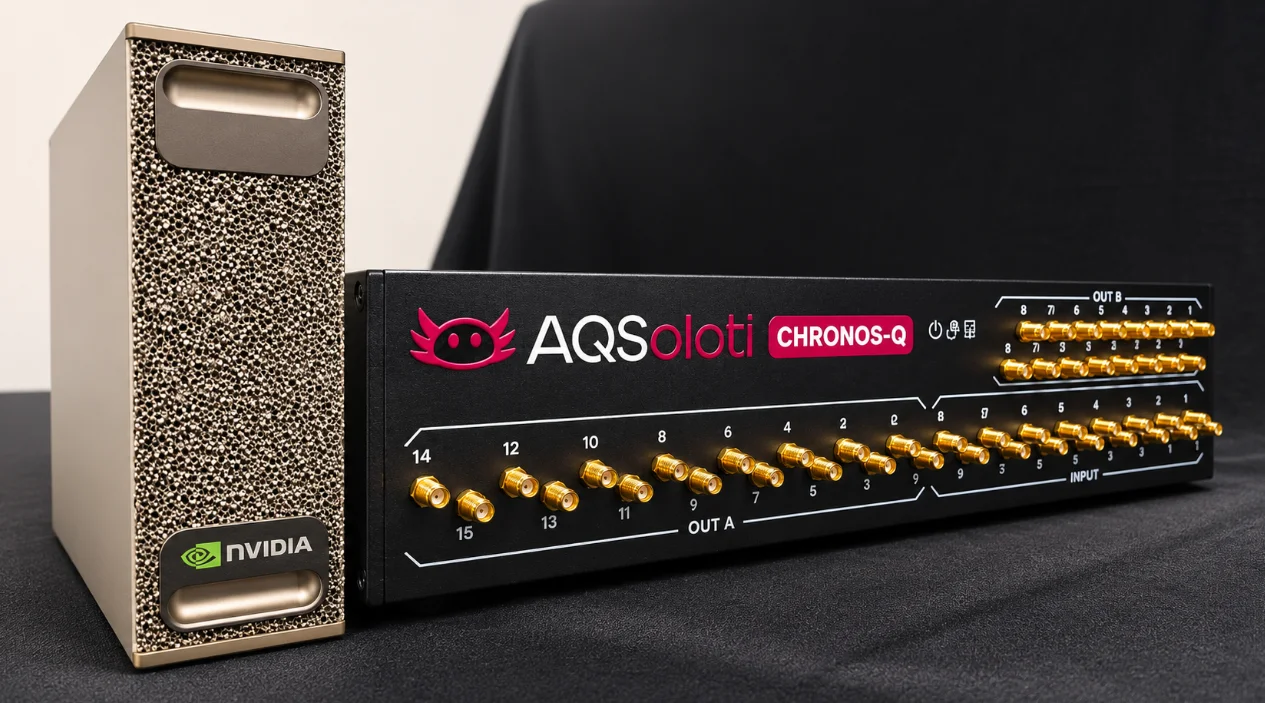
AQSolotl Shows Sub‑10 µs Latency with NVIDIA NVQLink
AQSolotl, a developer of quantum‑control hardware, announced the first latency measurements for its Chronos‑Q platform when linked to an NVIDIA DGX Spark via the NVQLink reference architecture. The test, which involved 1,000 round‑trip requests of 64‑byte packets, recorded a minimum latency of 6.94 µs, a median of 8.02 µs, and a 99th‑percentile latency of 9.01 µs. The reported numbers include both communication and the simple addition operation performed on the GPU; no quantum processor was part of the experiment.
Why Low Latency Matters
Quantum processors depend on classical controllers to issue gate commands, read out results, and perform real‑time calibration. Reducing the time it takes for a control system to exchange data with an accelerator can enable tighter feedback loops, potentially speeding up calibration routines and improving overall system stability. NVQLink is NVIDIA’s open reference architecture designed to provide high‑throughput, low‑latency links between quantum‑control hardware and GPU‑based compute resources.
Test Methodology Overview
- Platform: Chronos‑Q control stack communicating with an NVIDIA DGX Spark.
- Payload: Single 64‑byte packet per request.
- Traffic Pattern: 1,000 requests sent in 250 groups of four, with 100 ms gaps between requests in a group.
- Processing: The DGX performed a trivial addition before returning the response.
- Metrics: Minimum, median, and 99th‑percentile round‑trip latencies were recorded using internal timestamps within Chronos‑Q.
The latency range observed was 6.94 µs to 14.77 µs, indicating that the system can consistently stay under 10 µs for the majority of transactions.
Next Steps and Outlook
AQSolotl plans to extend the integration to real‑world calibration workflows, partnering with quantum‑hardware teams to test GPU‑assisted calibration loops that involve actual qubits. If the low‑latency link can be maintained when processing more complex data (e.g., error‑correction syndromes), it could become a key enabler for hybrid quantum‑classical algorithms that require rapid classical feedback.
While the current results are limited to a synthetic benchmark without a quantum processor, they provide a concrete baseline for future work. Stakeholders interested in tighter quantum‑classical integration should watch for follow‑up studies that incorporate live qubit data and more demanding computational kernels.
--- This article is based on AQSolotl’s press release and does not include independent verification.
Hype check
PartlyThe latency numbers are reported in a press release with no peer‑reviewed data or external validation; the claim is real but evidence is limited to the company's own test.
- Peer-reviewed paper, or press release only?Press release only — Only a press release is cited, no paper or preprint.
- Error-corrected (logical) qubits, or physical qubits only?Logical / not a qubit claim — The story does not involve qubit counts.
- A new milestone, or a rebrand / restatement?New — First reported latency measurement for NVQLink integration.
- Independent confirmation?Not yet — No external confirmation or replication mentioned.
- Does the headline claim match what the source shows?Matches — Headline accurately reflects the latency figures in the release.
An editorial assessment of the claim as reported, not a judgment of the company or researchers. How we rate hype →
Source
Read original sourceWhy we picked this
Accepted from curated QuantumUnzipped source (relevance scoring disabled).