ATLAS finds hints of the hidden structure of the vacuum
ATLAS reports an excess of isotropic proton‑collision events that could hint at the long‑predicted QCD instanton process.
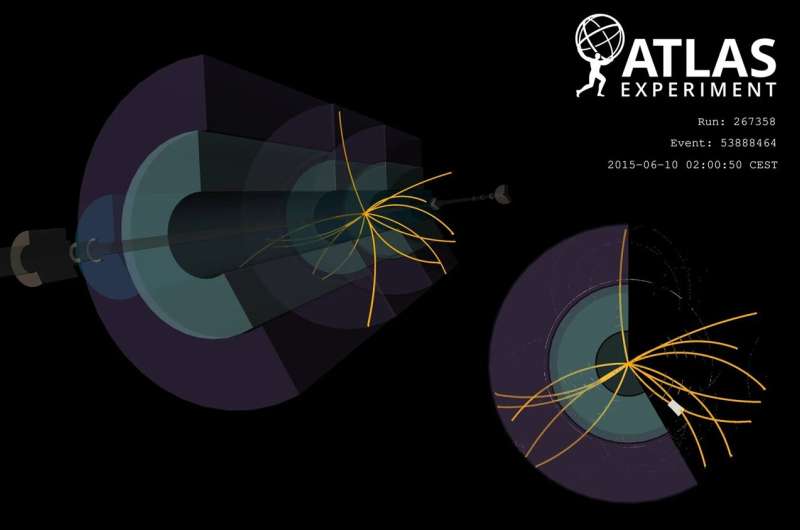
ATLAS Reports Possible Glimpse of QCD Instantons
The ATLAS Collaboration at CERN has released a new preprint describing an excess of proton‑proton collisions that match the expected signature of QCD instanton processes – rare tunnelling events that change the topological configuration of the strong‑force field in empty space. While the result is still preliminary, it marks the first dedicated search for these phenomena at the Large Hadron Collider (LHC) and could open a new experimental window onto the vacuum structure of quantum chromodynamics (QCD).
What the experiment looked for
QCD instantons are a theoretical prediction dating back roughly 50 years. They describe transitions between distinct vacuum states of the gluon field, each characterized by a different winding number. In a high‑energy proton collision, an instanton would manifest as a burst of many low‑energy particles emitted uniformly in all directions – a so‑called “isotropic” event. Ordinary QCD interactions can also produce roughly isotropic patterns, making the signal extremely difficult to isolate.
To tackle this, the ATLAS team trained a deep‑learning neural network on simulated data to recognize the subtle differences between standard QCD jets and the hypothesized instanton‑induced topology. The network was then applied to the full Run‑2 dataset at a centre‑of‑mass energy of 13 TeV, corresponding to an integrated luminosity of about 140 fb⁻¹.
The observed excess
The analysis identified a statistically significant excess of events in the signal region where the neural network assigned a high instanton‑likelihood score. The excess is reported as a deviation from the Standard Model background expectation at the level of ~2.5 σ. This is not sufficient for a discovery claim, but it is the first time such a pattern has been seen at the LHC.
The authors caution that ordinary QCD processes can mimic the signal, and systematic uncertainties – especially those related to the modeling of low‑energy particle production – remain large. Consequently, the result is presented as a hint rather than a definitive observation.
Why it matters
If confirmed, the detection of QCD instantons would provide the first experimental evidence that the vacuum of the strong force possesses a non‑trivial topological structure. This would validate a cornerstone of non‑perturbative QCD and could have far‑reaching implications:
- Testing fundamental theory – Directly probing instanton effects would test lattice‑QCD calculations and analytic techniques that rely on topological concepts.
- Matter‑antimatter asymmetry – While instantons themselves do not change the net baryon number, related processes (e.g., sphalerons) are thought to play a role in the early‑universe generation of the matter‑antimatter imbalance. An experimental handle on topological transitions could therefore inform cosmological models.
- New analysis tools – The successful use of machine‑learning classifiers for such a subtle signal demonstrates a powerful approach that could be applied to other rare phenomena at the LHC.
Next steps
The collaboration plans several follow‑up studies:
- Alternative collision topologies – Extending the search to events where one or both protons remain intact (so‑called diffractive collisions) could provide a cleaner environment.
- Cross‑checks with other detectors – Independent analyses by CMS and LHCb will be crucial to confirm or refute the excess.
- Improved modeling – Reducing systematic uncertainties in low‑energy particle production will sharpen the statistical significance.
Only after such corroborations can the community move from a hint to a robust observation of QCD instantons.
---
The findings are documented in the preprint “Search for the low‑mass isotropic signature of QCD instantons in pp collisions at √s = 13 TeV using the ATLAS detector” (arXiv:2611.22092). The article was originally published on Phys.org on 27 November 2026.
Hype check
PartlyThe preprint shows a 2.5 σ excess compatible with instantons, but the result is not peer‑reviewed, lacks independent confirmation, and is presented as a hint rather than a definitive discovery.
- Peer-reviewed paper, or press release only?Press release only — Result is only a preprint on arXiv, not a peer‑reviewed paper.
- Error-corrected (logical) qubits, or physical qubits only?Logical / not a qubit claim — Not a qubit‑count claim; question not applicable.
- A new milestone, or a rebrand / restatement?Restatement — Excess is a hint, not a confirmed new physics observation.
- Independent confirmation?Not yet — No external replication or confirmation mentioned.
- Does the headline claim match what the source shows?Matches — Headline correctly states ATLAS finds hints, matching the preprint's claim.
An editorial assessment of the claim as reported, not a judgment of the company or researchers. Checked against: phys.org. How we rate hype →
Source
Read original sourceWhy we picked this
Accepted from curated QuantumUnzipped source (relevance scoring disabled).