Atoms in sync: Superradiance offers a new kind of frequency comb
Caltech and Stanford researchers demonstrated a tunable superradiant frequency comb that emits synchronized microwave and optical light.
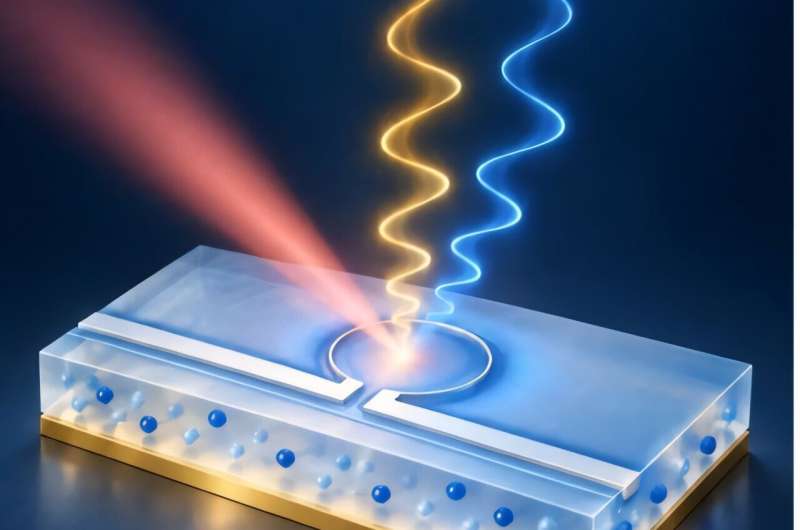
Superradiant Frequency Combs: A New Light‑Ruler
When a laser excites billions of ytterbium ions embedded in a yttrium orthovanadate crystal, the ions can emit light not just steadily but in a rhythmic pulse. By coupling the crystal to a tiny microwave resonator, the team at Caltech and Stanford forced the ions to share a common electromagnetic field, causing them to radiate together through superradiance. Unlike conventional lasers that rely on mirrors to set the frequency, this collective emission is governed by the atoms themselves, making the output intrinsically stable.
From Flash to Comb
Earlier superradiant experiments produced a single flash or a continuous beam. The new work shows that, above a certain pump power, the ion ensemble switches to a mode‑locked regime: the atoms fire in a regular, repeating rhythm. The resulting spectrum consists of equally spaced lines—a frequency comb—that appears simultaneously in the microwave and infrared domains. Because the same ion provides both transitions, the microwave and optical teeth of the comb are perfectly synchronized.
Why It Matters
Frequency combs act like a ruler for light, enabling ultra‑precise measurements of time, distance, and chemical composition. Current combs depend on cavity lengths defined by mirrors, which drift with temperature or vibration. The superradiant comb sidesteps this limitation; its spacing is set by atomic energy levels and the shared field, promising far‑greater stability.
Beyond metrology, the dual‑frequency nature of the comb could bridge two leading quantum‑technology platforms. Superconducting qubits operate at microwave frequencies but lose quantum information quickly unless kept near absolute zero. Optical photons, by contrast, travel long distances through fiber with minimal loss. Since the same ytterbium ion can emit both microwave and optical photons, the comb offers a natural interface for converting quantum information between these regimes.
Outlook and Challenges
The researchers envision programmable superradiant sources: by tweaking the laser pump or the resonator properties, they could shape pulse spacing, intensity, and spectral envelope on demand. Realizing this control will require deeper understanding of atom‑atom interference and the nonlinear dynamics that trigger the pulsing transition.
Future steps include:
- Demonstrating coherent quantum state transfer between microwave and optical photons using the comb.
- Scaling the system to larger ion ensembles while preserving stability.
- Integrating the device with existing superconducting circuits and fiber‑optic networks.
If these hurdles are cleared, superradiant frequency combs could become a cornerstone technology for next‑generation quantum networks, precision spectroscopy, and time‑keeping.
--- The findings are reported in Nature (2026) by Tian Xie et al., “Observation of tunable superradiant frequency combs,” DOI 10.1038/s41586-026-11289-7, and on arXiv (arXiv:2604.14601).
Hype check
RealThe paper in Nature provides experimental evidence of a tunable superradiant frequency comb; the claim is directly supported by peer‑reviewed data.
- Peer-reviewed paper, or press release only?Paper — Nature paper DOI 10.1038/s41586-026-11289-7
- Error-corrected (logical) qubits, or physical qubits only?Logical / not a qubit claim — Result does not involve qubit counts
- A new milestone, or a rebrand / restatement?New — First demonstration of a superradiant frequency comb
- Independent confirmation?Not yet — No external replication mentioned in input
- Does the headline claim match what the source shows?Matches — Headline accurately reflects the reported superradiant comb
An editorial assessment of the claim as reported, not a judgment of the company or researchers. Checked against: phys.org. How we rate hype →
Source
Read original sourceWhy we picked this
Accepted from curated QuantumUnzipped source (relevance scoring disabled).