Below-shot-noise capacity in phase estimation using nonlinear interferometers
The paper compares three nonlinear interferometer designs and finds that, under realistic loss, the Mandel‑type scheme offers the most robust phase sensitivity, typically limited to the shot‑noise level.
Below‑Shot‑Noise Capacity in Phase Estimation with Nonlinear Interferometers
Nonlinear interferometers—often called imaging with undetected light—allow a sample to be probed at one wavelength while detection occurs at another, more convenient wavelength. This dual‑color approach has attracted attention for both imaging and sensing because it can, in principle, surpass the classical shot‑noise limit (SNL) and even approach the Heisenberg limit. The new study by Oglialoro et al. systematically evaluates three widely used configurations using only intensity‑based measurements, which are straightforward to implement experimentally.
Configurations Compared
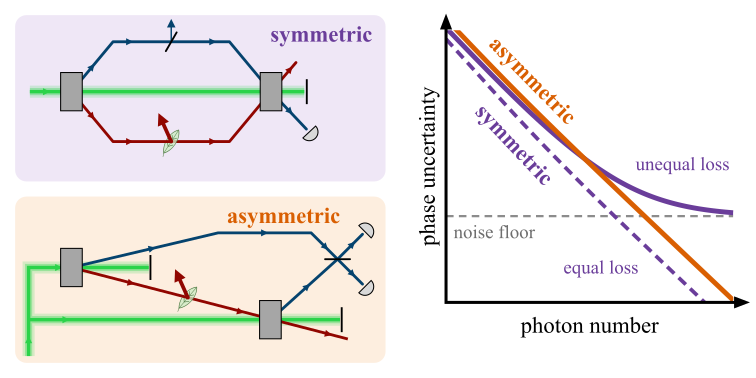
- Yurke‑type SU(1,1) interferometer – a symmetric arrangement where both signal and idler photons generated in the first crystal re‑enter a second crystal. Theory predicts Heisenberg‑scaling phase sensitivity, but the advantage is fragile.
- Mandel‑type induced‑coherence interferometer – an asymmetric layout where only the idler photons pass through the second crystal, while the signal photons are directly detected.
- Hybrid scheme – a continuous interpolation between the symmetric and asymmetric configurations, allowing the authors to explore the full parameter space.
All three setups are analyzed with differential intensity detection, a practical measurement that subtracts the photocurrents of two detectors to cancel common‑mode noise.
Main Findings
- Robustness to loss: Realistic imaging scenarios involve asymmetric loss because the sample typically absorbs the idler beam. In this regime, the symmetric (Yurke) configuration’s phase uncertainty quickly hits a noise floor and can become worse than the asymmetric scheme.
- Shot‑noise vs. sub‑shot‑noise: The Mandel interferometer consistently reaches the SNL and, under balanced loss and moderate gain, can dip below it. However, in high‑gain regimes—where many photons are generated—the sub‑shot‑noise advantage disappears.
- Hybrid performance: By tuning the degree of asymmetry, the hybrid scheme can trade off between the Heisenberg‑type scaling of the symmetric layout and the loss‑tolerance of the asymmetric one, but it never outperforms the pure Mandel configuration in realistic conditions.
The authors therefore conclude that the Mandel‑type interferometer with differential detection is the most reliable choice for practical phase estimation, delivering the highest sensitivity that remains bounded by the SNL when loss is present.
Implications for Quantum Imaging
These results temper earlier optimism that nonlinear interferometers could routinely achieve Heisenberg‑limited precision. Instead, they highlight the importance of loss engineering and detection strategy. For applications such as mid‑infrared microscopy, chemical sensing, or quantum‑enhanced tomography, the asymmetric configuration offers a pragmatic path: it leverages the wavelength‑flexibility of undetected‑light imaging while staying within experimentally achievable noise limits.
Outlook
Future work could explore seeded versions of these interferometers, active loss compensation, or hybrid quantum‑classical processing to push beyond the SNL. Nonetheless, the present comparative analysis provides a clear guideline for experimentalists seeking the best trade‑off between sensitivity and robustness in nonlinear‑interferometric metrology.
--- This article is based on the peer‑reviewed paper “Below‑shot‑noise capacity in phase estimation using nonlinear interferometers” (Quantum 10, 2272 (2026)).
Hype check
PartlyThe headline suggests a general below‑shot‑noise capacity, but the paper shows sub‑shot‑noise only under limited, balanced‑loss conditions; most realistic scenarios remain shot‑noise limited.
- Peer-reviewed paper, or press release only?Paper — Published in Quantum, a peer‑reviewed journal
- Error-corrected (logical) qubits, or physical qubits only?Logical / not a qubit claim — Not a qubit‑count claim
- A new milestone, or a rebrand / restatement?Restatement — Provides comparative analysis, not a novel record or breakthrough
- Independent confirmation?Not yet — No external replication or third‑party confirmation mentioned
- Does the headline claim match what the source shows?Overstated — Headline overstates general sub‑shot‑noise performance
An editorial assessment of the claim as reported, not a judgment of the company or researchers. Checked against: doi.org. How we rate hype →
Source
Read original sourceWhy we picked this
Accepted from curated QuantumUnzipped source (relevance scoring disabled).