Beyond Binary Quantum Computing: Exploring Higher-Dimensional Qudits
University of Rochester researchers are exploring superconducting qudits—multi‑level quantum units—to improve simulation, error correction, and flexible quantum architectures.
Beyond Binary Quantum Computing: Exploring Higher‑Dimensional Qudits
Quantum computing is usually described in terms of qubits, the quantum analogue of a classical binary bit. At the University of Rochester, Associate Professor of Physics Machiel Blok and his team are asking whether a richer, multi‑level approach—qudits—might sometimes be a more natural and efficient way to process quantum information.
Matching Hardware to Nature’s Multi‑Level Systems
Many physical systems that scientists aim to simulate—atoms, molecules, vibrational modes, quantum fields—are intrinsically multi‑level. A qudit can encode information across several energy states of a superconducting circuit, rather than being limited to the two states of a qubit. The Rochester group’s goal is not to replace qubits outright, but to identify problem domains where a higher‑dimensional representation reduces overhead and better mirrors the structure of the system under study.
Advantages for Quantum Simulation
Quantum chemistry and quantum field theory are prime candidates for qudit‑based simulation. By mapping each natural degree of freedom onto a distinct qudit level, researchers can avoid the binary encoding that forces many extra qubits and complex gate sequences. In principle, a qudit‑based simulator could model molecules or materials more directly, potentially achieving speed‑ups over classical methods that are out of reach for current binary quantum processors.
Toward More Efficient Error Correction
Error correction remains a bottleneck for scaling quantum computers. Higher‑dimensional systems offer alternative codes that can pack more logical information into a single physical element, reducing the total number of components needed for fault tolerance. The Rochester experiments are probing how noise behaves in excited states and whether multi‑level encodings can tolerate errors differently from traditional qubits.
Engineering Challenges and New Control Techniques
Moving from two‑level to multi‑level hardware introduces substantial engineering complexity. Each additional energy level creates new transition pathways, noise channels, and calibration demands. Blok’s team has developed a control scheme that drives multiple transitions simultaneously, rather than stepping through adjacent levels one at a time. This “all‑floors‑at‑once” approach, inspired by spin‑physics techniques, speeds up operations and simplifies pulse design for qudit manipulation.
Cryogenic Infrastructure as an Enabler
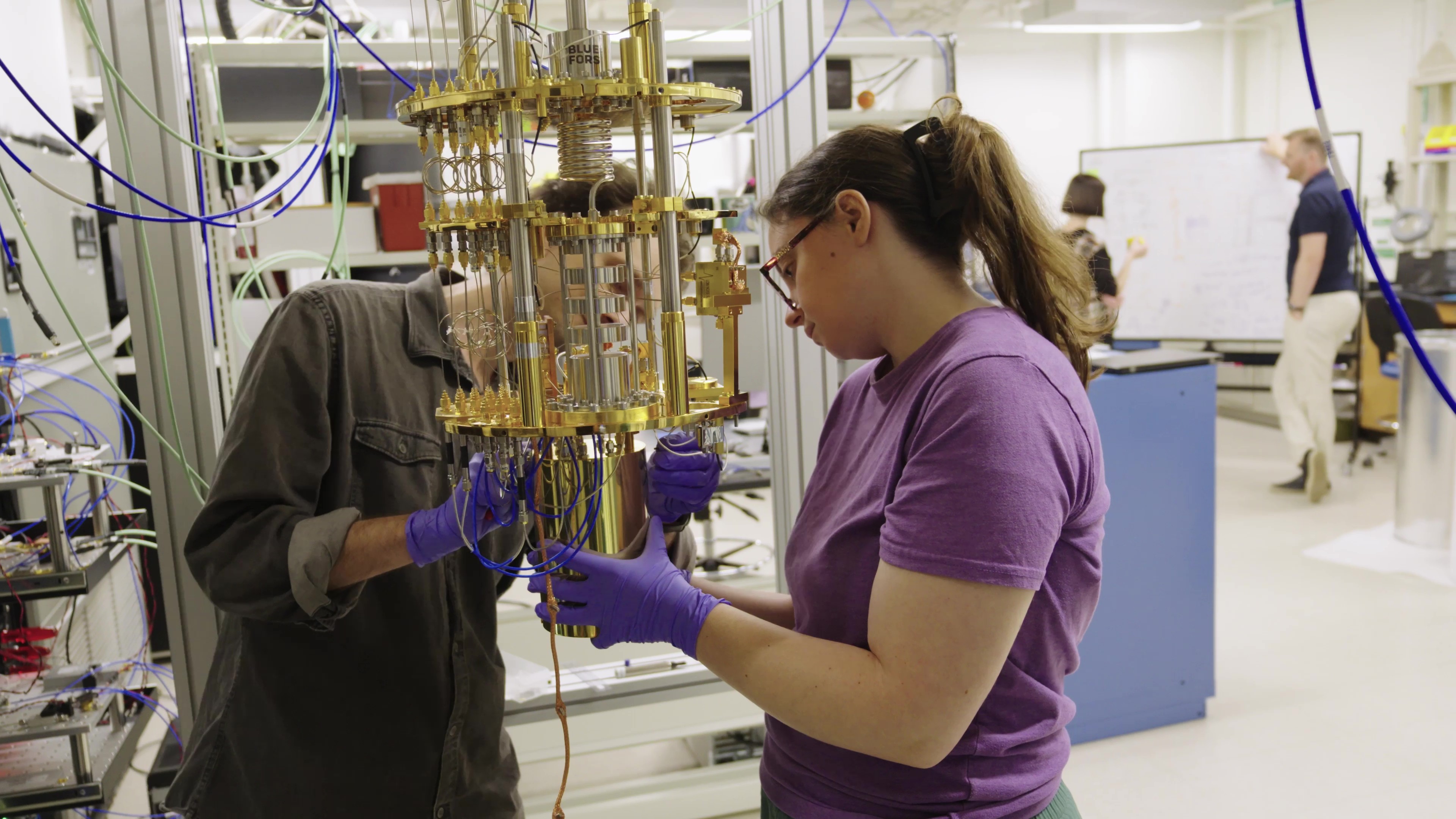
Superconducting qudits, like all superconducting quantum devices, require millikelvin temperatures. Reliable, fast‑cycling dilution refrigerators are essential for the rapid experimental turnaround needed to explore the expanded parameter space of qudit control. The lab relies on Bluefors ultra‑compact dilution systems, whose small footprint and dependable cooldowns free researchers to focus on physics rather than cryogenic logistics.
Training the Next Generation
Beyond the scientific advances, the Blok Lab emphasizes education. Graduate and undergraduate students work hands‑on with the qudit hardware, gaining experience that bridges theory and experimental practice. The university’s Center for Coherence and Quantum Science fosters interdisciplinary collaboration, exposing students to a spectrum of quantum technologies—from spin qubits to quantum optics—preparing them for careers in both academia and the growing quantum industry.
A Pluralistic Quantum Future
Blok envisions a future where qubits, qudits, and hybrid architectures coexist, each chosen for the problem they solve best. By expanding the toolkit beyond binary logic, researchers are opening new pathways for efficient simulation, robust error correction, and deeper insight into quantum mechanics itself. The work at Rochester illustrates how exploring higher‑dimensional quantum systems can reshape our understanding of what a quantum processor can be.
The exploration of qudits is still in its early stages, but the combination of novel control methods, reliable cryogenics, and a strong educational mission positions the University of Rochester as a key contributor to this emerging frontier.
Source
Read original sourceWhy we picked this
Accepted from curated QuantumUnzipped source (relevance scoring disabled).