BlueQubit Releases AI-Engineered State-Vector Simulator Outperforming NVIDIA cuStateVec Benchmarks
BlueQubit’s new bluesv simulator claims a 1.4‑1.8× speed advantage over NVIDIA’s cuStateVec on GPU and CPU benchmarks.
BlueQubit’s AI‑Engineered State‑Vector Simulator Beats NVIDIA’s cuStateVec
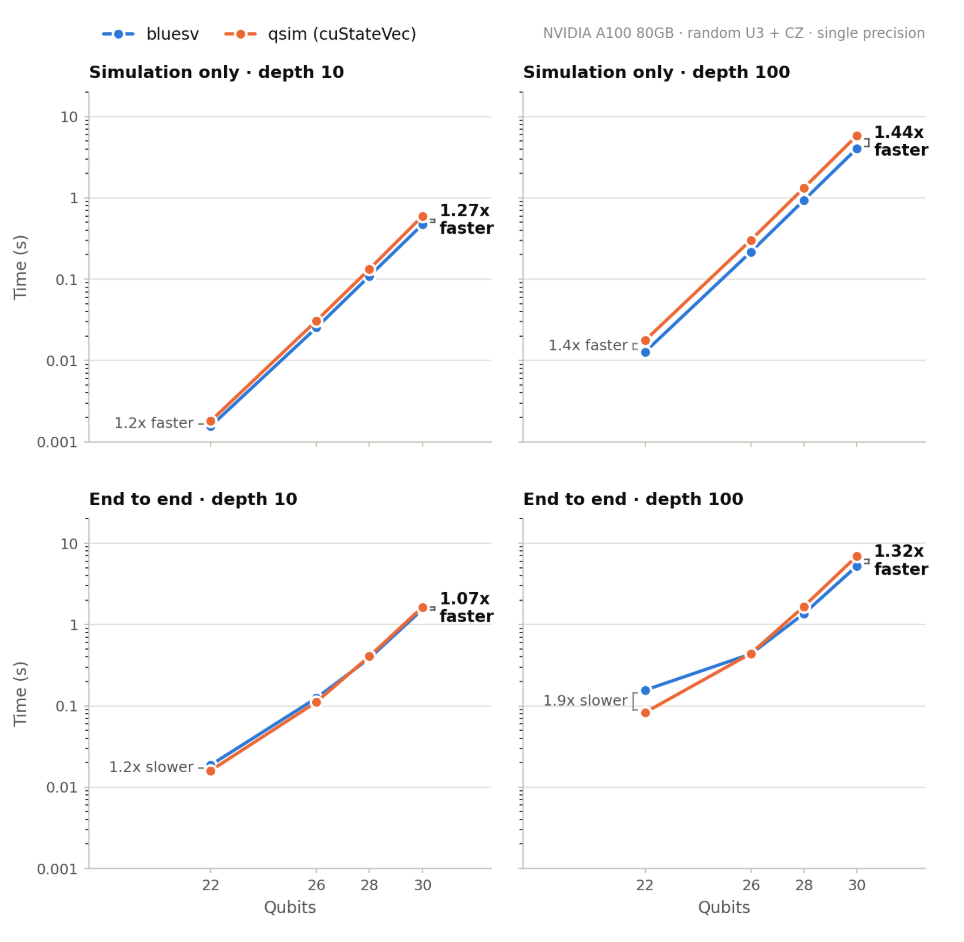
BlueQubit announced bluesv, a state‑vector quantum circuit simulator built entirely through automated, agentic coding workflows. The company says the tool can replace NVIDIA’s cuStateVec library without any code changes, offering direct compatibility with popular frameworks such as Qiskit, Cirq, and PennyLane. In internal benchmark tests, bluesv reportedly outperformed cuStateVec on an NVIDIA A100 GPU and delivered comparable gains on a 10‑core Intel Xeon CPU.
How bluesv was built
According to the press release, the development cycle for bluesv lasted only a few weeks—a stark contrast to the multi‑quarter timelines typical for high‑performance quantum software. BlueQubit leveraged Anthropic’s Claude Code model to generate and verify code against deterministic numerical oracles. The resulting binary is self‑contained, eliminating the need for complex library installations and making it suitable for high‑throughput batch processing of smaller circuits.
Benchmark methodology
The company tested bluesv against two reference points:
- NVIDIA cuStateVec on an A100 GPU, using randomly generated circuits ranging from 22 to 30 qubits and depths of 10 to 100 layers.
- qsim’s CPU backend on a 10‑core Intel Xeon processor, focusing on circuits of 26 qubits or more.
Key results reported:
- GPU tests: bluesv beat cuStateVec at every measured point, achieving a 1.4× speedup on the largest, deepest circuits.
- CPU tests: bluesv delivered 1.5‑1.6× speedups at shallow depth (10) and ≈1.8× at deeper circuits (depth 30), while matching reference outputs to machine precision.
What this means for developers
If the reported gains hold up under independent scrutiny, bluesv could become a valuable drop‑in replacement for teams already using cuStateVec. Its API compatibility means existing Qiskit, Cirq, or PennyLane codebases can switch to bluesv without rewriting simulation calls. Moreover, the open‑source release promises community contributions and broader validation across diverse hardware platforms.
Caveats and next steps
The performance claims are based on internal testing and have not yet been peer‑reviewed or reproduced by external groups. Users should verify the results on their own hardware configurations, especially if they rely on specific precision settings or circuit topologies not covered in the benchmark suite. BlueQubit plans to extend the agentic engineering approach to other SDK components, suggesting that future releases may bring additional speedups or feature enhancements.
---
Bottom line: bluesv appears to deliver a noticeable performance edge over NVIDIA’s cuStateVec in the reported tests, but the lack of independent verification means developers should treat the numbers as promising yet provisional.
Hype check
PartlyThe press release provides specific benchmark numbers but lacks peer review or external validation, so the claim is promising but not fully confirmed.
- Peer-reviewed paper, or press release only?Press release only — Only a press release; no paper or preprint cited.
- Error-corrected (logical) qubits, or physical qubits only?Logical / not a qubit claim — Not a qubit‑count claim; performance claim only.
- A new milestone, or a rebrand / restatement?New — First AI‑engineered simulator claiming speedup over cuStateVec.
- Independent confirmation?Not yet — No external replication or third‑party confirmation mentioned.
- Does the headline claim match what the source shows?Matches — Headline accurately reflects the benchmark claim in the text.
An editorial assessment of the claim as reported, not a judgment of the company or researchers. How we rate hype →
Source
Read original sourceWhy we picked this
Accepted from curated QuantumUnzipped source (relevance scoring disabled).