Bounding the entanglement of a state from its spectrum
The paper presents a general framework that uses only a state's eigenvalues to derive tight upper bounds on its entanglement, applicable to measures like negativity and Schmidt number across any dimension.
Introduction
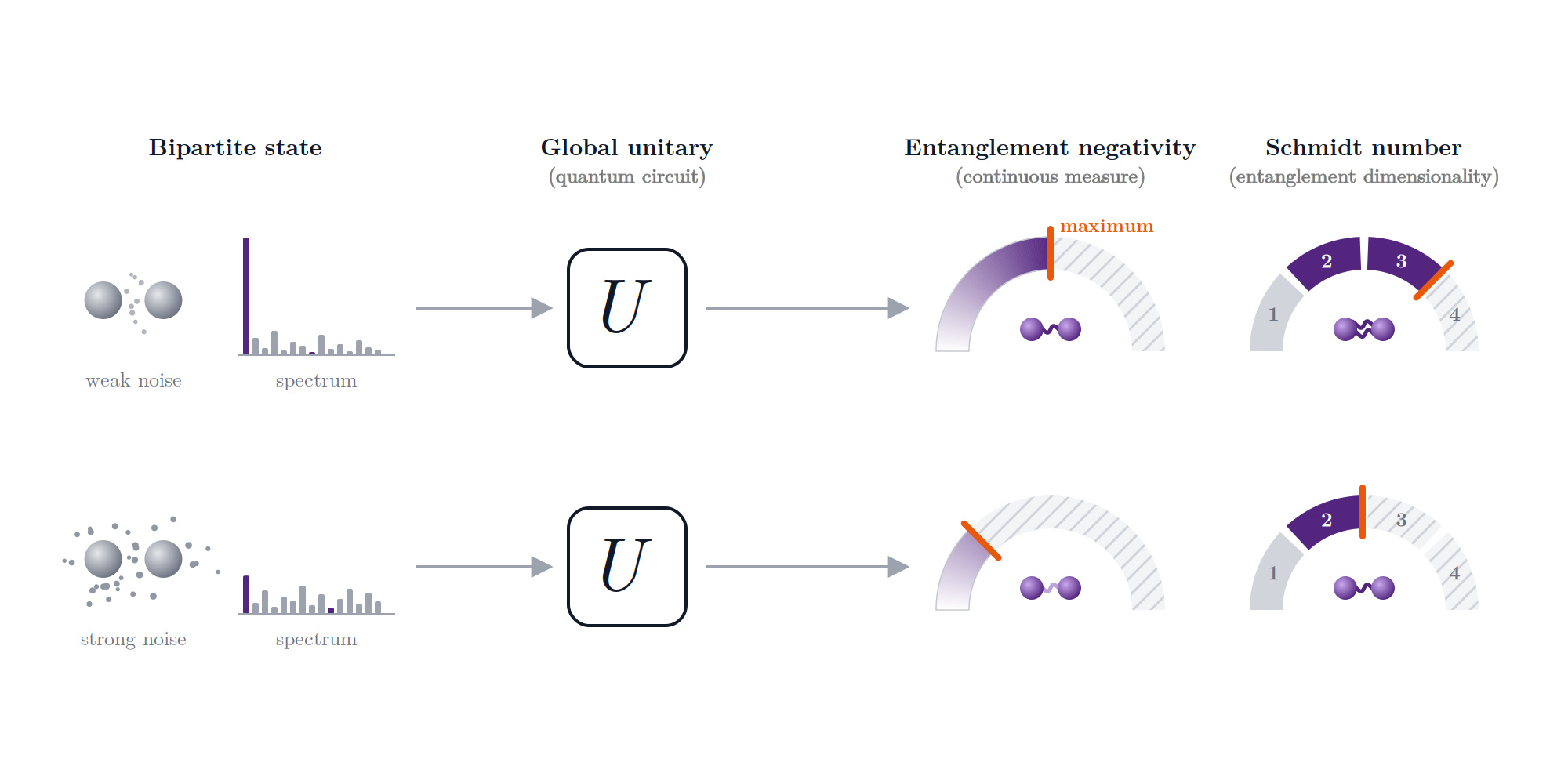
Entanglement is the cornerstone of quantum technologies, yet quantifying it in realistic, noisy (mixed) states remains challenging. While many criteria can tell whether a state is entangled, they often fall short of indicating how much entanglement can be extracted using global unitary operations. The recent work by Abellanet‑Vidal et al. introduces a powerful, spectrum‑based approach that yields analytical upper bounds on the entanglement that any bipartite state can host, regardless of its dimension. By relying solely on a few eigenvalues of the density matrix, the method offers a low‑cost, scalable tool for both theorists and experimentalists.
Spectral Bounds via Linear Maps
The core idea is to map the problem of maximizing entanglement under unitary dynamics onto a set of linear‑map constraints. For a bipartite state \(\rho\) with eigenvalues \(\lambda1\ge\dots\ge\lambdad\), the authors construct an invertible linear map \(\Phi\) whose action preserves the spectrum but reshapes the state’s correlations. By analysing \(\Phi^{-1}\) they derive inequalities that any admissible entanglement measure \(E\) must satisfy:
``` E(\rho) \le f(\lambdai, \lambdaj) ```
where \(f\) is an explicit function of just two eigenvalues (typically the largest and smallest). This remarkable reduction means that, even for high‑dimensional systems, the bound can be evaluated with negligible computational effort.
Applications to Negativity and Schmidt Number
Two widely used entanglement quantifiers are examined in detail:
- Negativity – a computable measure based on the partial transpose. The authors show that the maximal negativity achievable after any global unitary is bounded by a simple expression involving \(\lambda1\) and \(\lambdad\). For several noise models (e.g., depolarizing and dephasing channels) the bound is proven to be tight, matching known optimal protocols.
- Schmidt Number – the minimal number of Schmidt coefficients needed to represent a pure‑state decomposition of \(\rho\). By translating the Schmidt‑number witness conditions into spectral constraints, the paper derives sufficient criteria that guarantee an upper limit on the Schmidt number solely from the spectrum.
Both results are presented in compact analytical form, making them immediately useful for assessing entanglement dimensionality in experiments such as high‑dimensional photonic platforms or trapped‑ion registers.
Practical Implications and Outlook
The spectral framework has several practical advantages:
- Low computational overhead – only two eigenvalues are required, avoiding full state tomography or semidefinite programming.
- Dimension‑independent – the formulas hold for arbitrary local Hilbert space sizes, enabling analysis of large‑scale quantum processors.
- Versatility – while demonstrated for negativity and Schmidt number, the method extends to any convex entanglement monotone that can be expressed as a linear functional of the state.
These features open the door to rapid, on‑the‑fly entanglement certification in noisy intermediate‑scale quantum (NISQ) devices, where real‑time feedback on resource quality is essential.
Conclusion
Abellanet‑Vidal et al. provide a unifying, spectrum‑centric toolkit for bounding the entanglement content of mixed bipartite states. By reducing the problem to simple eigenvalue‑based inequalities, the work bridges a gap between theoretical entanglement quantification and practical, scalable diagnostics for quantum technologies. Future research may explore extensions to multipartite settings and to dynamical scenarios where the spectrum evolves under open‑system dynamics.
Source
Read original sourceWhy we picked this
Accepted from curated QuantumUnzipped source (relevance scoring disabled).