California Awards $5.7 Million in Workforce Grants to Establish Sub-Doctoral Quantum Hardware and Technician Pipelines
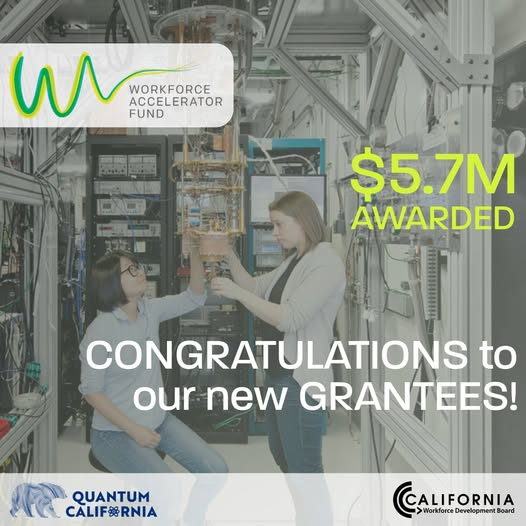
California’s Workforce Development Board is investing $5.74 million in five partnerships to create sub‑doctoral training pipelines for quantum hardware technicians and related deep‑tech roles.
Building a Quantum Technician Pipeline in California
California is taking a concrete step to address the talent shortage that has long hampered the state’s burgeoning quantum hardware sector. The California Workforce Development Board (CWDB) has awarded $5.74 million across five educational and regional partnerships under its Workforce Accelerator Fund (WAF‑14). The grants are earmarked for stack‑able, industry‑recognized certificates that prepare students and existing workers for hands‑on roles in quantum hardware design, fabrication, and testing—careers that typically do not require a doctoral degree.
---
1. Grant Recipients and Program Focus
| Institution | Grant | Program | Core Training |------------|------|---------|-------------- | San Jose State University Research Foundation | $1.50 M | Quantum Computing Hardware Design | Three‑tier certificate linking high‑school, community‑college, and university tracks to quantum hardware engineering. | University of California, Berkeley | $1.03 M | Northern California Quantum Pipeline | 8‑ to 13‑week industry‑verified credential plus associate and bachelor pathways for grades 9‑16. | University of California, Santa Barbara | $993,900 | Q‑COAST Hardware Technician Pathway | Non‑degree vocational track covering superconductivity, photonic integrated circuits, and quantum optics assembly. | Valley Vision, Inc. | $746,040 | Quantum Capital (Greater Sacramento) | Regional skill‑mapping that aligns K‑12 and community‑college curricula with employer needs. | University of California, San Diego | $1.48 M | Fusion CAL Career Pathway | 13‑week stackable credential for ~160 participants, spanning fusion‑energy and high‑vacuum technology roles.
These programs share three design principles:
- Modular certification – short, intensive courses (8‑13 weeks) that culminate in credentials recognized by quantum hardware firms.
- Stackability – learners can accumulate multiple certificates, eventually bridging to associate or bachelor degrees if desired.
- Regional alignment – each initiative maps local industry demand, ensuring that curricula stay current with the specific hardware stacks used by nearby companies.
---
2. Why Sub‑Doctoral Talent Matters
While U.S. universities continue to churn out large numbers of PhDs in quantum theory and algorithms, commercial hardware developers face a different bottleneck. Building a dilution refrigerator, wiring superconducting qubits, or assembling photonic chips requires hands‑on engineering skills that are typically taught in vocational or associate‑level programs. Employers report chronic vacancies for:
- Cleanroom operators and wafer‑fab technicians
- Precision optics assemblers
- Ultra‑high‑vacuum (UHV) system specialists
- Cryogenic plumbing and wiring technicians
By targeting these roles, the CWDB grants aim to reduce lead times for hardware production, lower labor costs, and accelerate the commercialization of quantum devices.
---
3. Connecting Education to Industry
The Valley Vision project exemplifies the ecosystem approach. It brings together local employers, community colleges, and K‑12 districts to develop a shared competency framework. This framework defines the exact skills—such as solder‑free wire bonding or photonic chip packaging—that companies need, allowing schools to tailor their curricula accordingly.
Similarly, the Q‑COAST pathway at UCSB provides a direct vocational route into hardware manufacturing. Students graduate with a certificate that explicitly states they can operate superconducting processors, handle photonic integrated circuits, and perform optical metrology—all without a four‑year degree.
---
4. Looking Ahead
California’s investment builds on more than $40 million already deployed through the Workforce Accelerator Fund since 2018 and aligns with recent state legislation aimed at consolidating quantum and fusion clusters. The expectation is that a robust sub‑doctoral pipeline will:
- Supply a ready‑made talent pool for existing and emerging quantum hardware firms in the Bay Area, Sacramento, and Southern California.
- Encourage other states to adopt similar models, potentially creating a national network of quantum technician schools.
- Accelerate time‑to‑market for quantum processors, photonic chips, and related technologies, helping California maintain its leadership in deep‑tech innovation.
---
Practical Takeaways
- For educators: Design short, stackable certificates that map directly to employer‑defined competencies.
- For employers: Partner with local training programs to co‑develop curricula and offer apprenticeship slots.
- For policymakers: Continue funding modular, region‑focused initiatives that address specific skill gaps rather than broad, degree‑centric programs.
By weaving together universities, community colleges, and industry, California is laying the groundwork for a sustainable, sub‑doctoral workforce that can keep pace with the rapid evolution of quantum hardware.
Source
Read original sourceWhy we picked this
Accepted from curated QuantumUnzipped source (relevance scoring disabled).