Cat-like quantum states confirmed in a three-photon chip
A three‑photon Kerr parametric oscillator chip has demonstrated coherent three‑component cat‑like states, establishing a protected qutrit manifold and a new time‑domain method for measuring its energy‑gap protection.
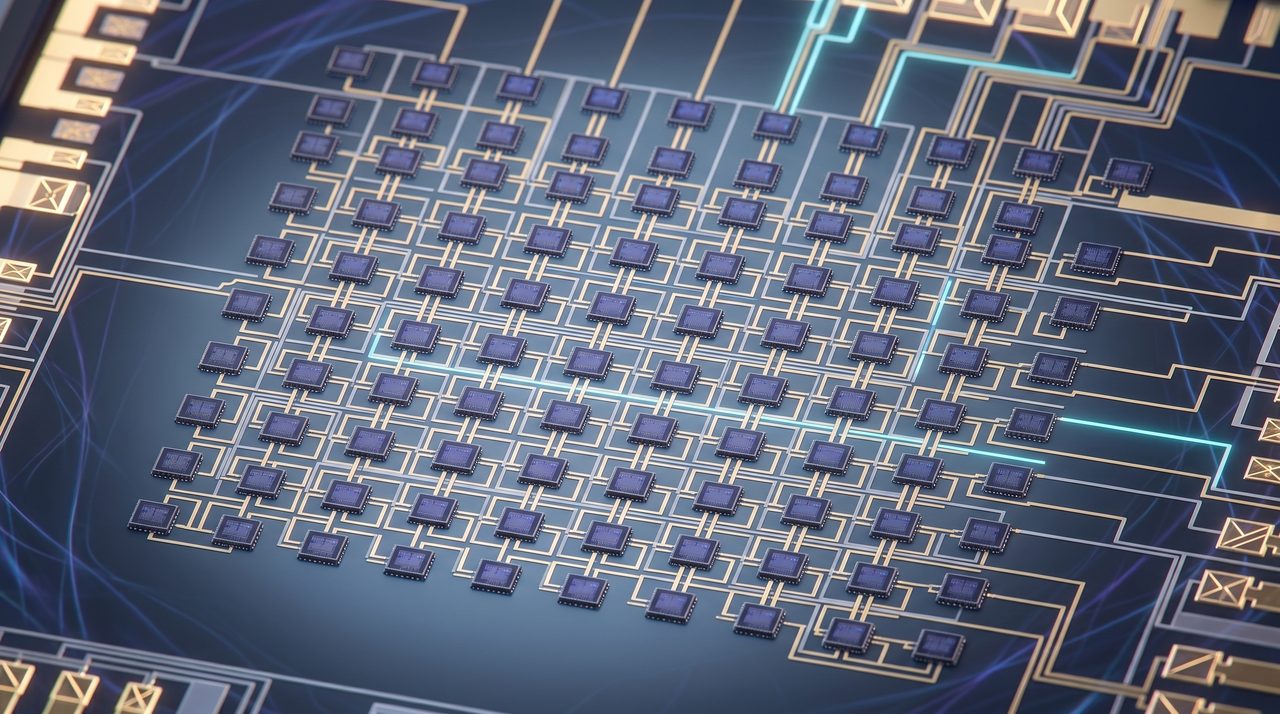
Cat‑like Quantum States in a Three‑Photon Chip
Researchers have reported the first experimental confirmation of three‑component cat‑like quantum states on a superconducting chip driven by a three‑photon Kerr parametric oscillator (KPO). Moving beyond the familiar two‑component cat states, these new states form a qutrit manifold—a three‑level logical system—whose basis states are distinguished by photon numbers that are multiples of three. The work showcases quantum coherence through three‑photon Rabi oscillations and direct Wigner‑function imaging, and it introduces a practical, time‑domain technique for quantifying the protective energy gap that shields the qutrit from leakage.
---
1. From Two‑Component Cats to Three‑Component Qutrits
Traditional bosonic cat qubits encode information in superpositions of even‑ and odd‑photon‑number states, offering protection against certain errors. The new three‑photon KPO extends this idea by enforcing a mod‑3 symmetry in the Hamiltonian. The resulting logical states—labelled |0C⟩, |1C⟩, and |2C⟩—occupy photon‑number subspaces where the total photon count satisfies \(n = 3k\) for non‑negative integers \(k\). This symmetry is not a mathematical curiosity; it is actively maintained by the three‑photon drive, providing a more robust foundation for high‑dimensional quantum logic.
---
2. Observing Coherence: Rabi Oscillations and Wigner Tomography
The team measured three‑photon Rabi oscillations by pulsing the pump amplitude and tracking the mean photon number. The oscillation frequency directly reflects the energy gap between the protected qutrit manifold and higher‑lying excited states. Simultaneously, two‑dimensional Wigner‑function reconstructions revealed a characteristic three‑fold symmetry in phase space, confirming the presence of genuine quantum superpositions rather than semiclassical mixtures.
---
3. Energy‑Gap Protection and Its Limits
The observed oscillations serve as a time‑domain probe of the protective gap. When the system is prepared in an unprotected state (e.g., |0_exC⟩), the population decays monotonically. In contrast, the protected qutrit manifold exhibits a recovery of total population toward unity, with only minor residual oscillations caused by imperfect state preparation. This behavior demonstrates that the gap suppresses leakage into non‑computational subspaces, especially against low‑frequency dephasing noise.
However, the experiment also identified a parasitic higher‑order pump term as the dominant limitation on achievable photon numbers. This term interferes with the ideal three‑photon drive, reducing the size of the cat states relative to theoretical predictions. Mitigating this effect is a clear target for future device engineering.
---
4. Error Dynamics in the Protected Qutrit
Single‑photon loss, a ubiquitous decoherence channel, induces a cyclic population transfer within the qutrit manifold (e.g., |0C⟩ → |2C⟩ → |1C⟩). Unlike the ladder‑type decay seen in conventional transmon qutrits, this cyclic behavior does not immediately erase the encoded information, though it does introduce logical errors that must be addressed for scalable computation.
Preparing arbitrary superpositions of the three logical states remains challenging because precise phase control is required. The authors suggest adapting measurement‑based state preparation—successful in two‑photon KPOs—to the three‑photon platform, but experimental validation is still pending.
---
5. Outlook: Toward Higher‑Dimensional Protected Encodings
The demonstrated three‑photon KPO provides a solid foundation for protected bosonic qutrits and points toward extending the approach to four‑level systems (ququarts). Such higher‑dimensional encodings could enable autonomous quantum error correction schemes that exploit biased‑noise properties, a crucial ingredient for fault‑tolerant quantum processors.
Future work will focus on:
- Reducing the impact of higher‑order pump terms to enlarge cat‑state amplitudes.
- Refining measurement‑based protocols for deterministic superposition preparation.
- Exploring the interplay between engineered tunnelling dynamics and residual loss mechanisms.
- Scaling the architecture to multi‑qutrit arrays for logical gate demonstrations.
---
Practical Takeaway: The three‑photon KPO chip not only confirms the existence of multi‑component cat states but also offers a concrete, experimentally accessible method for quantifying their protective energy gap. By addressing the identified pump‑term limitation and improving state‑preparation techniques, this platform could become a versatile building block for high‑dimensional, error‑resilient quantum computing.
Source
Read original sourceWhy we picked this
Accepted from curated QuantumUnzipped source (relevance scoring disabled).