Certification of quantum correlations at arbitrary distances through routed Bell tests
Routed Bell tests can theoretically certify quantum correlations over any distance despite arbitrary transmission loss.
Quantum Correlations Without Distance Limits
Device‑independent quantum protocols, such as DI‑QKD, rely on Bell‑test violations to guarantee security. A persistent obstacle is transmission loss: as photons travel farther, fewer reach the remote detector, eventually closing the detection loophole and invalidating the test. The recent paper Certification of quantum correlations at arbitrary distances through routed Bell tests (Sekatski et al., Quantum 10, 2288 (2026)) offers a purely theoretical solution.
Routed Bell Experiments
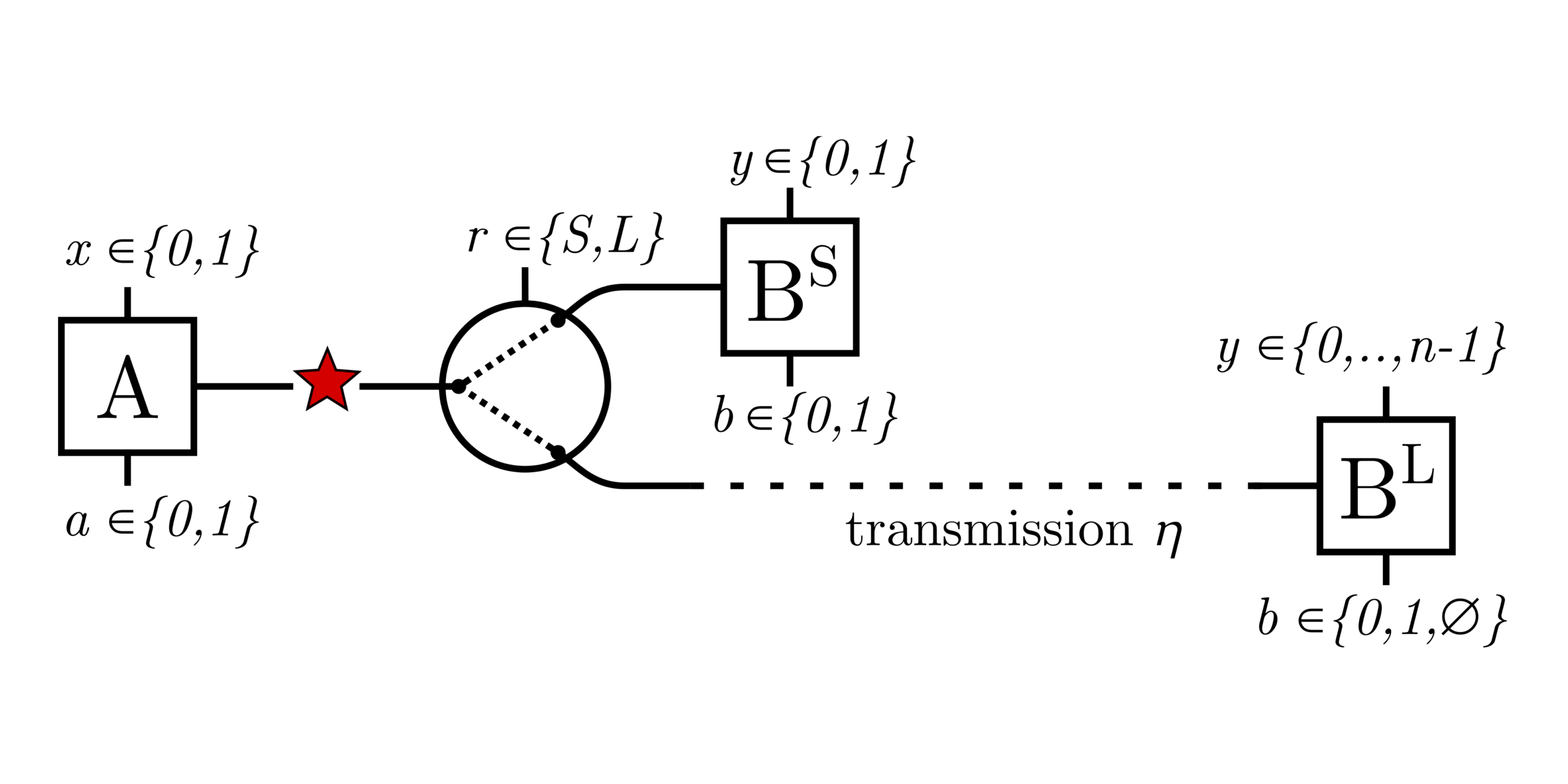
In a routed Bell scenario, a source distributes entangled qubits to Alice (A) and Bob. After the source, a switch directs Bob’s particle either to a nearby measurement device \(B^{S}\) or to a distant device \(B^{L}\) that suffers loss with transmission \(\eta\). By first performing a standard Bell test between A and the near device \(B^{S}\), the parties can self‑test the underlying state and measurement operators. The authors show that this certified information is sufficient to infer genuine quantum correlations on the long path, even when \(\eta\) is arbitrarily small (but non‑zero).
From Self‑Testing to Device‑Independent Security
The proof adapts techniques from self‑testing and quantum steering. Crucially, it does not require any additional assumptions about the loss channel beyond its existence. The authors also sketch a DI‑QKD protocol that leverages the routed test: the near‑side Bell violation guarantees that the distant correlations are trustworthy, enabling secret‑key extraction over any distance in principle.
Practical Implications
While the result is currently a mathematical proof, it reshapes how we think about long‑range quantum networks. Existing loophole‑free Bell experiments have demonstrated entanglement over kilometers, but loss quickly becomes prohibitive for device‑independent tasks. Routed Bell tests could, in theory, bypass this limitation without needing quantum repeaters or heralded amplifiers. Implementing the scheme will demand ultra‑low‑noise switches, high‑fidelity local measurements, and rigorous certification of the near‑side Bell violation—challenges that experimental groups are already tackling.
Outlook
The paper opens several research directions:
- Experimental validation of routed Bell tests with photons, atoms, or solid‑state qubits.
- Optimization of switching strategies to minimize added noise.
- Integration with existing quantum‑network architectures, potentially reducing the overhead of quantum repeaters for DI‑QKD.
If realized, the approach could make device‑independent security scalable to continental or even inter‑satellite distances, fulfilling a long‑standing goal of quantum cryptography.
--- The findings are theoretical; practical deployment will require substantial engineering and experimental confirmation.
Hype check
RealThe paper provides a peer‑reviewed theoretical proof that routed Bell tests certify correlations over arbitrary loss, with clear mathematical arguments and no over‑stated experimental claims.
- Peer-reviewed paper, or press release only?Paper — Published in Quantum, volume 10, 2026
- Error-corrected (logical) qubits, or physical qubits only?Logical / not a qubit claim — No qubit‑count claim; focuses on Bell‑test certification
- A new milestone, or a rebrand / restatement?New — First proof of arbitrary‑loss certification via routed Bell tests
- Independent confirmation?Not yet — No external replication mentioned; only authors' work
- Does the headline claim match what the source shows?Matches — Headline accurately reflects the paper’s theoretical result
An editorial assessment of the claim as reported, not a judgment of the company or researchers. Checked against: doi.org. How we rate hype →
Source
Read original sourceWhy we picked this
Accepted from curated QuantumUnzipped source (relevance scoring disabled).