Chalmers University Demonstrates Hardware-Level Microwave Crosstalk Suppression via Parasitic Capacitance Engineering
Chalmers researchers show that engineering on‑chip parasitic capacitances can cancel microwave drive crosstalk in superconducting qubit processors via multi‑path interference, independent of exchange‑coupling nulls.
Introduction
Microwave drive crosstalk—unwanted excitation of neighboring qubits when a control pulse is applied—remains a practical obstacle for scaling superconducting quantum processors. A recent preprint from Chalmers University of Technology demonstrates a hardware‑level solution: deliberately shaping on‑chip parasitic capacitances so that multiple drive pathways interfere destructively. The result is a dramatic reduction of spurious qubit excitations without relying on the conventional strategy of nulling the effective exchange coupling (J_eff = 0).
How Parasitic Capacitance Engineering Works
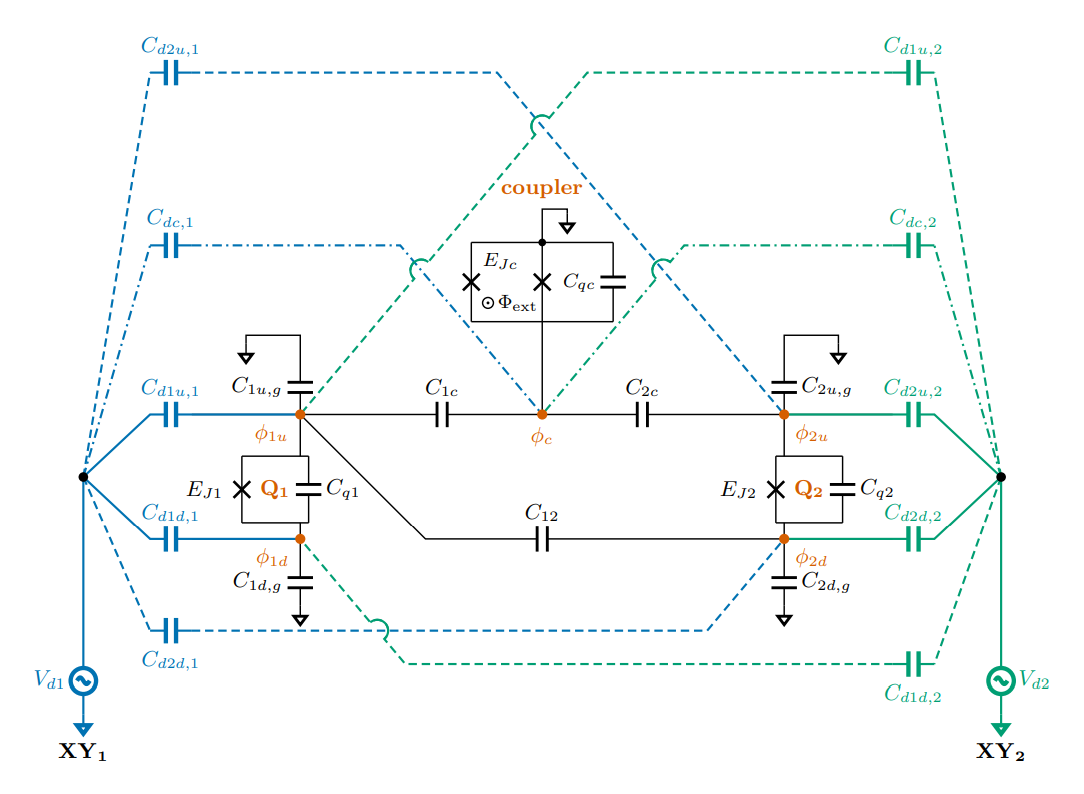
The team fabricated a test chip containing two fixed‑frequency floating transmons (Q1 at 4.752 GHz, Q2 at 4.658 GHz) coupled through a flux‑tunable grounded transmon coupler. By measuring the cross‑Rabi response—how a drive on Q1 affects Q2—they identified a crosstalk‑null point that was offset by roughly 300 MHz from the J_eff = 0 bias point of the coupler. This observation contradicted the prevailing assumption that minimizing exchange interaction automatically minimizes drive crosstalk.
A first‑order high‑frequency expansion of the system Hamiltonian revealed three coherent drive channels reaching the victim qubit:
- Direct capacitive coupling from the drive line to the victim qubit.
- Indirect coupling via stray capacitance to the tunable coupler (C_dc).
- Direct stray capacitance from the drive line to the victim qubit (C_d,victim).
Each channel contributes a complex amplitude to the effective drive on the victim. By adjusting the geometry of the on‑chip wiring, the researchers tuned the magnitudes and phases of Cdc and Cd,victim so that the indirect and direct contributions arrive with opposite phase. When the amplitudes match, the sum cancels (Θ_victim = 0), yielding a complete destructive interference of the unwanted drive.
Practical Advantages of Floating Transmons
The study highlighted a key design benefit of floating transmons over grounded variants. In floating configurations, the frequencies at which crosstalk nulls occur shift together as parasitic capacitances vary, giving designers a broader lithographic margin to align the null with the desired operating point. Grounded transmons, by contrast, exhibit opposite‑direction shifts for the two drive lines, demanding far tighter fabrication tolerances.
Moreover, the tunable coupler possesses bias points where static ZZ interactions vanish. By co‑optimizing the coupler geometry and the parasitic capacitances, the same flux bias can simultaneously suppress both quantum‑level ZZ coupling and classical microwave crosstalk. This dual‑null condition simplifies calibration and reduces the overhead of separate mitigation strategies.
Implications for Scalable Quantum Processors
The ability to engineer crosstalk suppression at the hardware level offers several practical benefits:
- Reduced Calibration Complexity: With the crosstalk null built into the chip layout, fewer software‑level compensation pulses are needed.
- Higher Gate Fidelity: Eliminating stray excitations and AC Stark shifts directly improves single‑qubit gate performance, a critical factor for error‑corrected architectures.
- Design Flexibility: The attofarad‑scale parasitic capacitances (Cdc ≈ 18–30 aF, Cd,victim ≈ 2–10 aF) can be tuned through modest layout adjustments, allowing the approach to be applied across a range of qubit frequencies and coupler designs.
Conclusion
Chalmers University’s demonstration shows that careful engineering of parasitic capacitances provides a robust, hardware‑native method for suppressing microwave drive crosstalk in superconducting quantum processors. By leveraging multi‑path destructive interference rather than relying on exchange‑coupling cancellation, designers gain greater flexibility and tighter control over unwanted interactions. As quantum hardware moves toward larger qubit counts, such layout‑level techniques will become increasingly valuable for maintaining high‑fidelity operation without excessive calibration overhead.
Source
Read original sourceWhy we picked this
Accepted from curated QuantumUnzipped source (relevance scoring disabled).