Chirality of 'trions' illuminates new paths for quantum optics
Trions in single‑walled carbon nanotubes inherit the handedness of excitons, enabling electrical control of circular dichroism.
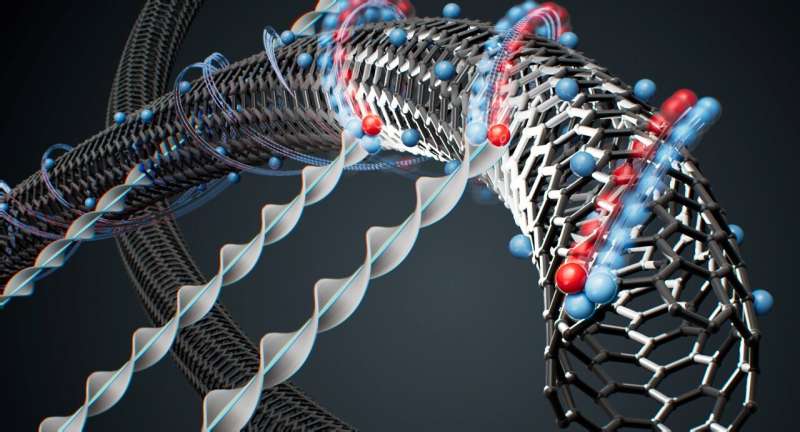
Trions Keep Their Handedness
Charged quasiparticles known as trions—pairs of electrons with an extra hole, or two holes with an extra electron—have been shown to preserve the chirality of the carbon nanotubes they inhabit. A team from Tokyo Metropolitan University generated trions electrochemically in enantiopure single‑walled carbon nanotubes (SWCNTs) and measured their circular dichroism with unprecedented precision. The results, published in Nature Communications (2026), demonstrate that the trions’ optical response mirrors that of the neutral excitons from which they are derived.
Why Chirality Matters
Chirality, or handedness, is a fundamental symmetry property: an object and its mirror image cannot be superimposed. In optics, left‑ and right‑circularly polarized light interact differently with chiral materials, a phenomenon called circular dichroism. SWCNTs can be synthesized with a specific atomic arrangement that gives them a left‑ or right‑handed structure. Excitons—bound electron‑hole pairs—already exhibit chirality‑dependent absorption, making SWCNTs attractive for room‑temperature optoelectronics.
From Excitons to Trions
Adding a charge to an exciton creates a trion, which could be more convenient for device engineering because charges can be injected electrically. The open question was whether this extra charge would disturb the intrinsic chirality. By separating left‑ and right‑handed nanotube samples and using electrochemical gating, the researchers generated trions and recorded their circular dichroism spectra. The spectra showed the same handedness and comparable magnitude as the exciton signals, confirming that the structure‑derived chirality survives the addition of an extra charge.
Implications for Quantum‑Enabled Optics
The ability to electrically toggle the interaction between light’s circular polarization and a material opens several avenues:
- Polarization‑controlled light sources: Trion‑based emitters could be switched on/off with voltage, producing circularly polarized photons on demand.
- Sensitive detectors: Devices that discriminate left‑ versus right‑circular light could benefit from the strong, tunable dichroism of trions.
- Quantum photonics: Preserved chirality at the quasiparticle level may aid schemes that encode quantum information in photon polarization, linking solid‑state platforms with photonic quantum circuits.
Looking Ahead
Future work will explore the dynamics of trion formation, coherence times, and integration with nanophotonic cavities. If trion chirality can be maintained in complex architectures, it could become a building block for next‑generation optoelectronic and quantum‑optical technologies.
--- This article is based on the study “Chiral trions in enantiopure single‑wall carbon nanotubes” (Nature Communications, 2026) and the accompanying press release.
Hype check
RealThe paper provides direct experimental evidence that trions retain the chirality of excitons, matching the headline claim.
- Peer-reviewed paper, or press release only?Paper — Published in Nature Communications
- Error-corrected (logical) qubits, or physical qubits only?Logical / not a qubit claim — Not a qubit‑count claim
- A new milestone, or a rebrand / restatement?New — First demonstration of chiral trions
- Independent confirmation?Unclear — No external replication mentioned
- Does the headline claim match what the source shows?Matches — Headline reflects paper's findings
An editorial assessment of the claim as reported, not a judgment of the company or researchers. Checked against: phys.org. How we rate hype →
Source
Read original sourceWhy we picked this
Accepted from curated QuantumUnzipped source (relevance scoring disabled).