CISOs supplement encryptors with PQC-derived material on key corridors.
CISOs are using external quantum‑safe key sources to protect high‑value network corridors now, reducing exposure while full post‑quantum migration rolls out.
Introduction
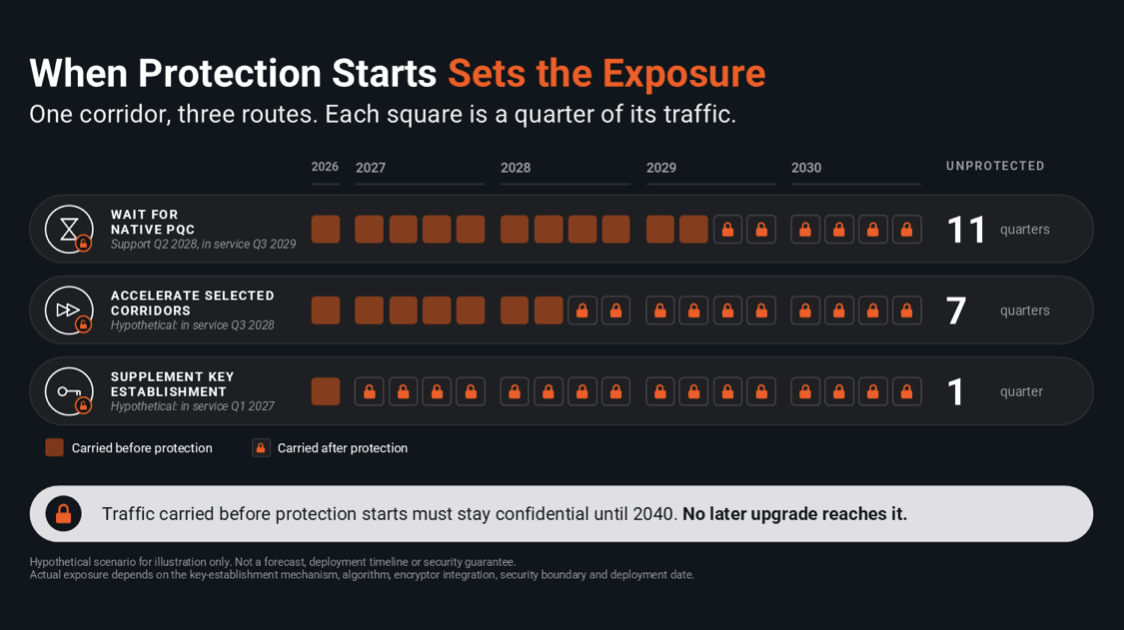
Chief Information Security Officers (CISOs) are bringing quantum‑security concerns to boardrooms earlier than many expected. The driver isn’t an imminent quantum computer breaking today’s TLS, but the long‑lived data that traverses network corridors whose upgrade paths stretch years into the future. When a data flow has a confidentiality lifetime that outlasts a planned cryptographic refresh, the data remains vulnerable to a future "harvest‑now‑decrypt‑later" attack. To shrink that exposure window, organizations are supplementing existing encryptors with external, quantum‑safe key material—often a mix of post‑quantum cryptography (PQC) and quantum key distribution (QKD). This approach protects the most critical traffic now while the broader estate continues its gradual migration to native PQC.
Prioritizing Data Corridors Over Endpoints
Traditional migration strategies focus on replacing or upgrading every encryptor and endpoint to support PQC. In practice, heterogeneous environments, long procurement cycles, and legacy hardware make a network‑wide switch a multi‑year effort. CISOs are instead asking a simpler question: Which network paths carry data that must stay confidential for the longest period? By identifying those high‑value corridors, security teams can apply a targeted mitigation that delivers quantum‑safe keys to existing encryptors without a full hardware overhaul.
Key benefits of this corridor‑centric view include:
- Immediate risk reduction – The exposure calculation only counts data transmitted before protection begins; it does not require predicting when a quantum computer will appear.
- Cost efficiency – Upgrading a single key‑management layer is far cheaper than replacing every encryptor.
- Future‑proof agility – Once an external key path and policy layer are in place, subsequent algorithm or standard changes can be rolled out as policy updates rather than massive infrastructure projects.
External Key Sources: How They Work
Vendors such as IonQ offer platforms (e.g., Clarion KX) that act as a bridge between existing encryptors and quantum‑safe key material. The workflow is straightforward:
- Key generation – A quantum‑random number generator (QRNG) or a PQC algorithm produces fresh key material.
- Key delivery – The material is fed to the encryptor via a supported external‑key interface (e.g., KMIP, custom APIs).
- Session keying – The encryptor incorporates the external key into its normal key‑exchange process, leaving the native protocol untouched.
Because the external source can be buffered locally in a secure enclave, the system tolerates brief feed interruptions. Administrators can configure fail‑open (continue with native keys) or fail‑closed (halt traffic and raise an alert) behavior, aligning the response with business continuity requirements.
Strategic Advantages and Long‑Term Outlook
- Assurance diversity – Combining PQC‑derived keys with QKD‑derived keys reduces reliance on any single cryptographic assumption, offering an extra safety margin for the most sensitive data.
- Phased rollout – Organizations can protect the most critical corridors today while vendor roadmaps and budget cycles catch up for the rest of the network.
- Reduced upgrade friction – As native PQC support becomes common in TLS stacks, operating systems, and network devices, the external‑key layer gradually becomes a performance‑enhancing add‑on rather than a stop‑gap.
The overarching principle is clear: waiting for a complete, network‑wide quantum‑safe upgrade is not a neutral stance. By decoupling the protection of high‑value data flows from the broader migration timeline, CISOs can demonstrate tangible risk mitigation to their boards now, rather than promising a distant future.
Practical Takeaways
- Map data lifetimes – Identify which network corridors handle data with multi‑year confidentiality requirements.
- Validate external‑key compatibility – Check that existing encryptors support an external‑key interface and that the chosen vendor’s solution integrates with current key‑management policies.
- Deploy a pilot – Start with a single high‑risk corridor to evaluate operational impact, fail‑over behavior, and policy management.
- Plan for transition – As native PQC adoption matures, treat the external‑key layer as a stepping stone that can be retired or repurposed for assurance diversity.
By focusing on the flow of data rather than individual assets, CISOs can deliver quantum‑ready protection where it matters most, buying time for the enterprise to complete its full post‑quantum migration without leaving a critical exposure window open.
Source
Read original sourceWhy we picked this
Accepted from curated QuantumUnzipped source (relevance scoring disabled).