Classiq Updates Qmod Compiler to Synthesize 2048-Bit Shor’s Algorithm in Under 10 Seconds
Classiq’s updated Qmod compiler can synthesize the period‑finding part of a 2048‑bit Shor’s algorithm in under ten seconds.
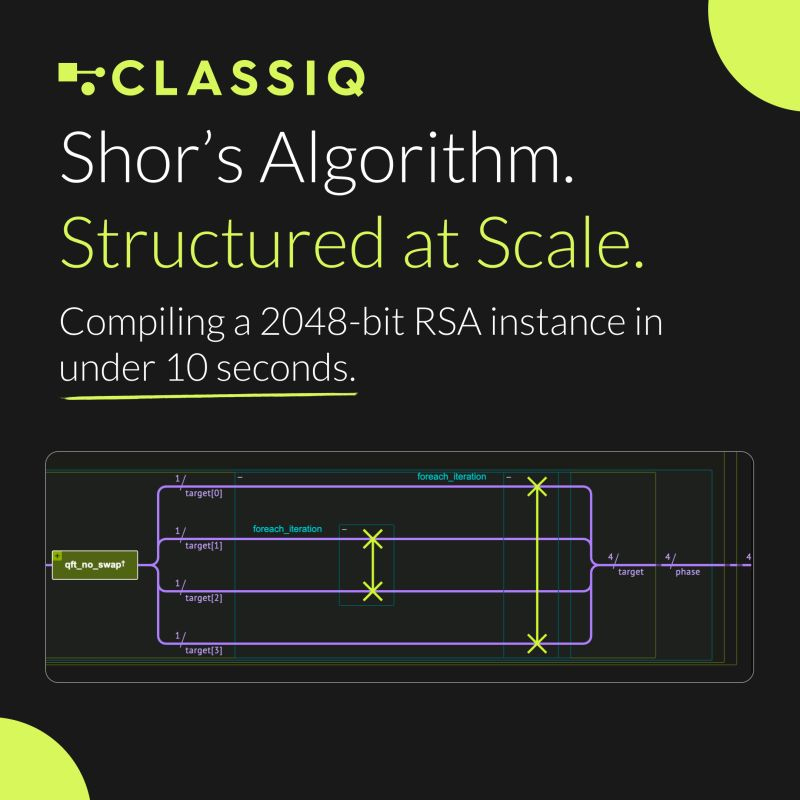
Classiq’s Qmod Compiler Breaks the Shor Synthesis Barrier
Classiq announced a major upgrade to its Qmod quantum programming language and synthesis compiler. The new version can compile the period‑finding sub‑routine of Shor’s algorithm for a 2048‑bit RSA‑scale integer in under ten seconds—a task that previously required minutes or even hours as circuit sizes exploded.
Symbolic Control Flow Keeps Compilation Fast
Traditional fault‑tolerant quantum software tools flatten all classical loops and duplicate sub‑routines, causing synthesis runtimes to grow dramatically with operand width. Classiq’s approach preserves high‑level control structures such as `repeat`, `foreach`, and conditional blocks throughout the compilation pipeline. By allowing classical iteration variables to symbolically index quantum registers, the compiler can treat arithmetic modules, quantum Fourier transforms, and quantum phase‑estimation routines as near‑constant‑time operations regardless of the number of bits involved.
A Single Program for Many Shor Iterations
The updated compiler also treats the coprime base \(a\) as a runtime parameter rather than hard‑coding it. This means a single compiled program can be reused across multiple runs of Shor’s algorithm, further reducing the overhead of generating new circuits for each trial.
Why This Matters for Fault‑Tolerant Computing
Shor’s algorithm is the canonical benchmark for fault‑tolerant quantum computers, but the sheer size of the required circuits has made software tooling a bottleneck. Faster synthesis directly translates into shorter development cycles, more rapid algorithmic exploration, and a clearer path toward practical quantum advantage on future error‑corrected hardware.
Looking Ahead
Classiq’s technical post (linked in the original announcement) provides deeper details on the symbolic indexing and control‑flow preservation techniques. While the claim is not yet backed by a peer‑reviewed paper, the result represents a tangible step forward for quantum software stacks that must scale to cryptographically relevant problem sizes.
--- The article is based on Classiq’s own technical announcement and does not include independent verification.
Hype check
PartlyThe claim is described in a company technical post without peer review or external validation, so the result is promising but not fully verified.
- Peer-reviewed paper, or press release only?Press release only — Only a technical post by Classiq is cited
- Error-corrected (logical) qubits, or physical qubits only?Logical / not a qubit claim — The story is about compilation speed, not qubit counts
- A new milestone, or a rebrand / restatement?New — First reported sub‑10‑second synthesis for 2048‑bit Shor
- Independent confirmation?Not yet — No external confirmation mentioned
- Does the headline claim match what the source shows?Matches — Headline accurately reflects the technical post’s claim
An editorial assessment of the claim as reported, not a judgment of the company or researchers. How we rate hype →
Source
Read original sourceWhy we picked this
Accepted from curated QuantumUnzipped source (relevance scoring disabled).