Computational complexity of Berry phase estimation in topological phases of matter
A new quantum algorithm and complexity classifications reveal Berry phase estimation as BQP‑complete with a guiding state and UQMA∩co‑UQMA‑complete without it.
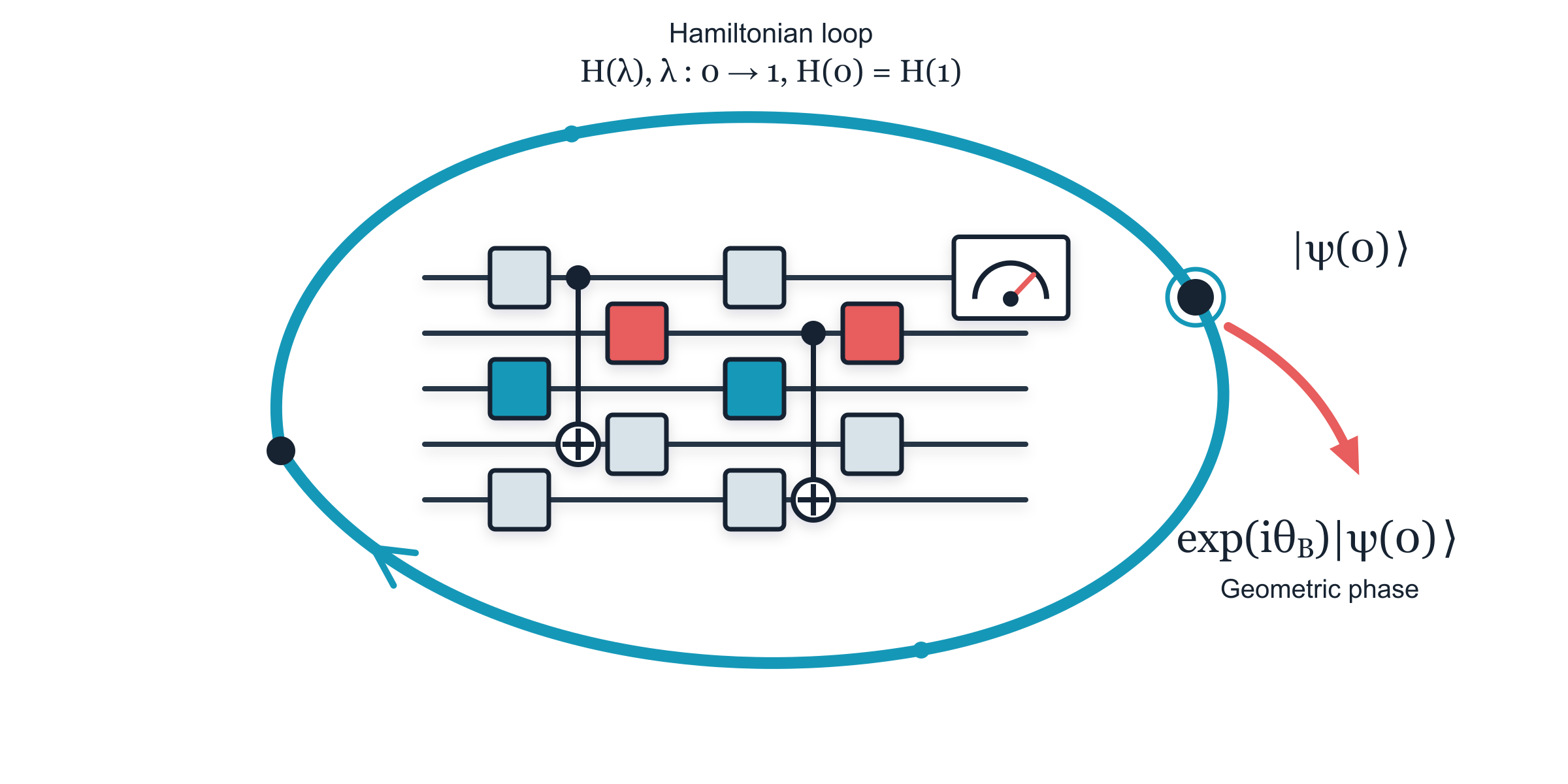
Berry Phase Estimation Meets Quantum Complexity
The Berry phase—a geometric phase acquired by a quantum state undergoing adiabatic evolution—has long been a cornerstone for classifying topological phases of matter. In a recent paper, Hayakawa, Sakamoto, and Kiumi introduce a quantum algorithm that estimates this phase across its full $2\pi$ range and, crucially, place the problem within well‑studied complexity classes.
A General‑Purpose Quantum Algorithm
Previous quantum approaches to Berry‑phase estimation required restrictive assumptions about the Hamiltonian path or the initial state. The authors’ algorithm lifts many of these constraints, delivering a provable guarantee for arbitrary loops in parameter space. The method leverages phase‑estimation techniques combined with a controlled adiabatic evolution, allowing the Berry phase to be extracted modulo $2\pi$ with polynomial overhead.
Complexity Landscape
Two complementary hardness results are established:
- BQP‑completeness with a guiding state – When a quantum state with large overlap with the ground state is supplied, the authors prove that estimating the Berry phase is complete for BQP. This demonstrates a natural setting where a quantum computer can achieve an exponential speed‑up over classical algorithms.
- UQMA ∩ co‑UQMA‑completeness without a guiding state – If only an a‑priori bound on the ground‑state energy is known, the problem becomes complete for the intersection of unique‑witness QMA and its complement. According to the authors, this is the first natural problem identified as complete for this class, highlighting a nuanced boundary between quantum verification and decision problems.
Implications for Topological Matter and Quantum Computing
These results tighten the link between topological physics and computational complexity. By showing that Berry‑phase estimation can be both a practical quantum subroutine and a benchmark for quantum advantage, the work suggests new pathways for using near‑term quantum devices to probe topological invariants. Moreover, the classification of the problem within UQMA ∩ co‑UQMA opens fresh theoretical questions about the power of quantum verification when uniqueness constraints are imposed.
Looking Ahead
While the algorithm is theoretically sound, practical implementation will depend on advances in error‑corrected quantum hardware capable of executing long adiabatic evolutions with high fidelity. Nonetheless, the paper provides a clear roadmap: improve quantum control, supply good guiding states where possible, and leverage the algorithm to explore previously inaccessible topological phenomena.
---
The findings appear in Quantum 10, 2271 (2026) and are available on arXiv (arXiv:2509.13423v4).
Hype check
RealThe paper presents a peer‑reviewed quantum algorithm and provable complexity results, with clear definitions and proofs, matching the headline claim.
- Peer-reviewed paper, or press release only?Paper — Published in Quantum, a peer‑reviewed journal
- Error-corrected (logical) qubits, or physical qubits only?Logical / not a qubit claim — Not a qubit‑count claim
- A new milestone, or a rebrand / restatement?New — First natural UQMA∩co‑UQMA‑complete problem
- Independent confirmation?Not yet — No external replication mentioned
- Does the headline claim match what the source shows?Matches — Headline accurately reflects the paper’s content
An editorial assessment of the claim as reported, not a judgment of the company or researchers. Checked against: doi.org. How we rate hype →
Source
Read original sourceWhy we picked this
Accepted from curated QuantumUnzipped source (relevance scoring disabled).