Cross-Platform Cloud Benchmark Reveals Wide Gap Between Physical Qubit Counts and Entangled GHZ State Sizes
A cross‑platform cloud benchmark shows that current quantum processors generate GHZ states on only a fraction of their physical qubits, revealing a large performance gap.
Introduction
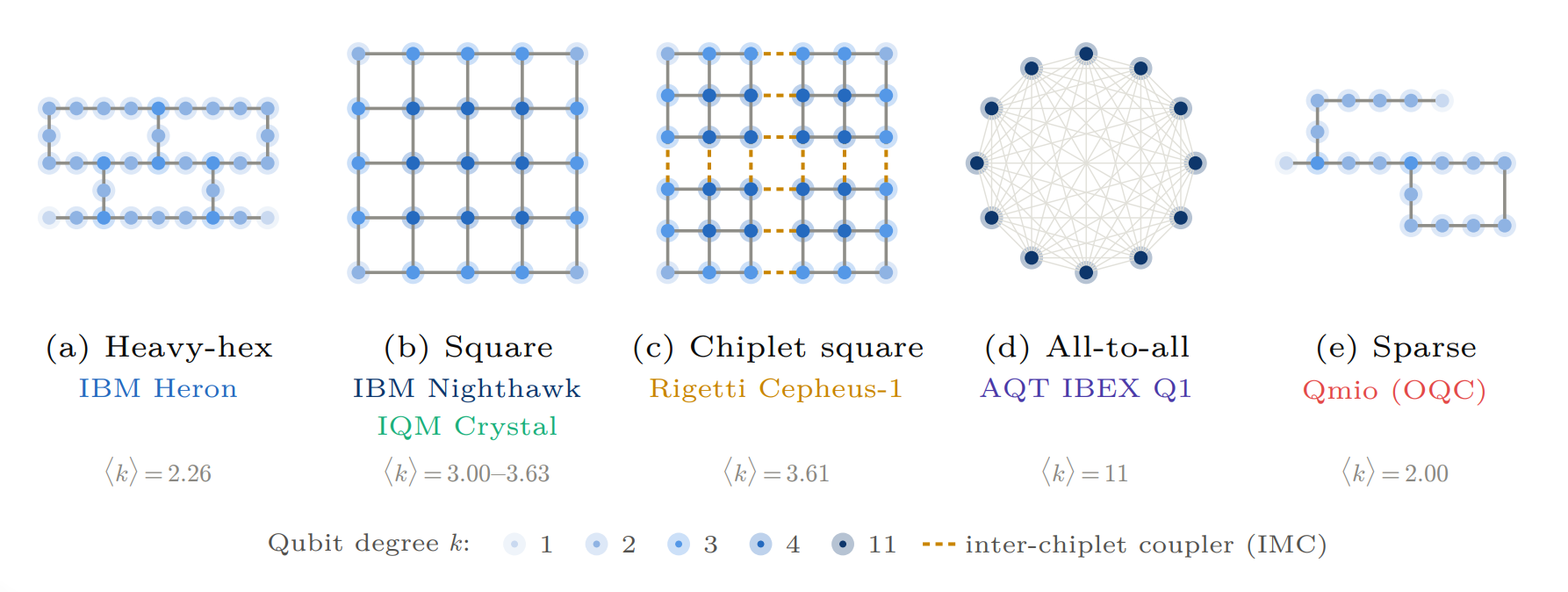
A recent study by a Spanish research consortium evaluated nine publicly accessible quantum processors from five vendors using a standardized GHZ‑state benchmark. Running the tests through ordinary cloud interfaces and without any error‑mitigation techniques, the authors measured how many qubits could be reliably entangled in a single multipartite state. The results highlight a stark disparity between the advertised physical qubit counts and the size of usable entangled registers.
Benchmark methodology
The team implemented the multipartite‑entanglement protocol from the open‑source QuSquare suite. For each circuit size they performed Direct Fidelity Estimation (DFE) on 2,952 randomly sampled stabilizers, applying a decision rule based on the genuine multipartite‑entanglement (GME) threshold (F = 0.5). All experiments were executed on cloud back‑ends via IBM Quantum, Amazon Braket, and the Galicia Supercomputing Center, using default compilation settings and no post‑processing mitigation.
Key findings
| Backend (Architecture) | Physical qubits | Max passing GHZ size (N*) | Register utilization (Y) | Per‑qubit GHZ error | |---|---|---|---|---| | IBM Phoenix (Nighthawk r2) | 120 | 27 (Y = 0.438) | 23% | 3.0% | | IBM Basquecountry (Heron r2) | 156 | 24 (Y = 0.430) | 15% | 3.5% | | IBM Pittsburgh (Heron r3) | 156 | 21 (Y = 0.510) | 13% | 3.2% | | IQM Emerald (Crystal 54) | 54 | 20 (Y = 0.421) | 37% | 4.2% | | IBM Miami (Nighthawk r1) | 120 | 18 (Y = 0.423) | 15% | 4.7% | | IQM Garnet (Crystal 20) | 20 | 13 (Y = 0.437) | 65% | 6.2% | | AQT IBEX Q1 (Trapped‑Ion) | 12 | 12 (Y = 0.711) | 100% | 2.8% | | Rigetti Cepheus‑1 (Chiplet) | 107 | 4 (Y = 0.491) | 4% | 16.3% | | CESGA Qmio / OQC (Coaxmon) | 32 | 3 (Y = 0.513) | 9% | 20.0% |
When the GME certification criterion was tightened (Y − ε ≥ 0.5), only four devices retained a passing record: the two IBM heavy‑hex chips, the trapped‑ion system, and IQM Garnet. The study also found that median calibration metrics (e.g., two‑qubit gate error) were poor predictors of multipartite performance, and that per‑qubit GHZ error rates were roughly an order of magnitude higher than the reported two‑qubit gate errors.
Practical implications
For cloud users, the benchmark underscores that raw qubit counts can be misleading. Even the largest superconducting devices (≈120–156 qubits) reliably entangle fewer than 30 qubits in a GHZ state without mitigation. This gap suggests that software stacks, error‑mitigation strategies, and hardware‑aware compilation will remain essential for scaling quantum applications.
Closing thoughts
The consortium’s open‑access dataset and code provide a valuable baseline for future performance tracking. As hardware improves and mitigation techniques mature, follow‑up benchmarks will be needed to gauge whether the observed gap narrows, ultimately informing realistic expectations for near‑term quantum advantage.
Hype check
RealThe benchmark presents concrete, reproducible GHZ‑state data backed by an arXiv preprint; the headline accurately reflects the observed gap between physical qubits and entangled register sizes.
- Peer-reviewed paper, or press release only?Paper — preprint on arXiv cited
- Error-corrected (logical) qubits, or physical qubits only?Physical only — results concern physical qubits only
- A new milestone, or a rebrand / restatement?Restatement — benchmark, not a new technology claim
- Independent confirmation?Not yet — no external replication mentioned
- Does the headline claim match what the source shows?Matches — headline matches benchmark findings
An editorial assessment of the claim as reported, not a judgment of the company or researchers. How we rate hype →
Source
Read original sourceWhy we picked this
Accepted from curated QuantumUnzipped source (relevance scoring disabled).