CZ and sqrt(iSWAP) gates may resist noise better than SWAP in spin qubits
A new theoretical study shows CZ and √(iSWAP) gates can tolerate correlated low‑frequency noise better than SWAP gates in semiconductor spin qubits.
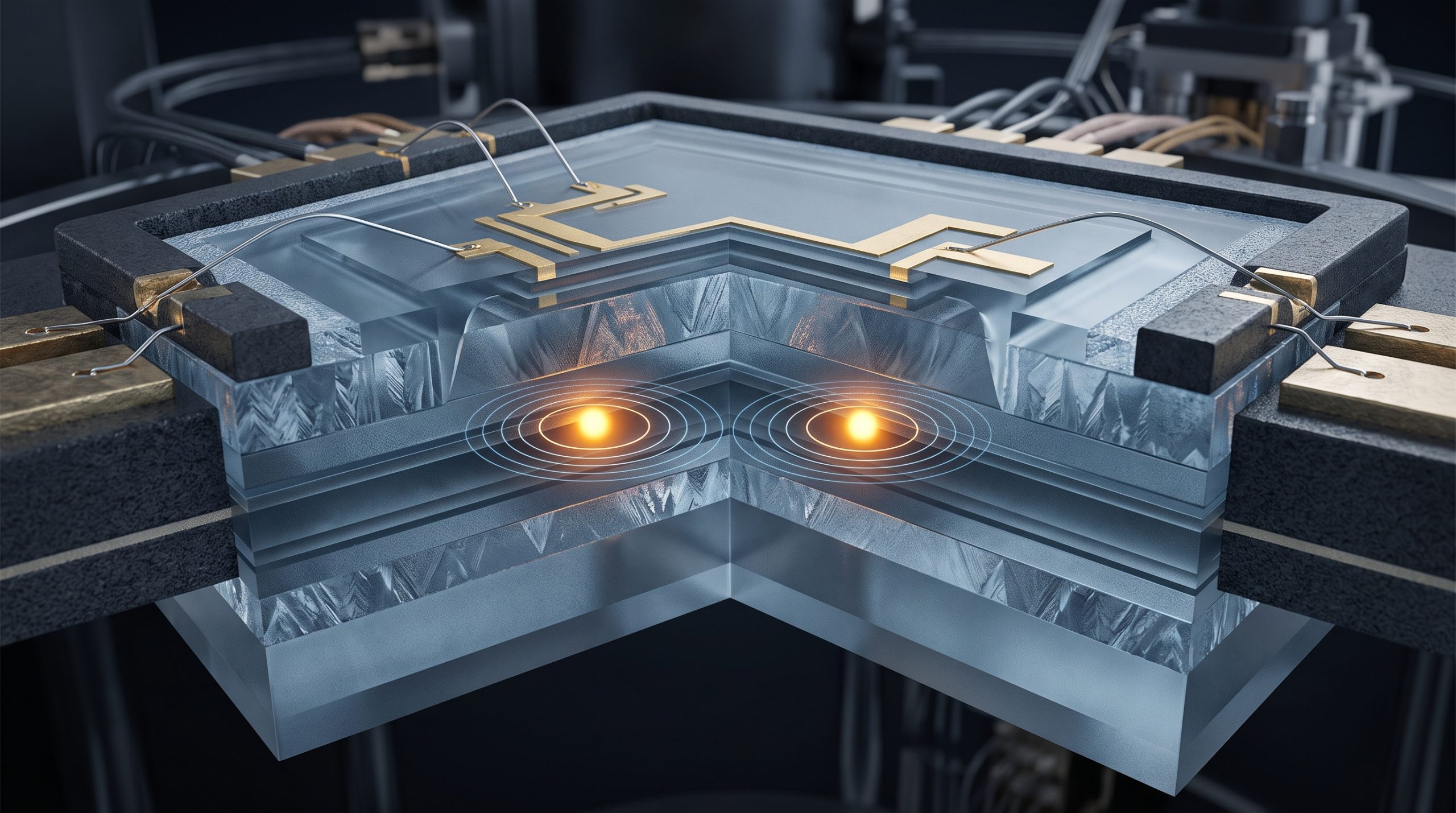
Gate‑Dependent Noise Resilience in Spin Qubits
Semiconductor spin qubits are advancing toward larger, more complex processors, but correlated low‑frequency noise—often described by 1/f or Lorentzian spectra—remains a major obstacle to high‑fidelity multiqubit operations. A recent pre‑print from the University of Basel and collaborators provides a quantitative framework that links the intrinsic dynamics of a two‑qubit gate to its susceptibility to such noise. Their analysis reveals a clear hierarchy: the controlled‑Z (CZ) and the √(iSWAP) gates are markedly more robust than the SWAP gate, making gate choice a “first‑order design decision” for scalable architectures.
Why the Gate Matters
The authors derive a general expression for average gate infidelity that incorporates an effective filter function. This filter captures how the gate’s coherent evolution samples the noise spectrum. For CZ and √(iSWAP) gates, the filter shifts weight away from the low‑frequency region where 1/f and Lorentzian noise dominate, reducing the overlap with the noise power spectral density. By contrast, the SWAP gate’s filter concentrates at zero frequency, exposing it to the full strength of the correlated fluctuations.
Modeling Correlated Noise
Using realistic parameters (exchange coupling J = 1, detuning Δ₁ = 10, gate time τ = π/J, and dephasing time T₂* = 100τ), the study simulates both spatially correlated Lorentzian noise and purely local noise. The results show:
- Interaction‑noise contributions decay faster for CZ and √(iSWAP) than for SWAP, because the former’s filter functions sample frequencies where the Lorentzian spectrum rolls off.
- Under purely local noise, all three gates exhibit similar infidelity, confirming that the advantage is specific to correlated noise.
- The filter‑function analysis predicts a non‑monotonic dependence of interaction‑noise infidelity on the gate’s operating angle, with a minimum at a specific rotation that can be exploited in hardware calibration.
Practical Implications
The work suggests that quantum processor designers should prioritize entangling gates with filter functions that suppress low‑frequency noise. In practice, this could mean:
- Choosing CZ or √(iSWAP) as the native two‑qubit operation for spin‑based platforms, rather than SWAP, when correlated noise dominates.
- Optimizing gate parameters (e.g., detuning, rotation angle) to align filter zeros with the dominant noise frequencies.
- Integrating the filter‑function framework into error‑budget calculations, enabling more accurate predictions of system‑wide fidelity as qubit counts grow.
While the analysis assumes weak system‑environment coupling and minimal control‑error contributions (thanks to pulse shaping and dynamical decoupling), it provides a concrete tool for translating measured noise spectra into quantitative error budgets. This bridges the gap between abstract noise models and the engineering decisions that will shape the next generation of spin‑qubit processors.
Looking Ahead
Future experimental work will be needed to validate the theoretical predictions, especially in devices where correlated noise has been directly characterized. If confirmed, the gate‑selection principle could become a standard part of quantum‑hardware design, complementing other error‑mitigation strategies such as dynamical decoupling and quantum error correction.
--- The analysis discussed here is based on the pre‑print “Resilience of Entangling Gates to Spatiotemporally Correlated Noise” (arXiv:2611.31114v1).
Hype check
PartlyThe paper provides a theoretical model and simulations showing CZ and √(iSWAP) are more resilient, but it is not peer‑reviewed and lacks independent experimental verification.
- Peer-reviewed paper, or press release only?Press release only — Only an arXiv pre‑print is cited
- Error-corrected (logical) qubits, or physical qubits only?Logical / not a qubit claim — The claim does not involve qubit‑count metrics
- A new milestone, or a rebrand / restatement?New — Introduces a novel gate‑dependent noise‑filter framework
- Independent confirmation?Not yet — No external replication or confirmation mentioned
- Does the headline claim match what the source shows?Matches — Headline accurately reflects the paper's conclusion
An editorial assessment of the claim as reported, not a judgment of the company or researchers. How we rate hype →
Source
Read original sourceWhy we picked this
Accepted from curated QuantumUnzipped source (relevance scoring disabled).