DataBrushing.AI Launches UEChain for Data Verification and Trust
DataBrushing.AI’s new UEChain platform leverages PKI, digital certificates and post‑quantum‑ready cryptography to create verifiable, auditable data evidence for enterprises and research institutions.
Introduction
DataBrushing.AI has announced the launch of UEChain, a trusted‑data platform built on public‑key infrastructure (PKI), digital certificates, cryptographic signatures and timestamps. Designed to answer three fundamental questions—who supplied the data, whether it has been altered, and if its authenticity can be independently verified—UEChain aims to turn raw data into auditable evidence that can be trusted across organizational boundaries.
---
How UEChain Establishes a Verifiable Evidence Chain
PKI‑Based Identity and Certificate Authority
UEChain uses X.509 digital certificates and a dedicated Certificate Authority (CA) to bind each data record to a verifiable identity. The platform validates the entire certificate chain, checks expiration dates, and monitors revocation status, ensuring that every piece of evidence can be traced back to a trusted source.
Cryptographic Digests, Signatures and Timestamps
When data is ingested, UEChain creates a cryptographic digest, applies a digital signature and attaches a trusted timestamp. This process preserves the data as immutable evidence without exposing the underlying content. The evidence can later be verified through the platform’s APIs and SDKs, which support both conventional and post‑quantum cryptographic algorithms.
Hardware‑Backed Key Management
Key lifecycle management follows NIST SP 800‑series guidance and is anchored by a root key generated in a witnessed key ceremony. All private‑key operations occur inside FIPS 140‑3 Level 3‑validated hardware security modules (HSMs), providing government‑grade protection for signing and verification activities.
---
Crypto‑Agility and Post‑Quantum Readiness
UEChain is designed with crypto‑agility at its core. In addition to traditional RSA and ECC schemes, the platform supports hybrid and post‑quantum cryptography (PQC) mechanisms, preparing customers for a future where quantum computers could compromise current algorithms. This forward‑looking approach is especially relevant for long‑term evidence preservation, such as bills of materials (xBOMs) for software and firmware, ESG and carbon‑inventory data, and high‑value technical datasets.
---
Cross‑Sector Collaboration and Early Use Cases
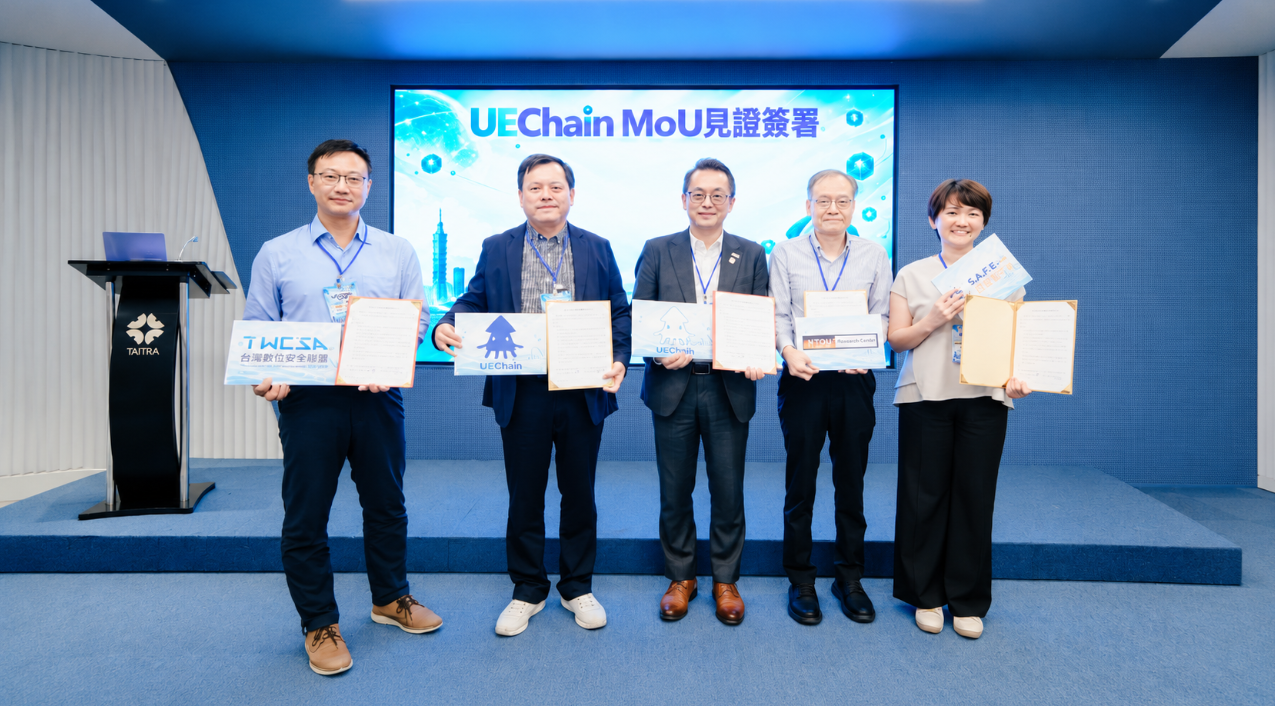
At the launch event, DataBrushing.AI signed memoranda of understanding (MOUs) with four Taiwanese institutions: the Artificial Intelligence Research Center at National Taiwan Ocean University, the School of Big Data Management at Soochow University, the Taiwan Cyber Security Alliance, and the Research Center for Information Security at Asia University. These partnerships will explore applications ranging from marine data sovereignty and big‑data mining protection to AI‑era cyber‑defense evidence preservation.
The event gathered more than 20 representatives from industry, academia, legal and professional bodies, underscoring the broad interest in a standardized, auditable data‑trust framework.
---
Getting Started with UEChain
Organizations interested in data provenance, cross‑institutional verification, or long‑term evidence preservation can register on the UEChain portal. The platform offers RESTful APIs and language‑specific SDKs to integrate certificate verification and evidence management into existing workflows. By adopting UEChain, enterprises and research institutions can embed a cryptographic trust layer into their data pipelines, reducing reliance on ad‑hoc encryption and manual audit processes.
---
Practical Takeaway
UEChain represents a concrete step toward a digital trust ecosystem where data is not only protected but also provably authentic. By combining PKI, robust key management, and post‑quantum‑ready cryptography, DataBrushing.AI provides a scalable solution for organizations that need to demonstrate data integrity and provenance in an increasingly interconnected and AI‑driven world.
Source
Read original sourceWhy we picked this
Accepted from curated QuantumUnzipped source (relevance scoring disabled).