E.ON, Qoro Quantum, and NQCC Scale Constrained Optimization on IBM Heron QPUs via Distributed QAOA and Spatial Packing
E.ON, Qoro Quantum and the NQCC demonstrated a distributed QAOA‑based pipeline that partitions a 1,710‑variable power‑grid optimization problem across IBM Heron QPUs, achieving roughly a three‑fold speedup while preserving solution quality.
Distributed Quantum Optimization for Large‑Scale Power Grids
European utility E.ON, quantum‑software firm Qoro Quantum, and the UK National Quantum Computing Centre (NQCC) have shown how a hybrid quantum‑classical workflow can tackle a realistic, thousand‑qubit‑scale optimization problem on today’s noisy intermediate‑scale quantum (NISQ) hardware. By breaking the Minimum Birkhoff Decomposition (MBD) of the PEGASE‑1354 transmission network into many small sub‑problems and executing them concurrently on IBM’s 156‑qubit Heron processors, the team cut quantum execution time by about 3× without sacrificing the quality of the final solution.
---
1. From a 1,710‑Variable Problem to 41 Sub‑Graphs
The MBD task asks for a sparse combination of matchings that reconstruct a network‑demand matrix—an NP‑hard formulation that underpins grid scheduling, optical routing, and peer‑to‑peer energy trading. Directly mapping the full 1,710‑edge line‑graph onto a single QPU would require one qubit per edge, far beyond any existing device.
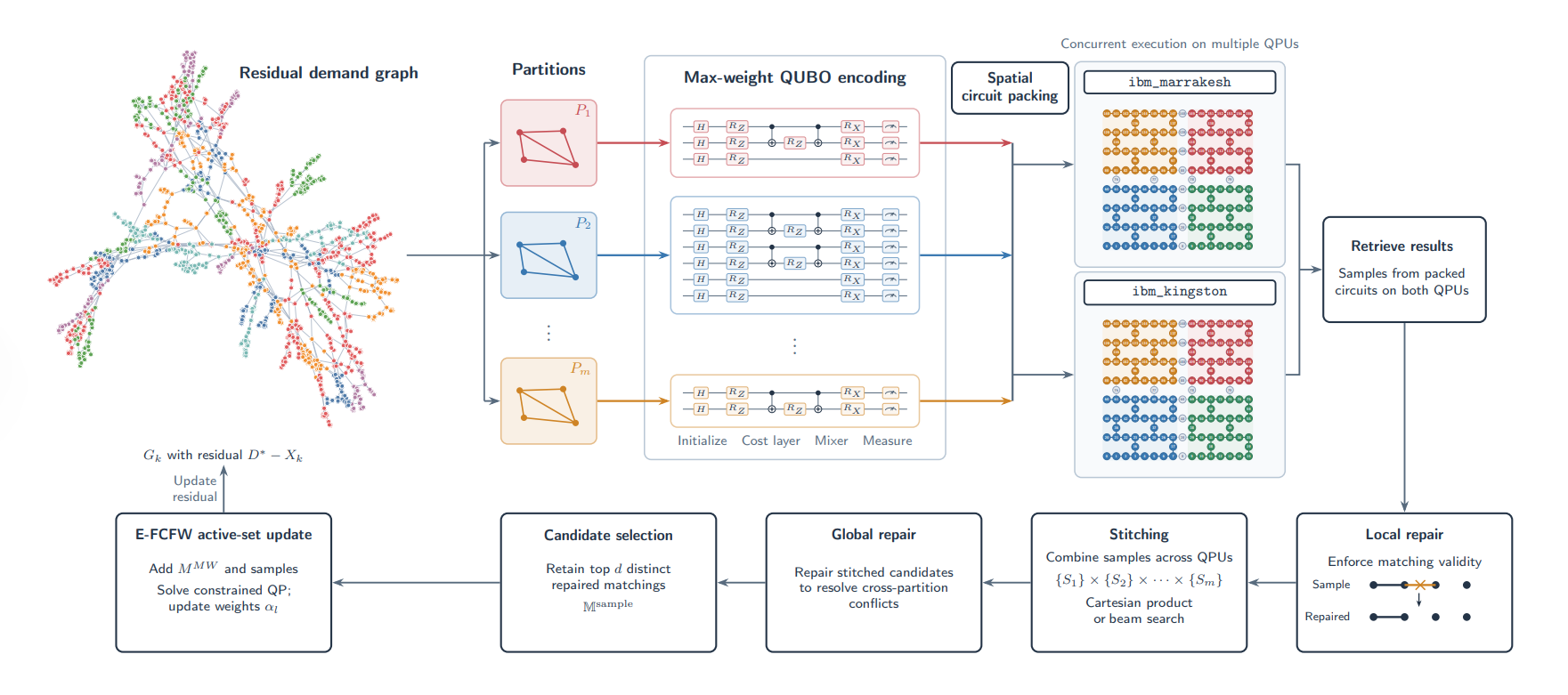
Spectral partitioning was used to split the residual demand graph into 41 sub‑graphs, each limited to ≤ 50 qubits. This bound respects the qubit budget of a single Heron QPU while preserving most local edge connectivity. The partitioning algorithm favours dense clusters, keeping cut edges (those that cross partitions) to a minimum.
---
2. Embedding QAOA in an Extended Frank‑Wolfe Loop
Each sub‑graph is solved with a single‑layer QAOA (p = 1). To avoid costly on‑the‑fly parameter optimisation, the team pre‑calibrated a fixed angle pair (γ₀, β₀) ≈ (2.49, 0.16) using offline simulations. The resulting bitstrings are fed into an Extended Fully‑Corrective Frank‑Wolfe (E‑FCFW) routine, which iteratively expands a classical active set with the quantum samples.
Because the quantum samples are generated independently, the workflow can dispatch four circuits (totaling 144 qubits) onto a single Heron chip via spatial circuit packing. This parallelism reduces the number of submission rounds by up to 4×, translating into the observed three‑fold runtime improvement.
---
3. Stitching, Repair, and Classical Post‑Processing
After sampling, the sub‑problem outputs are combined using a batched Cartesian product. Since the naïve product can produce infeasible matchings (edges sharing a vertex), a greedy repair step runs in O(|E| log |E|) time:
- Sort candidate edges by their residual weight.
- Scan the list, discarding any edge that conflicts with an already‑selected vertex.
- Preserve the matching feasibility required by the MBD formulation.
The repaired solution achieves a residual error of 1.58 × 10⁻⁶ (packed) versus 1.11 × 10⁻⁶ (unpacked), still outperforming classical simulated annealing and uniform random sampling under the same repair logic.
---
4. Insights on Scaling and Quantum Advantage
- Bond dimension matters – Matrix‑product‑state simulations showed that low bond dimensions (χ ≤ 16) degrade sample quality, while χ = 128 tracks hardware performance closely.
- Partition size trade‑off – Sub‑graphs smaller than 20 qubits lose too many cut edges, harming convergence. Partitions of 50–80 qubits retain most of the original problem’s structure.
- Circuit depth bottleneck – Even with modest qubit counts, dense SWAP routing in line‑graph regions pushes two‑qubit depth up to 169, highlighting that width alone does not dictate execution difficulty.
- Pulse‑level tricks omitted – Dynamical decoupling and gate twirling were left out because their added latency outweighed decoherence mitigation on the current hardware.
These observations suggest that distributed QAOA can preserve a quantum edge when partitions are carefully sized and when classical post‑processing respects the problem’s combinatorial constraints.
---
Practical Takeaways
- Hybrid pipelines that embed shallow QAOA inside classical optimisation loops are viable for real‑world, thousand‑variable problems on NISQ devices.
- Spatial packing across a single QPU can effectively emulate multi‑QPU parallelism, simplifying hardware orchestration.
- Pre‑calibrated variational angles eliminate runtime optimisation loops, a crucial step for time‑sensitive industrial workflows.
- Greedy feasibility repair offers a lightweight, scalable method to reconcile independent quantum samples into a globally feasible solution.
The collaboration demonstrates a concrete path for utilities and other infrastructure operators to harness near‑term quantum hardware for large‑scale optimisation, turning the current qubit‑count limitation into a manageable engineering challenge.
Source
Read original sourceWhy we picked this
Accepted from curated QuantumUnzipped source (relevance scoring disabled).