Encoding Fermions to Qubits Now Scales to Any Code Distance
Researchers have shown that fermion‑to‑qubit encodings can now scale to any code distance by embedding low‑distance mappings as topological defects in surface codes, paving the way for more efficient fault‑tolerant quantum simulations.
Encoding Fermions to Qubits Now Scales to Any Code Distance
Quantum computing researchers at IQM Quantum Computers and the Universidad Autónoma de Madrid have announced a breakthrough that removes a long‑standing bottleneck in fermion‑to‑qubit encodings: the ability to scale the code distance arbitrarily without inflating stabilizer weights. Published on Quantum Science and Technology (September 30 2026), the work demonstrates how low‑distance encodings can be embedded directly into the surface code as topological defects, preserving error‑correction performance while expanding the logical qubit’s protection.
Ladder Encodings: A New Family of Scalable Mappings
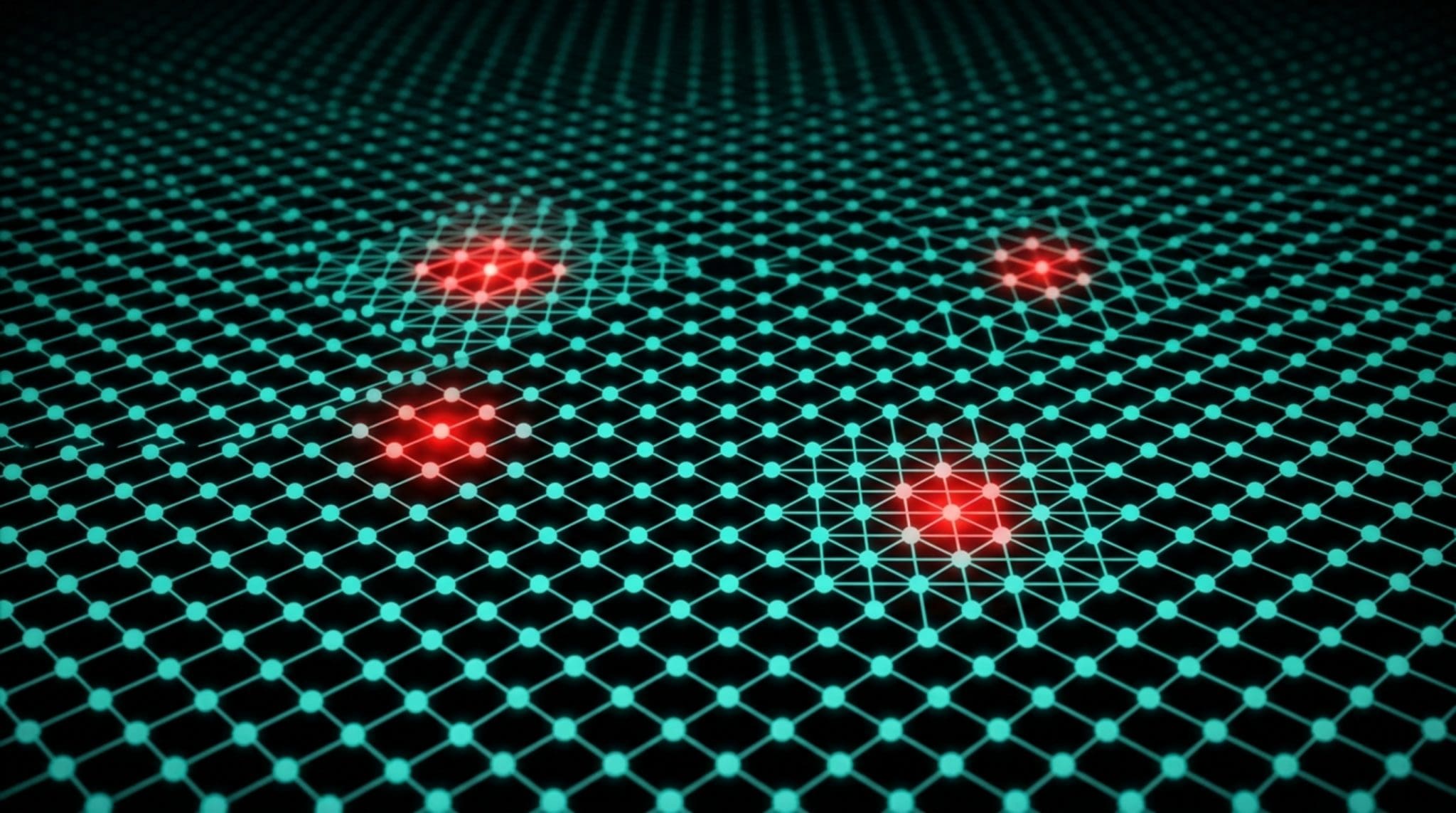
The core of the study is a family of Ladder Encodings that optimally relate the code distance to the weights of operators in a one‑dimensional Fermi‑Hubbard model. By arranging fermionic modes in a ladder‑like structure and mapping them onto a surface‑code lattice, the researchers achieved a direct correspondence: the code distance equals the weight of both density and nearest‑neighbor hopping operators. This precise relationship had been elusive in previous approaches, where increasing distance typically required heavier stabilizers and more complex circuitry.
The ladder construction is not limited to one dimension. The team extended the technique to two‑dimensional systems, embedding the encoding into a 6.6.6 color code as well. This shows that the strategy is compatible with a variety of topological codes, broadening its applicability across different hardware architectures.
Perforated Encodings and Local Mode Pairing
Beyond ladder mappings, the authors introduced Perforated Encodings, a method that locally encodes two fermionic spin modes within the same surface‑code structure. By creating controlled holes—or perforations—in the lattice, they can isolate mode pairs without compromising the overall code distance. This local encoding technique offers a flexible tool for tailoring qubit resources to specific fermionic problems, such as quantum chemistry simulations where spin symmetry plays a crucial role.
Practical Implications for Quantum Hardware
The ability to scale code distance without increasing stabilizer weight is a significant step toward fault‑tolerant quantum computers capable of handling complex calculations. In practice, this means that larger logical qubits can be protected against errors without demanding additional physical qubits or more intricate measurement protocols. For hardware developers, the findings suggest a pathway to design surface‑code lattices that naturally incorporate fermionic encodings, potentially reducing the overhead associated with mapping quantum chemistry Hamiltonians onto qubit hardware.
Looking Ahead
While the paper focuses on theoretical embeddings and proof‑of‑concept demonstrations, the next milestones will involve experimental validation on existing superconducting or trapped‑ion platforms. If successfully implemented, Ladder and Perforated Encodings could become standard components in quantum compilers, enabling more efficient use of qubit resources for fermionic simulations.
---
TL;DR: Researchers have shown that fermion‑to‑qubit encodings can now scale to any code distance by embedding low‑distance mappings as topological defects in surface codes, paving the way for more efficient fault‑tolerant quantum simulations.
Source
Read original sourceWhy we picked this
Describes a scalable fermion-to-qubit mapping with measurable code distance improvements.