EPB and IonQ Deploy Hybrid Trapped-Ion Algorithms on Forte Enterprise to Optimize Power Grid Topology
EPB and IonQ demonstrated hybrid trapped‑ion quantum algorithms that can guide classical solvers to near‑optimal power‑grid reconfigurations, showing measurable speed‑ups on medium‑size distribution networks.
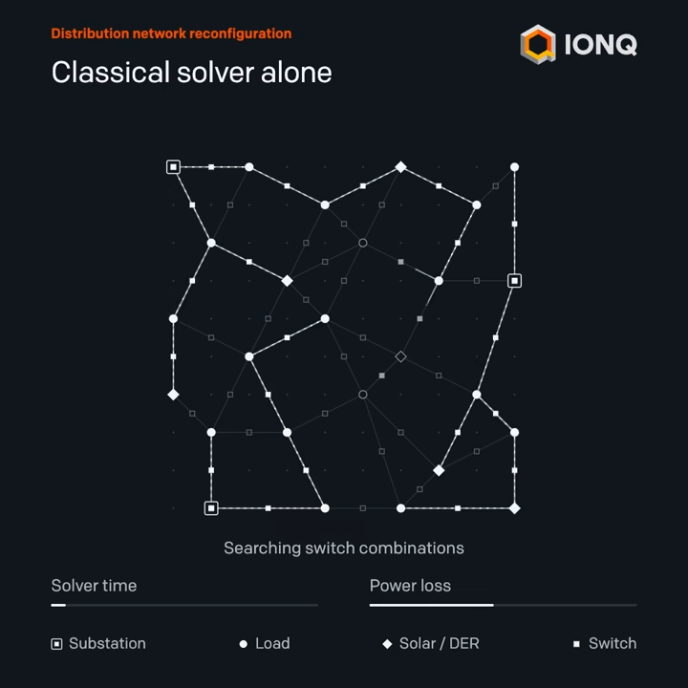
Hybrid Quantum‑Classical Optimization for Power‑Grid Topology
Municipal utility EPB, in partnership with quantum‑hardware provider IonQ, has released a series of preprints describing how trapped‑ion quantum processors can be integrated with classical optimization tools to improve distribution network reconfiguration (DNR). Funded by a $4 million NIST grant, the work was carried out on an on‑premises IonQ Forte Enterprise system located at EPB’s Quantum Center in Chattanooga, Tennessee.
---
Preserving Grid Topology on Quantum Hardware
Traditional quantum approaches to DNR translate the mixed‑integer nonlinear programming problem into a Quadratic Unconstrained Binary Optimization (QUBO) and rely on penalty terms to enforce the radial‑tree structure required for safe operation. Those penalties create artificial energy barriers that can lead to barren plateaus and degrade performance.
The EPB‑IonQ team sidestepped this issue by designing three topology‑preserving encodings that map the radiality constraint directly onto the quantum register:
- Quantum‑Enhanced Deep Reinforcement Learning (Q‑DRL) – a Double DQN architecture augmented with a four‑layer parameterized quantum circuit (PQC). The PQC supplies a compact representation of the switch‑state space, achieving a 95.8 % reduction in trainable parameters on the IEEE 33‑bus test case.
- Subspace LR‑QAOA with Guided MISOCP – a layered QAOA that embeds spanning‑tree constraints into multi‑qubit W‑states, providing high‑quality warm‑starts for a classical mixed‑integer second‑order cone programming (MISOCP) solver.
- Warm‑Start Iterative Quantum Imaginary‑Time Evolution (QITE) – a surrogate‑assisted scheme that iteratively refines binary switch configurations using quantum‑generated expectation values.
---
Experimental Benchmarks
All three methods were evaluated on standard IEEE test feeders ranging from 33 to 417 buses. Key results include:
- Q‑DRL achieved the exact optimal loss (0.1396 MW) on the 33‑bus network and stayed within 0.30 % of optimum on the 69‑bus case.
- LR‑QAOA + MISOCP reduced the median classical Gurobi runtime on a 417‑bus system from 1,415 s to 34.7 s while using only 29 qubits.
- Iterative QITE recovered global minima on six benchmark networks and converged to within 0.2 %–2.18 % of published reference losses on larger systems (up to 415 buses).
These figures illustrate that quantum‑derived variable hints can dramatically cut the time required for classical solvers on medium‑scale grids, though the overall end‑to‑end runtime remains dominated by circuit compilation, shot latency, and classical pre‑/post‑processing.
---
Practical Implications for Utilities
The experiments reveal a clear crossover point: only when the network size exceeds roughly 400 buses does the quantum‑assisted workflow begin to approach parity with pure classical pipelines. For smaller feeders, the overhead of quantum circuit execution outweighs the benefit of improved initial guesses.
From an operational perspective, the work suggests a hybrid deployment model:
- Pre‑processing – use classical heuristics to prune the search space.
- Quantum Hint Generation – run a shallow PQC or QITE iteration to produce high‑quality variable suggestions.
- Classical Refinement – feed the quantum hints into a mature MISOCP or AC power‑flow solver for final optimization.
Such a pipeline could be integrated into existing distribution‑management systems, offering utilities a path to incremental quantum advantage without requiring full‑scale quantum replacement of legacy tools.
---
Looking Ahead
The EPB‑IonQ collaboration demonstrates that trapped‑ion platforms, despite modest qubit counts (up to 36 ions on the Forte Enterprise), can deliver meaningful computational insight for real‑world engineering problems. Future work will likely focus on:
- Scaling the quantum register through modular trap architectures.
- Reducing compilation and readout latency via optimized pulse‑level control.
- Extending the methodology to other grid‑level challenges such as voltage‑regulation and renewable‑integration scheduling.
For utilities interested in exploring quantum‑enhanced grid optimization, the published preprints provide detailed algorithmic specifications and performance metrics that can serve as a starting point for pilot projects.
---
The findings described here are based on the three preprints indexed on arXiv and the accompanying IonQ co‑innovation report. No proprietary data beyond the publicly released results have been used.
Source
Read original sourceWhy we picked this
Accepted from curated QuantumUnzipped source (relevance scoring disabled).