EPFL Demonstrates Millimeter-Wave-to-Optical Transducer with 67% Internal Efficiency
EPFL researchers have built a lithium‑niobate transducer that converts 263 GHz millimeter‑wave signals to 1,561 nm optical photons with 67 % internal efficiency.
EPFL’s Millimeter‑Wave‑to‑Optical Transducer Hits 67 % Internal Efficiency
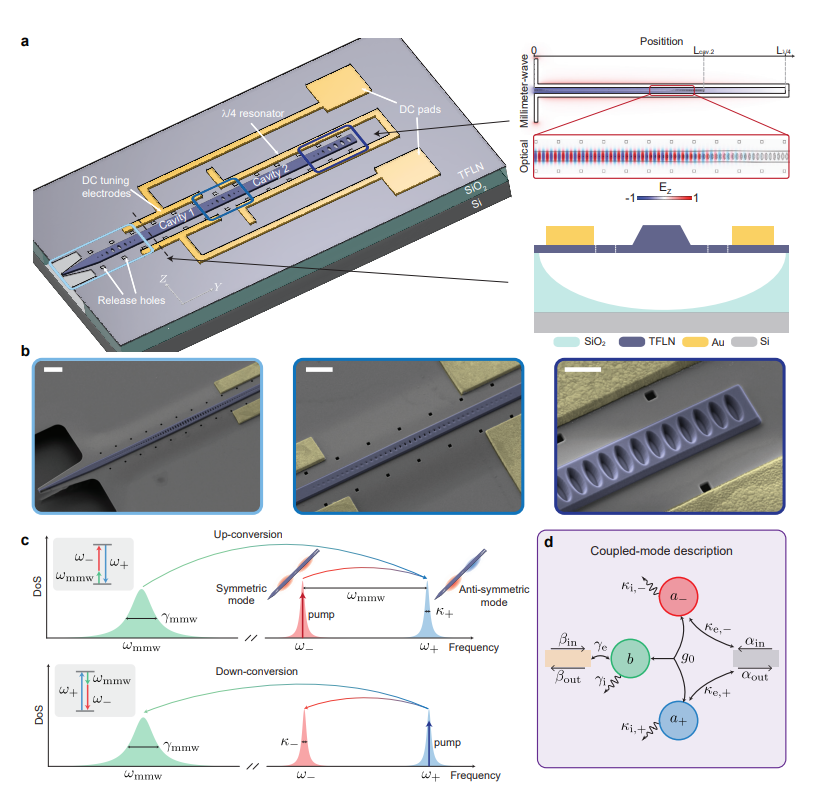
A team at the École Polytechnique Fédérale de Lausanne (EPFL) has demonstrated a compact electro‑optic device that directly links high‑frequency millimeter‑wave signals to telecom‑band light. The integrated transducer, built from thin‑film lithium‑niobate (TFLN) photonic cavities coupled to a sub‑millimeter metallic resonator, achieves an internal photon‑conversion efficiency of 67 %—a notable step toward low‑loss quantum interconnects.
---
Architecture and Key Parameters
The device combines two Fabry–Pérot micro‑cavities etched into a 400 nm TFLN membrane with a quarter‑wave gold resonator (≈165 µm long). The optical cavities (110 µm and 119 µm) provide free‑spectral ranges >650 GHz and quality factors up to 10⁶ (linewidth 186–230 MHz). The millimeter‑wave resonator operates at 263 GHz, matching the frequency of many cryogenic quantum processors and atomic Rydberg transitions.
- Vacuum electro‑optic coupling rate (g₀/2π): ≈ 60 kHz, roughly 60× higher than typical microwave‑domain electro‑optic devices.
- Electro‑optic cooperativity (C): up to 0.27, yielding the reported 67 % internal conversion efficiency.
- Thermal photon detection: 0.21 ± 0.08 photons, enabling sub‑single‑quantum background measurement via optical sidebands.
The design resolves a longstanding mode‑volume mismatch by shrinking the electromagnetic resonator to sub‑millimeter dimensions, allowing strong spatial overlap with the optical fields.
---
Operational Regime and Performance
Because the optical linewidth is two orders of magnitude narrower than the millimeter‑wave dissipation (γₘₘw/2π ≈ 15 GHz), the transducer operates in the reversed dissipation regime (κ ≪ γₘₘw). In this regime, the optical filter isolates the narrow slice of thermal millimeter‑wave photons that fall within its bandwidth, providing an internal standard for cooperativity measurement.
When driven coherently, electro‑optic dynamical back‑action manifests as linewidth modulation: the beam‑splitter up‑conversion interaction broadens the optical resonance, while parametric down‑conversion narrows it. These effects confirm coherent frequency conversion and open pathways to quantum‑limited transduction.
---
Outlook and Challenges
The current off‑chip wireless efficiency is limited by free‑space coupling (≈1.6 × 10⁻⁴). The authors suggest that replacing the gold resonator with a high‑gap superconductor such as NbTiN could suppress internal ohmic loss and raise total transduction efficiency at liquid‑helium temperatures.
If these improvements materialize, the transducer could serve as a low‑noise bridge between cryogenic quantum processors—whether superconducting qubits, neutral‑atom arrays, or Rydberg platforms—and long‑distance optical fiber networks, enabling distributed quantum computing architectures without adding thermal load to the cold stage.
---
Takeaway: EPFL’s integrated lithium‑niobate transducer demonstrates that high‑frequency millimeter‑wave signals can be coherently up‑converted to telecom‑band photons with a respectable 67 % internal efficiency, marking a practical advance toward scalable quantum interconnects.
Hype check
PartlyThe paper reports a 67% internal efficiency in a preprint, but it is not peer‑reviewed and lacks independent verification.
- Peer-reviewed paper, or press release only?Press release only — Result described in a technical preprint, not a peer‑reviewed paper
- Error-corrected (logical) qubits, or physical qubits only?Logical / not a qubit claim — Claim does not involve qubit counts
- A new milestone, or a rebrand / restatement?New — First demonstration of 67% internal efficiency for mm‑wave‑to‑optical conversion
- Independent confirmation?Not yet — No external replication or confirmation mentioned
- Does the headline claim match what the source shows?Matches — Headline accurately reflects the 67% internal efficiency claim
An editorial assessment of the claim as reported, not a judgment of the company or researchers. How we rate hype →
Source
Read original sourceWhy we picked this
Accepted from curated QuantumUnzipped source (relevance scoring disabled).