European XFEL’s Quantum Gas Microscope Observes 3-Component Hubbard System
A team led by Prof. Peter Schauss used a quantum gas microscope to create and image a stable three‑component Hubbard system, revealing Mott insulating behavior and magnetic correlations.
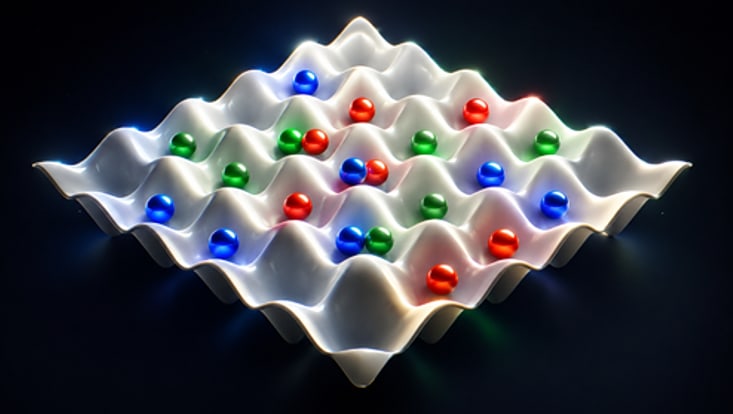
European XFEL’s Quantum Gas Microscope Captures a Three‑Component Hubbard System
Researchers at the University of Hamburg, in collaboration with the Cluster of Excellence CUI: Advanced Imaging of Matter, have achieved the first experimental realization of a three‑flavor Hubbard model using ultracold fermionic atoms. By employing a quantum gas microscope, the team could resolve individual atoms on an optical lattice, tune their interactions, and directly observe a Mott insulating state—an achievement that expands the toolbox for quantum simulation of complex materials and nuclear‑physics analogues.
---
From Two‑Spin Hubbard Models to Three‑Flavor Physics
The Hubbard model is a cornerstone of condensed‑matter theory, describing electrons hopping between lattice sites while experiencing on‑site repulsion. Historically, quantum‑simulation experiments have implemented the model with two internal states of atoms (often called “spin‑up” and “spin‑down”). Adding a third distinguishable state—referred to as a “flavor”—introduces new degrees of freedom that mirror the three colors of quarks in quantum chromodynamics and enable exploration of richer phase diagrams.
In the Hamburg experiment, three hyper‑fine states of fermionic atoms were prepared as separate species. These atoms were loaded into a two‑dimensional optical lattice, where the depth of the lattice controls the tunneling rate, and magnetic‑field‑induced Feshbach resonances provide independent tuning of the interaction strengths between each pair of flavors.
---
Observing the Mott Insulator with Single‑Atom Resolution
A central goal was to detect a Mott state, a phase where strong repulsion suppresses double occupancy of lattice sites, leading to insulating behavior despite a partially filled band. Using the quantum gas microscope, the researchers imaged the occupation of each site and measured the probability of finding two atoms on the same site for all flavor combinations.
“It was particularly important to us to observe a so‑called Mott state, in which the interactions suppress the double occupation of sites,” said Prof. Schauss.
The data showed a marked reduction of double occupancy across the lattice, confirming the emergence of a Mott insulating phase even with three interacting components. Remarkably, the system remained stable against three‑body loss processes, which are often a limiting factor in multi‑component ultracold gases.
“It turned out that the experimental realization is surprisingly stable. Usually, one fears that three‑body collisions could quickly destroy the system,” Schauss noted.
---
Magnetic Correlations Beyond Conventional Models
Beyond the Mott transition, the microscope enabled measurement of spin‑correlation functions between different flavor pairs. The analysis revealed both ferromagnetic and antiferromagnetic correlations emerging in distinct regions of the parameter space, highlighting the interplay of competing interactions that is absent in two‑flavor systems.
These observations provide a concrete platform for testing theoretical predictions about exotic magnetic orders, possible superconducting precursors, and even analogues of quark‑matter phases. By adjusting the relative interaction strengths, researchers can navigate a multi‑dimensional phase diagram that was previously only accessible through numerical simulations.
---
Implications for Quantum Simulation and Materials Science
The successful implementation of a three‑component Hubbard model opens several research avenues:
- Benchmarking many‑body theories – Exact experimental data on multi‑flavor correlations can validate advanced numerical methods such as tensor‑network approaches and quantum Monte Carlo algorithms.
- Simulating nuclear‑physics phenomena – The three‑flavor setup mimics the color degree of freedom in quarks, offering a tabletop analogue for studying confinement and related effects.
- Exploring routes to high‑temperature superconductivity – Since Mott insulators often sit adjacent to superconducting phases, the added flavor dimension may reveal new pairing mechanisms.
The work demonstrates that quantum gas microscopy, originally developed for two‑component systems, can be scaled to more complex Hamiltonians without prohibitive loss rates, reinforcing its role as a versatile quantum‑simulation platform.
---
Looking Ahead
Future experiments will likely probe dynamical phenomena such as quenches across the Mott transition, transport in the presence of synthetic gauge fields, and the impact of disorder on three‑flavor ordering. Combining the microscope with programmable optical potentials could further tailor lattice geometries, enabling studies of frustration and topological phases.
The Hamburg team’s achievement marks a significant step toward emulating the full richness of strongly correlated electron systems and paves the way for quantum‑engineered insights into materials that have long eluded conventional theoretical approaches.
---
For more details, see the original Science publication and the University of Hamburg press release.
Source
Read original sourceWhy we picked this
Accepted from curated QuantumUnzipped source (relevance scoring disabled).