Festival season finds Quantum Software Lab in high spirits
The Quantum Software Lab’s thriving community and its partnership with the National Quantum Computing Centre have turned the Quantum Fringe festival into a vibrant showcase of collaborative research, education, and industry engagement.
Festival season finds Quantum Software Lab in high spirits
The third anniversary of Edinburgh’s Quantum Software Lab (QSL) coincided with a bustling Quantum Fringe festival, highlighting the lab’s rapid growth, its strategic partnership with the UK’s National Quantum Computing Centre (NQCC), and a series of collaborative events that brought together researchers, industry, and students.
A festival of collaboration
Modeled on Edinburgh’s famous Fringe, the Quantum Fringe offered 16 diverse events that emphasized inclusivity across the quantum ecosystem. Workshops such as the Integrated Quantum Networks (IQN) two‑day session explored authentication needs for future quantum communications, while the QCi3‑hosted workshop connected academics with defence‑sector experts to discuss integration challenges. The TartanQEC workshop, co‑organized by the Universities of Edinburgh and Strathclyde, attracted over 120 participants to discuss practical quantum error‑correction methods, featuring a keynote on superconducting qubit error‑correction schemes.
Building the ecosystem
Beyond technical sessions, the festival fostered start‑up engagement. A hardware‑vendor workshop addressed scalable verification and benchmarking frameworks, and legal counsel from Simmons + Simmons clarified intellectual‑property protection for emerging firms. The regular AIMday brought together companies of all sizes with academics to tackle real‑world problems, such as using quantum optimisation to design a multi‑hub logistics network for the UK.
Educational outreach was also a cornerstone. A three‑day summer school introduced high‑school students to quantum‑computing fundamentals and hands‑on coding, while a week‑long program on the Isle of Skye offered postgraduate researchers an intensive dive into quantum informatics. The festival’s cultural side featured “Quantum Worlds,” a music‑and‑poetry performance that translated concepts like superposition and entanglement into an accessible artistic experience.
Research momentum and the QATCH programme
Since its launch in 2023, QSL has expanded from roughly 15 to nearly 100 researchers covering theory, algorithms, and software development. The partnership with NQCC provides direct access to seven test‑bed platforms spanning major qubit modalities, enabling software teams to experiment on real hardware and uncover practical bottlenecks.
Examples of this synergy include:
- A PhD project using quantum machine learning on a neutral‑atom platform from Infleqtion, where hardware timing insights helped reduce noise through recompilation.
- A photonic‑sampling effort led by Leo Monbroussou, collaborating with ORCA Computing and Aegiq to align software approaches with differing photonic architectures.
These collaborations underpin the newly announced QATCH (Quantum Advantage TurboCHarger) initiative, a £20 million UK‑government‑funded programme that will extend four years of cross‑platform benchmarking, optimisation, and ambitious experiment design.
Community impact and looking ahead
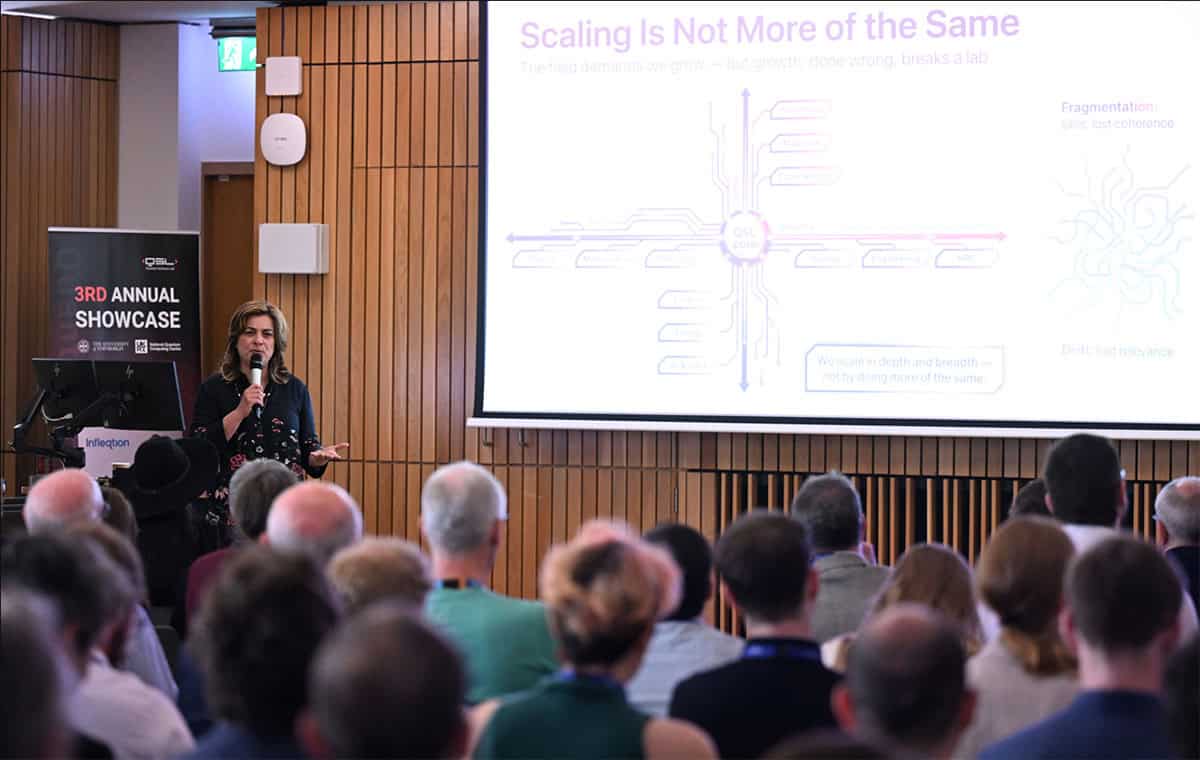
Around 170 participants attended QSL’s third annual showcase, reflecting the lab’s role as a hub for the broader quantum community. Director Elham Kashefi emphasizes that while hardware often dominates headlines, the real value lies in software that can deliver trustworthy answers—a perspective that drives QSL’s mission.
The festival’s success demonstrates how a vibrant, inclusive event can accelerate knowledge exchange, nurture talent, and strengthen industry ties. As QSL moves forward with QATCH and continues to host interdisciplinary gatherings, the quantum ecosystem in Edinburgh—and beyond—appears poised for sustained growth and innovation.
--- The article is based on the supplied editorial brief and does not contain invented quotations or external references.
Source
Read original sourceWhy we picked this
Accepted from curated QuantumUnzipped source (relevance scoring disabled).