Germany’s Quint Raises 9.1 Million Euros to Develop Quantum Chips With Fewer Errors
German quantum startup Quint secured €9.1 million to develop superconducting chips that cut error rates and lower the cost of fault‑tolerant quantum computing.
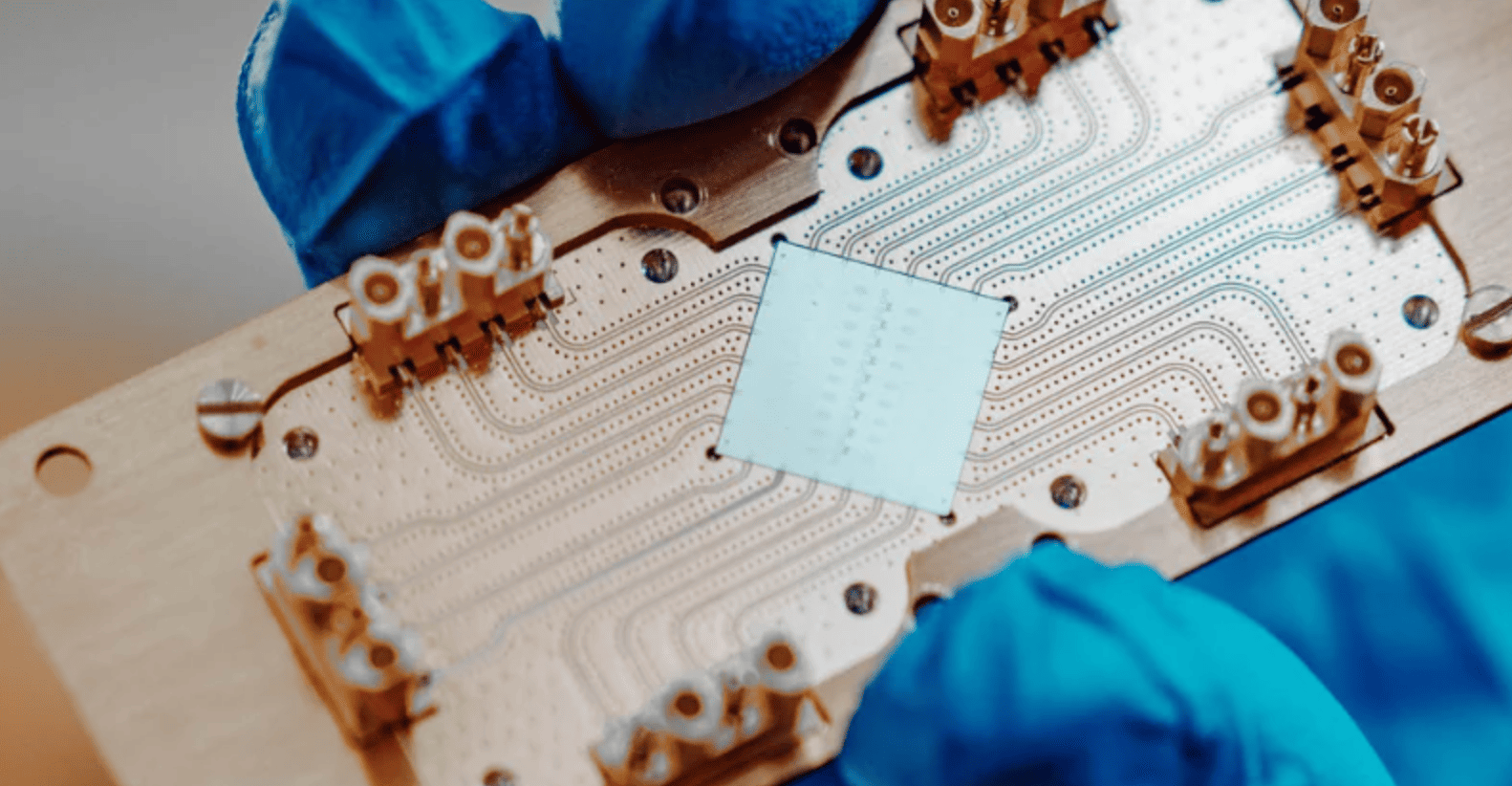
Quint’s €9.1 M Funding Pushes Error‑Reduced Quantum Chips Forward
German quantum‑computing spin‑out Quint has closed a €9.1 million seed round, led by Munich‑based Vsquared Ventures with participation from Quantonation, Nucleus Capital and industry experts such as IQM co‑founder Mikko Möttönen. The capital, complemented by a €2 million EU grant, will fund the refinement of Quint’s patented superconducting chip architecture and the transition to contract manufacturing.
Tackling the Error‑Correction Bottleneck
Current superconducting quantum processors rely on large numbers of physical qubits to encode logical qubits, because each qubit is prone to decoherence and control errors. Error‑correction codes therefore dominate the hardware budget, inflating the qubit count needed for useful calculations. Quint’s approach seeks to suppress a substantial share of those errors at the circuit level. By co‑designing the physical layout of the qubit, its wiring, and the control‑pulse signals, the company claims to achieve a more stable operating point that reduces the frequency of error events.
Co‑founder Michael Hartmann explains that the architecture “aligns the component geometry with the electrical control so that the system is intrinsically less sensitive to noise.” Investors such as Maximilian Schwarz (Nucleus Capital) see this as a potential shortcut to fault‑tolerant quantum computers, lowering the hardware overhead that currently makes large‑scale quantum advantage expensive.
From Lab to Fab: A European‑Centric Roadmap
Quint emerged from Friedrich‑Alexander University Erlangen‑Nürnberg, where Hartmann and Christopher Eichler spent years developing the chip concept. The founders deliberately based the company in Munich to stay close to industrial customers in chemistry and pharmaceuticals—sectors where quantum simulation promises early economic impact. Potential partners mentioned include BASF and Bayer, which are actively exploring quantum‑enhanced molecular modelling.
The startup plans to outsource production to established contract manufacturers, a model reminiscent of NVIDIA’s design‑first, fab‑later strategy. This decision allows Quint to focus on circuit innovation while leveraging existing foundry expertise for scaling. However, as investor Ion Hauer cautions, “a patent on a better circuit is not yet a chip that works in large quantities.” Demonstrating that the error‑reduction advantage persists when the architecture is replicated across hundreds of qubits will be a decisive milestone.
Competitive Landscape and Outlook
Quint enters a field dominated by deep‑pocket players such as Google, IBM and European rivals like IQM. Those companies invest billions in superconducting hardware and software stacks, but many still rely on conventional qubit designs that demand extensive error correction. If Quint’s chips can deliver a measurable reduction in logical error rates without sacrificing coherence time, they could carve out a niche for cost‑effective, near‑term quantum processors.
The next 12‑18 months will test the company’s ability to move from prototype to production‑ready silicon. Success would not only validate the error‑suppression concept but also position Quint as a compelling European investment in a market where early‑stage funding is scarce. For now, the €9.1 million raise signals strong confidence from the venture community that engineering‑focused innovations—rather than raw qubit counts—may be the key to unlocking practical quantum advantage.
--- Quint’s journey underscores a broader shift in quantum hardware: moving from sheer scale toward smarter, error‑aware design. As the ecosystem matures, startups that can bridge the gap between physics breakthroughs and manufacturable chips will likely shape the next wave of quantum computing.
Source
Read original sourceWhy we picked this
Accepted from curated QuantumUnzipped source (relevance scoring disabled).