Hardware-Efficient Entanglement Distillation Using Bosonic Systems
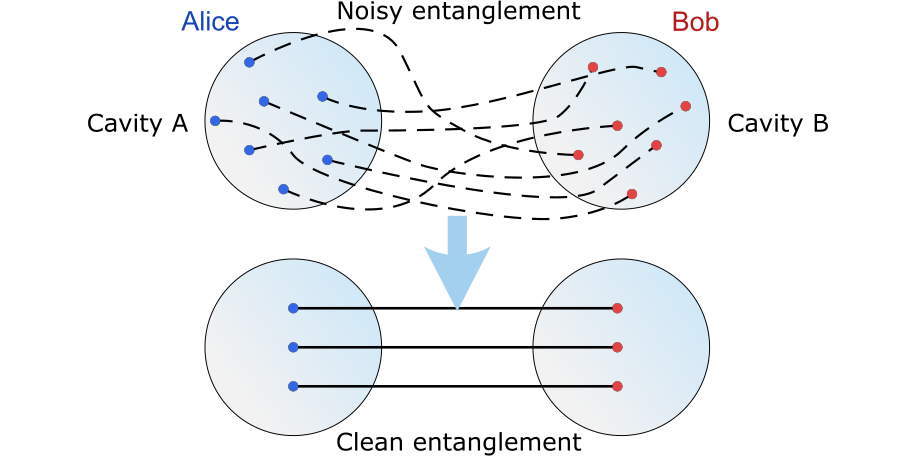
A new protocol uses the high-dimensional space of two bosonic cavities to distill entanglement more efficiently than multi‑qubit approaches.
Introduction
Entanglement is the cornerstone of quantum networks, enabling secure communication and distributed computation. Traditional entanglement‑distillation schemes require many noisy Bell pairs, inflating hardware demands and error‑correction overhead. Jacoby, Arnon‑Friedman, and Rosenblum propose a hardware‑efficient alternative that leverages the large Hilbert space of a single pair of bosonic systems—such as superconducting microwave cavities—to store and purify entanglement.
Bosonic Platforms as Entanglement Reservoirs
Bosonic modes possess a ladder of energy levels, allowing a single physical system to encode far more quantum information than a two‑level qubit. By preparing two cavities in a noisy, high‑dimensional entangled state, the authors exploit this richness to hold a substantial amount of entanglement without replicating many physical qubits. The protocol operates entirely with local bosonic operations—displacements, squeezes, and photon‑number‑selective measurements—followed by classical communication between the parties.
The Distillation Protocol
The core of the method is a tailored entanglement‑distillation routine:
- State Preparation – Two cavities share a noisy entangled state across multiple Fock levels.
- Local Filtering – Each side applies a sequence of Gaussian and non‑Gaussian operations that probabilistically project the joint state onto a lower‑dimensional subspace with higher fidelity.
- Classical Coordination – Measurement outcomes are exchanged, and conditional corrections are applied to align the remaining modes.
- Output Extraction – The result is a smaller set of high‑fidelity Bell‑like states encoded in a few selected energy levels.
Through analytical bounds and numerical simulations, the authors demonstrate that the protocol significantly mitigates photon‑loss and dephasing errors common in cavity QED systems. Compared with conventional multi‑pair distillation, the bosonic approach reduces the required physical resources by orders of magnitude while achieving comparable or better final fidelities.
Practical Implications for Quantum Networks
By replacing dozens of qubits with just two cavities, the scheme offers a clear path toward scalable quantum repeaters and modular quantum processors. The reduced hardware footprint eases cryogenic integration, simplifies control wiring, and aligns with existing superconducting‑circuit architectures. Moreover, the protocol is compatible with established bosonic error‑correcting codes (cat, binomial, and grid states), suggesting a seamless transition from error correction to entanglement purification within the same hardware stack.
Conclusion
The paper presents a compelling, hardware‑efficient route to entanglement distillation that could accelerate the deployment of long‑distance quantum communication. Its reliance on well‑understood bosonic operations makes experimental implementation realistic, and the theoretical performance gains merit further experimental validation.
Hype check
RealThe paper reports a concrete, peer‑reviewed protocol with analytical and numerical evidence; the claim matches the presented results and no external confirmation is required for a theoretical contribution.
- Peer-reviewed paper, or press release only?Paper — Published in Quantum, DOI link provided
- Error-corrected (logical) qubits, or physical qubits only?Logical / not a qubit claim — Not a qubit‑count claim; focuses on bosonic modes
- A new milestone, or a rebrand / restatement?New — Introduces a novel entanglement‑distillation protocol
- Independent confirmation?Not yet — No external replication mentioned in the input
- Does the headline claim match what the source shows?Matches — Headline accurately reflects the paper’s content
An editorial assessment of the claim as reported, not a judgment of the company or researchers. Checked against: doi.org. How we rate hype →
Source
Read original sourceWhy we picked this
Accepted from curated QuantumUnzipped source (relevance scoring disabled).