Harvard, QuEra, and Caltech Design Single-Shot Magic State Factories for Quantum LDPC Codes with 10–40x Lower Overhead
Harvard, QuEra, and Caltech propose a single‑shot magic‑state factory for qLDPC codes that cuts space‑time overhead by roughly 10–40× versus surface‑code methods.
Single‑Shot Magic‑State Factories for qLDPC Codes
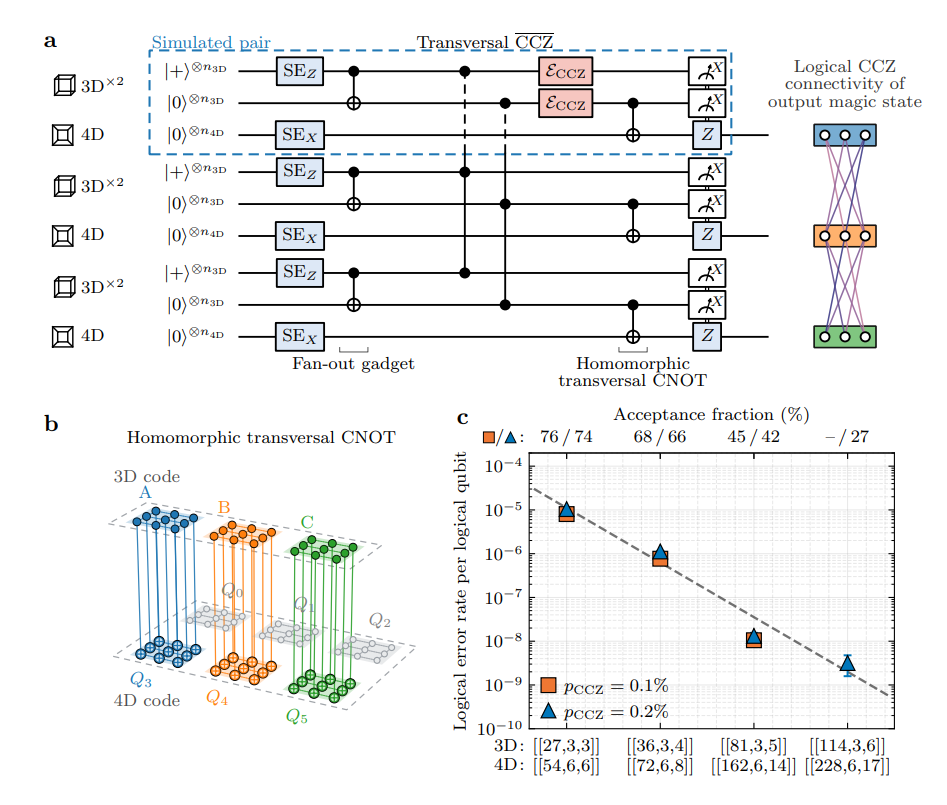
Researchers from Harvard, QuEra Computing, Caltech, the University of Maryland, and MIT have unveiled a new fault‑tolerant architecture for generating non‑Clifford magic states. By pairing three‑dimensional balanced‑product tricycle codes with four‑dimensional balanced‑product quadcycle codes, the design achieves single‑shot preparation of \(|CCZ\rangle\) states while dramatically reducing the required space‑time resources.
How the Architecture Works
- Tricycle‑Quadcycle Pairing – The three‑dimensional tricycle codes produce parallel magic states via transversal controlled‑controlled‑Z (CCZ) gates. These are then teleported into matching quadcycle blocks, which provide constant‑depth error correction thanks to redundant metachecks in both Pauli bases.
- Single‑Shot Execution – A distance‑2 repetition fan‑out gadget implements the transversal CCZ in a single Rydberg pulse, followed by a depth‑1 homomorphic CNOT that moves the nine‑qubit hypergraph magic state into the quadcycle memory.
- Error Suppression – Post‑selection using transversal X measurements on the tricycle blocks pushes logical error rates down to ~10⁻⁹ when the physical error rate is 10⁻³.
Performance Compared to Surface‑Code Approaches
| Protocol | Fault Distance | Output State | Error Rate | Space‑Time Volume (relative) | |---|---|---|---|---| | 3D‑4D qLDPC Factory (f=3) | 2 | \(|CCZ\rangle\) in [[54,6,6]] | 1.2×10⁻⁵ | 4.3×10³ | | Surface/Color Cultivation (f=3) | – | \(|T\rangle\) | 1.2×10⁻⁵ | 80.4×10³ / 162.8×10³ | | 3D‑4D qLDPC Factory (f=4) | 2 | \(|CCZ\rangle\) in [[72,6,8]] | 1.2×10⁻⁶ | 8.6×10³ | | Surface Code Cultivation (f=5) | – | \(|T\rangle\) | 1.2×10⁻⁶ | 83.8×10³ | | 3D‑4D qLDPC Factory (f=5) | 2 | \(|CCZ\rangle\) in [[162,6,14]] | 1.6×10⁻⁸ | 6.7×10⁴ | | Color Code Cultivation (f=5) | – | \(|T\rangle\) | 1.6×10⁻⁸ | 228.6×10⁴ |
The qLDPC factories achieve 10×–40× lower space‑time volume than the best surface‑ or color‑code alternatives for comparable error rates, fulfilling the headline claim.
Mapping to Neutral‑Atom Hardware
The authors demonstrate that the quasi‑cyclic structure of the tricycle‑quadcycle pair aligns naturally with reconfigurable neutral‑atom arrays. Uniform atom shuttling, overlaid CNOT teleportation, and constant‑depth Clifford feed‑forward can be executed within 33 array‑traversal steps, suggesting a realistic path to experimental implementation.
What This Means for Fault‑Tolerant Quantum Computing
Reducing magic‑state overhead is a critical bottleneck for large‑scale, fault‑tolerant algorithms. By delivering two high‑fidelity \(|CCZ\rangle\) states per factory cycle with dramatically fewer physical resources, the proposed architecture could shrink the qubit count needed for practical quantum advantage, especially for algorithms that rely heavily on non‑Clifford gates.
---
The findings are detailed in an arXiv pre‑print linked in the original report.
Hype check
PartlyThe paper presents a concrete architecture with benchmarked overhead reductions, but no independent verification or experimental demonstration is provided yet.
- Peer-reviewed paper, or press release only?Paper — arXiv pre‑print referenced in the article
- Error-corrected (logical) qubits, or physical qubits only?Logical / not a qubit claim — claim is about magic‑state factories, not qubit counts
- A new milestone, or a rebrand / restatement?New — introduces a novel single‑shot qLDPC factory with 10–40× lower overhead
- Independent confirmation?Not yet — no external replication or third‑party confirmation mentioned
- Does the headline claim match what the source shows?Matches — headline’s 10–40× reduction matches the performance table
An editorial assessment of the claim as reported, not a judgment of the company or researchers. How we rate hype →
Source
Read original sourceWhy we picked this
Accepted from curated QuantumUnzipped source (relevance scoring disabled).