Heat drives electron orbital currents, revealing first experimental evidence of orbital Nernst effect
National Taiwan University researchers have experimentally demonstrated the orbital Nernst effect, showing that heat can generate transverse orbital angular momentum currents.
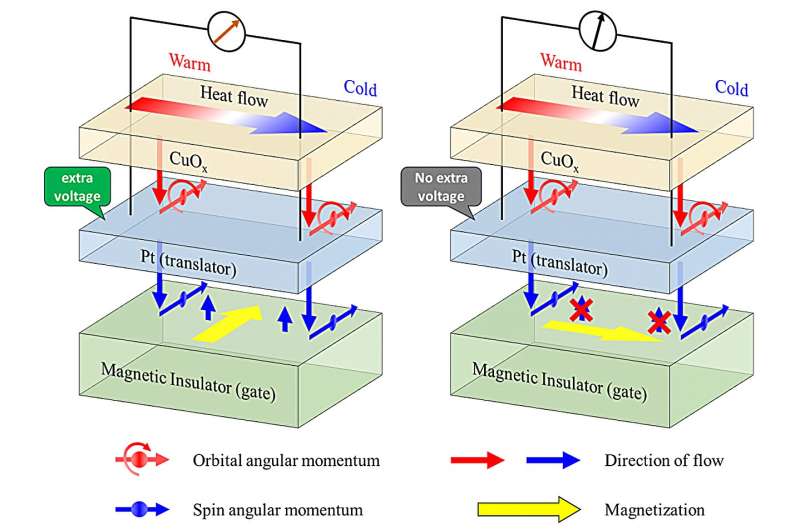
Heat‑driven orbital currents: First experimental evidence of the orbital Nernst effect
A team at National Taiwan University (NTU) has reported the inaugural experimental observation of the orbital Nernst effect—a thermal analogue of the orbital Hall effect—in a paper published in Nature Communications (2026). The work demonstrates that a temperature gradient can generate a transverse flow of electron orbital angular momentum, which can then be converted into a detectable spin signal.
From heat to orbital angular momentum
The researchers built a multilayer stack consisting of a naturally oxidized copper film (CuOₓ), a thin platinum (Pt) interlayer, and a magnetic insulator, yttrium iron garnet (YIG). CuOₓ is known to produce strong orbital Hall currents while emitting negligible spin currents. When a temperature gradient is applied along the plane of the stack, the orbital Nernst effect in CuOₓ creates a transverse orbital current that accumulates near the film surfaces. The Pt layer, with its strong spin‑orbit coupling, converts this orbital angular momentum into a spin current, which then reaches the Pt/YIG interface. Depending on the magnetization direction of YIG, the reflected spin current is transformed into an electric voltage via the inverse spin Hall effect, providing a measurable read‑out of the original orbital flow.
Untangling competing thermal signals
Thermal transport experiments are notoriously plagued by spurious voltages. The NTU team identified three major sources of background:
- Charge Seebeck effect from temperature differences in the wiring.
- Out‑of‑plane temperature gradients that generate spin Seebeck voltages with opposite symmetry.
- Spin Nernst effect in Pt, which also produces a transverse spin current under a thermal gradient.
By exploiting the distinct magnetic‑field symmetries of each contribution, the authors isolated the orbital‑Nernst‑derived signal. Comparative measurements on three sample configurations—YIG/Pt, YIG/CuOₓ, and YIG/Pt/CuOₓ—showed that only the combined Pt/CuOₓ stack produced a sign‑reversed, amplified voltage, indicating an additional orbital‑driven component.
Quantifying the effect
Analysis of the voltage data, together with a macroscopic spin/orbital diffusion model, suggests that the orbital Nernst response of CuOₓ is roughly four times larger than the spin Nernst response of Pt. Although the absolute voltages are small (serving as detection signals rather than power sources), the result highlights a new pathway for converting waste heat into angular‑momentum currents, a resource that could be harnessed in future spintronic devices.
Outlook for spin‑orbitronics
The orbital Nernst effect expands the toolbox of spin‑orbitronics by adding a thermally driven mechanism for orbital‑to‑spin conversion. As electronic components continue to generate heat, leveraging this effect could complement existing electrical methods for writing magnetic memory or driving spin‑torque oscillators. Further work will be needed to optimize material stacks, increase signal strength, and integrate the phenomenon into practical device architectures.
“Our work provides experimental evidence that a temperature gradient can generate orbital angular momentum transport. This finding extends our understanding of orbital transport from electrical to thermal driving and may offer new possibilities for spintronic applications,” says corresponding author Dr. Danru Qu.
---
This article is based on the NTU study reported in Nature Communications (doi:10.1038/s41467-026-77878-2).
Hype check
RealThe paper provides peer‑reviewed experimental data showing a measurable orbital Nernst signal, matching the headline claim of first evidence.
- Peer-reviewed paper, or press release only?Paper — Published in Nature Communications
- Error-corrected (logical) qubits, or physical qubits only?Logical / not a qubit claim — Not a qubit‑count claim
- A new milestone, or a rebrand / restatement?New — First experimental evidence of orbital Nernst effect
- Independent confirmation?Not yet — No external replication mentioned
- Does the headline claim match what the source shows?Matches — Headline accurately reflects the reported result
An editorial assessment of the claim as reported, not a judgment of the company or researchers. Checked against: phys.org. How we rate hype →
Source
Read original sourceWhy we picked this
Accepted from curated QuantumUnzipped source (relevance scoring disabled).