Hidden defects return a qubit's lost energy
Continuous monitoring of a superconducting qubit reveals that hidden material defects can capture and later return its lost energy, offering a new way to study and mitigate decoherence.
Hidden Defects Return a Qubit’s Lost Energy
Superconducting qubits, the workhorse of many quantum computers, lose energy to their surroundings—a process that erases the fragile quantum information they carry. A recent study published in Physical Review Letters shows that some of this lost energy is not gone forever. Tiny defects in the qubit’s environment can temporarily store the energy and feed it back, creating a subtle “memory” effect that standard lifetime measurements miss.
Detecting Memory Without Probing
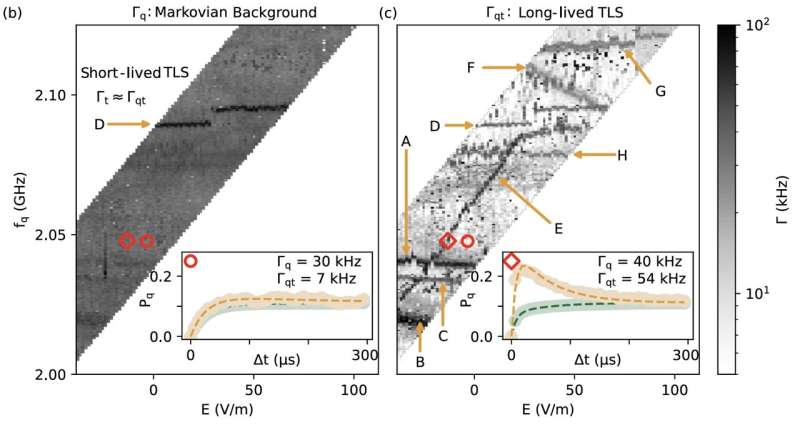
Instead of deliberately driving the qubit, the Karlsruhe Institute of Technology team performed a continuous weak measurement, watching the qubit’s spontaneous jumps between its ground and excited states. By correlating later jumps with earlier ones, they built a statistical model of energy exchange with the surrounding material. Varying the qubit’s frequency and the applied electric field let them isolate individual defects, each appearing as a distinct peak in the data.
Clusters of Quantum Jumps Reveal Defect Dynamics
If a qubit simply emitted energy, its jumps would be roughly evenly spaced. The researchers observed clusters of jumps, indicating that energy was being shuttled back and forth between the qubit and a defect before finally escaping. This behavior persisted without any intentional excitation, demonstrating that the defects act as tiny energy reservoirs with their own relaxation timescales.
Implications for Error‑Correction Strategies
Understanding which defects store energy and how they respond to electric fields provides clues to their microscopic origin. Armed with this knowledge, engineers can design materials and control protocols that either avoid such defects or incorporate their dynamics into error‑correction schemes, potentially improving qubit coherence in real‑world devices.
Looking Ahead
The technique offers a practical, non‑invasive tool for mapping long‑lived defects across a range of superconducting platforms. Future work may combine this approach with material‑science investigations to pinpoint defect sources and develop fabrication methods that suppress them, moving quantum hardware closer to fault‑tolerant operation.
The findings were reported by Nicolas Gosling et al., “Probing the memory of a superconducting qubit environment,” Physical Review Letters (2026).
Hype check
RealThe article reports a peer‑reviewed experimental result that directly demonstrates energy‑returning defects; the claim matches the presented data.
- Peer-reviewed paper, or press release only?Paper — Physical Review Letters publication cited
- Error-corrected (logical) qubits, or physical qubits only?Logical / not a qubit claim — Not a qubit‑count claim
- A new milestone, or a rebrand / restatement?New — First observation of defect‑mediated energy return
- Independent confirmation?Not yet — No external replication mentioned
- Does the headline claim match what the source shows?Matches — Headline reflects the reported experimental finding
An editorial assessment of the claim as reported, not a judgment of the company or researchers. Checked against: phys.org. How we rate hype →
Source
Read original sourceWhy we picked this
Accepted from curated QuantumUnzipped source (relevance scoring disabled).