Horizon Quantum Announces Q3 2026 Financial Results: Advances Triple Alpha Pulse Integration with OQC and Announces Intent to Acquire Entropica Labs
Horizon Quantum reports a loss‑heavy Q3 2026, highlights pulse‑level integration with OQC’s 32‑qubit processor, and outlines a planned acquisition of Entropica Labs.
Horizon Quantum Q3 2026: Financials, Software Progress, and an Upcoming Acquisition
Horizon Quantum Holdings Ltd. (Nasdaq: HQ) released its third‑quarter 2026 earnings, showing a dramatic swing from a loss in Q3 2025 to a GAAP net income driven entirely by a non‑cash accounting gain. Alongside the financial tables, the company used the filing to showcase two technical milestones – a pulse‑level integration with Oxford Quantum Circuits (OQC) and a new multiplexed qubit‑characterization protocol – and to announce a non‑binding letter of intent to acquire Singapore‑based Entropica Labs, a firm focused on quantum error‑correction tools.
Financial snapshot
- Revenue: $0 M (no commercial sales recorded).
- Operating expenses: $10.49 M, up 115 % YoY, reflecting higher R&D headcount, expanded infrastructure, and public‑company costs.
- GAAP net income: $33.41 M, stemming from a $43.10 M fair‑value gain on warrant‑related derivatives after the share price fell.
- Cash position: $102.79 M, with no long‑term debt.
The numbers illustrate a classic “cash‑burn” phase for a pre‑revenue quantum‑software company: the firm is investing heavily in engineering talent and test‑bed hardware while awaiting commercial contracts.
Software and hardware integration milestones
Pulse‑level control on OQC’s “Toshiko” processor
Horizon’s Triple Alpha IDE was linked to OQC’s 32‑qubit superconducting chip, allowing developers to issue calibrated gate pulses directly from high‑level code. The integration demonstrated real‑time access to coherence metrics (T₁ and T₂) and the execution of custom gate sequences, a step toward tighter software‑hardware co‑design.
Multiplexed characterization across 100+ qubits
The company unveiled a proprietary protocol that simultaneously measures ZZ‑crosstalk and control‑crosstalk on large‑scale processors. On a 100‑qubit device, the method collapsed roughly 5,000 pairwise experiments into just seven runs, a >700‑fold reduction in characterization overhead. If broadly adopted, such a technique could accelerate calibration cycles for near‑term quantum processors.
Triple Alpha runtime advances
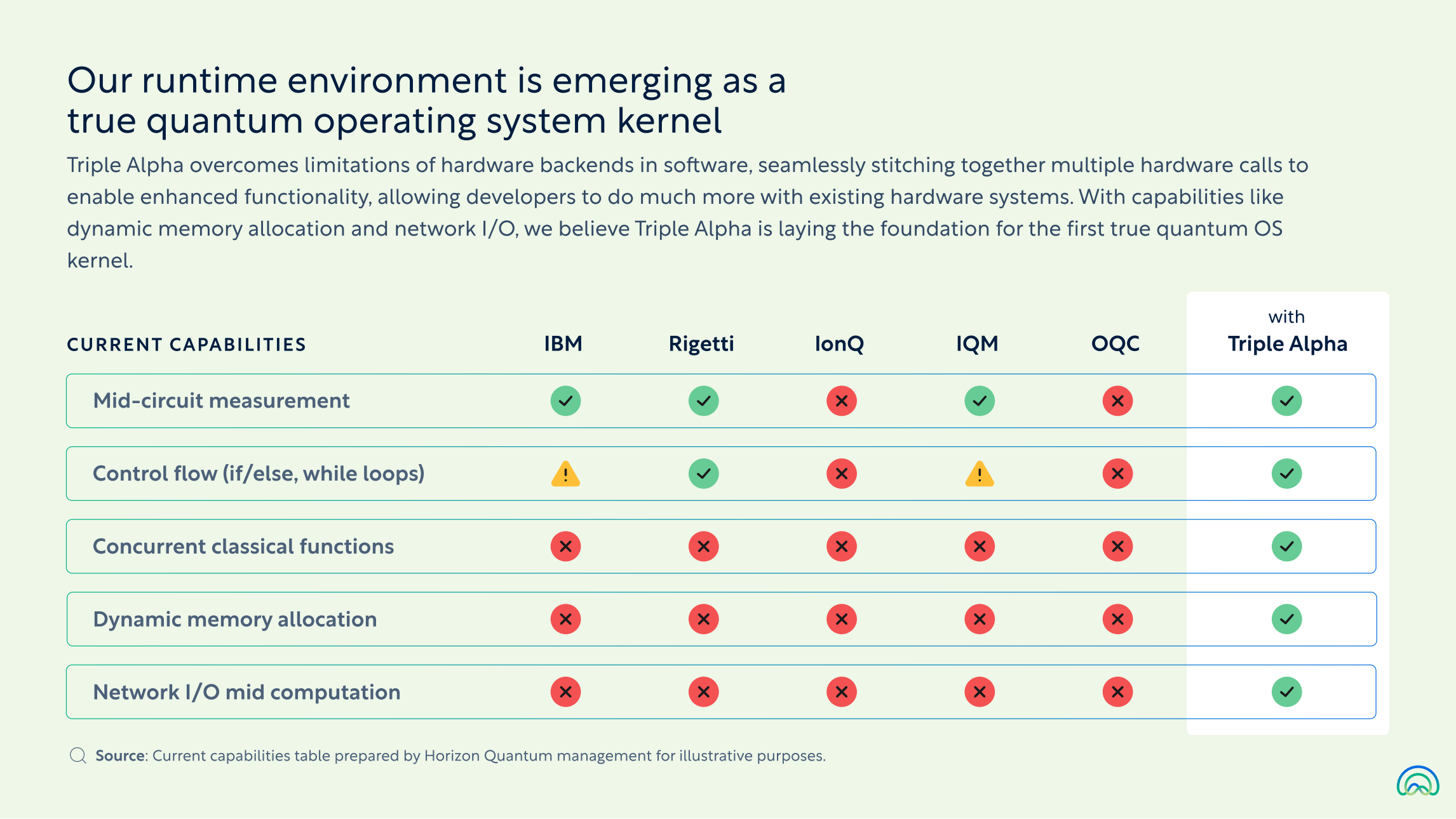
Beyond low‑level pulse control, Horizon reported progress on its Triple Alpha runtime layer, adding dynamic memory management, conditional logic (if/else, loops), and mid‑circuit measurement support. These features aim to make the platform agnostic to the underlying QPU, easing migration between superconducting, trapped‑ion, or neutral‑atom backends.
Strategic M&A: Intent to acquire Entropica Labs
Horizon signed a non‑binding LOI to purchase Entropica Labs for an estimated $27 M in Horizon stock. Entropica specializes in quantum error‑correction (QEC) algorithms and fault‑tolerant architecture tooling. The acquisition is intended to embed QEC capabilities directly into Horizon’s compilation stack, potentially shortening the path from noisy‑intermediate‑scale quantum (NISQ) devices to fault‑tolerant execution.
What this means for the market
- Software‑centric play: Horizon continues to bet on a hardware‑agnostic software stack, positioning itself as a “middleware” layer for diverse quantum processors.
- Capital runway: With over $100 M in cash, the firm can sustain its R&D spend while pursuing the Entropica deal and further integration projects.
- Competitive landscape: The pulse‑level integration mirrors similar efforts at larger players (e.g., IBM, Google), but Horizon’s focus on a unified IDE could appeal to startups and research labs seeking a single development environment.
Bottom line
Horizon Quantum’s Q3 2026 report underscores a classic growth‑stage narrative: heavy spending on talent and infrastructure, a handful of technical demos to prove the software stack’s viability, and a strategic acquisition aimed at bolstering its error‑correction portfolio. Investors and partners will be watching whether the promised software capabilities translate into commercial contracts as the quantum‑hardware ecosystem matures.
--- The analysis draws exclusively from the company’s earnings release and associated investor materials.
Source
Read original sourceWhy we picked this
Accepted from curated QuantumUnzipped source (relevance scoring disabled).