How M.C. Escher’s Art Creates Bizarre Mathematical Worlds
The new MoMath exhibition shows how M.C. Escher’s hand‑drawn tessellations and visual tricks have inspired generations of mathematicians.
Introduction
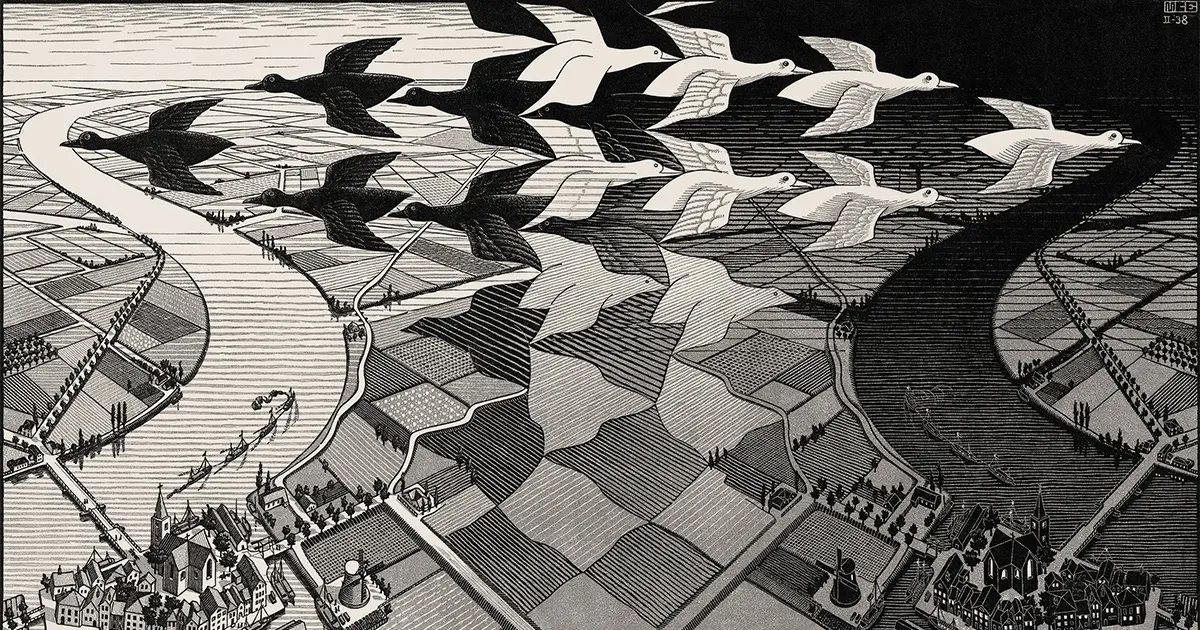
M.C. Escher never studied mathematics formally, yet his intricate woodcuts, lithographs, and prints have become a staple in classrooms and research seminars. A new exhibition, Mathematics and the Art of M.C. Escher, at the National Museum of Mathematics (MoMath) in New York, highlights the ways Escher’s imagination anticipated modern concepts in geometry, symmetry, and topology.
From Alhambra Tiles to Formal Tessellations
Escher’s fascination with repeating patterns began after a 1922 trip to the Alhambra in Granada, where he was captivated by the palace’s Moor‑Moorish tilework. Decades later, a paper by mathematician George Pólya—sent to him by his half‑brother—catalogued the 17 symmetry groups that can fill a plane without gaps. Escher painstakingly traced these diagrams, eventually devising his own “layman’s theory” of edge‑matching that let him fill a sheet with fish, birds, and lizards while obeying strict color‑symmetry rules. Curator Doris Schattschneider notes that Escher’s intuitive grasp of these groups rivaled that of professional crystallographers.
Collaborations that Deepened the Math
In 1954 Escher presented his work at the International Congress of Mathematicians in Amsterdam, where he met the eminent geometer H.S.M. Coxeter. Their correspondence spurred some of Escher’s most mathematically sophisticated pieces, including the celebrated Relativity and the Metamorphosis series, which explore impossible spaces and continuous deformation of grids. These exchanges illustrate how a dialogue between artist and mathematician can generate new visual language for abstract ideas.
Visual Illusions as Mathematical Experiments
Escher’s prints often disguise a rigorous experiment in perception. Balcony (1945) uses a hand‑drawn grid to warp a flat image into the illusion of a curved mirror, a technique now trivial for computers but remarkable for a pre‑digital artist. Three Spheres I reveals a three‑dimensional sphere that is, in fact, a flat circle, prompting viewers to question the relationship between projection and reality. Such works anticipate modern discussions of dimensional reduction and topology.
The Exhibition Experience
The MoMath show, running through February 2027, arranges Escher’s pieces alongside explanatory panels that connect each artwork to the underlying mathematical concepts—group theory, hyperbolic geometry, and graph theory. Interactive stations let visitors experiment with tiling software, reproducing Escher‑style patterns and seeing how small rule changes produce entirely new designs. The exhibition underscores how Escher’s legacy continues to inspire both artistic creation and mathematical research.
Closing Thoughts
Escher’s art demonstrates that deep mathematical insight can arise from pure visual curiosity. By turning the page of his sketchbooks, mathematicians discover new problems; by studying his prints, artists find fresh ways to bend reality. The MoMath exhibition invites the public to step into this shared world of impossible yet rigorously logical beauty.
Hype check
Not a research claimThe piece reports an exhibition opening; there is no technical claim to evaluate, so the story is factual and straightforward.
We rate research and technical results only. How we rate hype →
Source
Read original sourceWhy we picked this
Accepted from curated QuantumUnzipped source (relevance scoring disabled).