How the Department of Commerce’s Quantum Awards Work and What Companies Give in Return
The Commerce Department’s quantum awards combine research funding with minority equity stakes, giving companies capital for engineering projects while the government holds restricted shares.
How the Commerce Department’s Quantum Awards Work and What Companies Give in Return
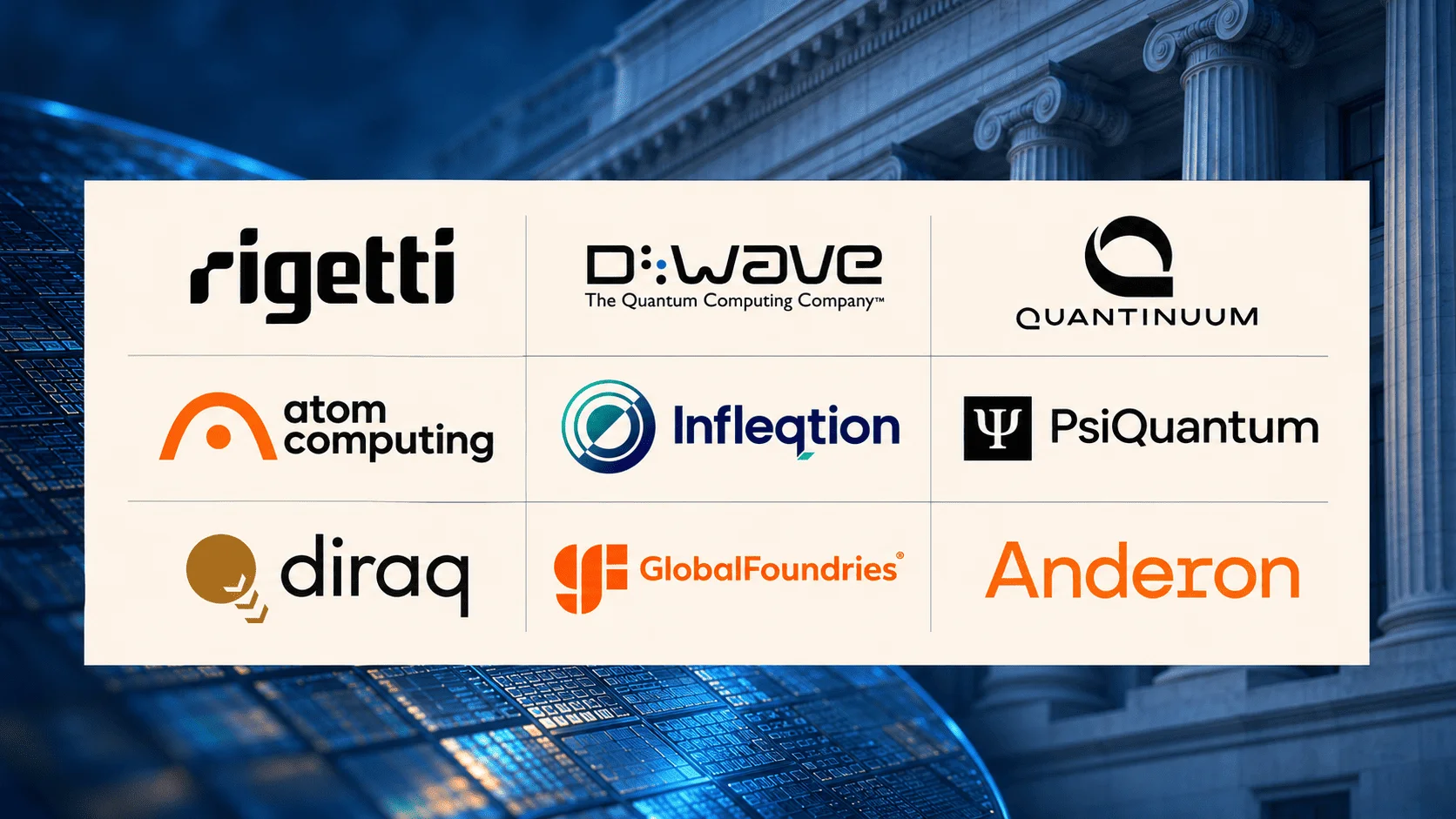
The U.S. Department of Commerce is using the CHIPS initiative to fund quantum‑computing companies while taking a minority, non‑controlling equity stake in each. The program earmarks $2.013 billion for nine firms, with award sizes ranging from $38 million for Diraq to $1 billion for IBM’s quantum‑foundry subsidiary, Anderon. Six other recipients—including Rigetti, D‑Wave, Quantinuum, Atom Computing, Infleqtion and PsiQuantum—can receive up to $100 million each.
Funding structure and equity stakes
SEC filings from Rigetti, D‑Wave and Quantinuum reveal a common template:
- An initial cash tranche is released up front, with later payments tied to specific milestones.
- The companies issue a block of shares to the Commerce Department calculated against the full potential award. For example, Rigetti issued 7,739,938 shares at an implied $12.92 per share, while Quantinuum issued 2,369,528 Class A shares at a contractual price of $42.20 per share.
- The government’s shares carry voting and transfer restrictions: they cannot be sold without company consent, cannot be transferred to competitors, and voting rights are limited to material corporate actions.
- If a company fails to meet milestones, the department can recover cash already paid and, in some cases, retain the issued shares.
What the money supports
The awards target the “hard‑parts” of scaling quantum computers:
- Rigetti: miniaturized read‑out electronics, a new cryostat architecture for greater cooling capacity, and higher‑connectivity chip fabrication.
- D‑Wave: tools and prototypes for both annealing and gate‑model superconducting processors, including manufacturing integration and benchmarking.
- Quantinuum: low‑loss integrated photonics for trapped‑ion systems, cryogenic control chips, and reliable optical components at 422 nm.
These projects focus on control electronics, cooling, packaging and photonics—critical infrastructure that becomes increasingly demanding as qubit counts grow.
Disbursement timelines
All three agreements were signed in early September 2024, with cash availability as follows:
- Rigetti: $43.9 M initially, followed by two tranches of $29.9 M and $26.2 M.
- D‑Wave: $53.6 M up front, with later payments of $9.1 M, $16.7 M, $20.4 M and a small $0.3 M final tranche.
- Quantinuum: $56 M initially, then potential $32 M and $12 M payments.
The agreements allow the department to withhold or recover funds if milestones are missed, and unused cash must be returned within 30 days of receipt.
Risks and rewards for taxpayers
The equity component gives the government a potential upside if the companies succeed, but also exposes it to market risk. Share prices are set using discounted formulas based on historic closing prices, and the government cannot freely sell its holdings until the corresponding cash has been drawn and retained by the company. Moreover, the shares are excluded from earnings‑per‑share calculations, as seen in Quantinuum’s filing.
Overall, the Commerce Department’s approach blends research investment with a modest financial stake, aiming to accelerate domestic quantum‑hardware capabilities while giving taxpayers a share of future growth—subject to significant safeguards and performance‑based conditions.
--- This article synthesizes information from SEC filings and Department of Commerce announcements to explain the mechanics of the quantum awards program.
Hype check
Not a research claimThe piece reports a funding and equity arrangement, not a technical breakthrough, so there is no result to hype.
We rate research and technical results only. How we rate hype →
Source
Read original sourceWhy we picked this
Accepted from curated QuantumUnzipped source (relevance scoring disabled).