IBM Launches Unified Quantum Safe Software Suite to Automate Enterprise PQC Migration
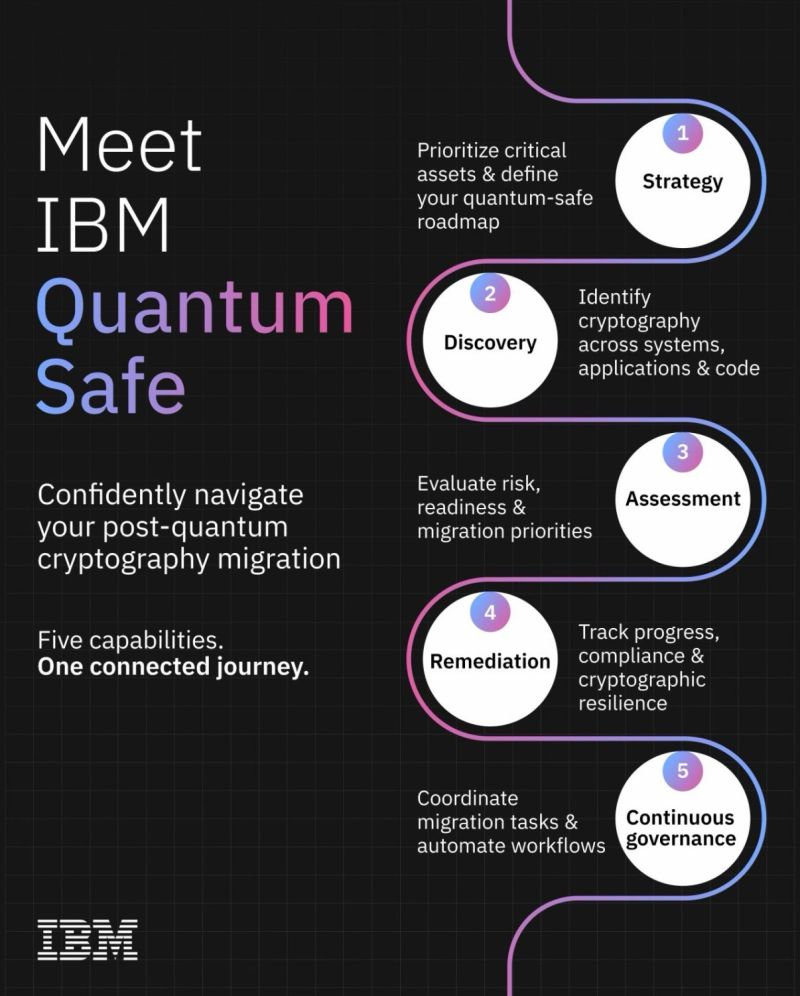
IBM unveiled its Quantum Safe software suite, a unified platform that automates the discovery, assessment, and migration of enterprise cryptography to post‑quantum standards.
Introduction
IBM announced the commercial launch of IBM Quantum Safe, a unified software suite designed to help enterprises and government agencies automate the transition from classical cryptography to post‑quantum cryptography (PQC). The announcement coincides with the release of NIST’s final migration roadmap (NIST IR 8547) and targets the looming federal migration deadlines that begin in 2030.
A modular architecture for end‑to‑end migration
The platform bundles three core components that address the most painful steps in a PQC migration:
- Quantum Safe Explorer – a source‑code scanner that builds a Cryptography Bill of Materials (CBOM). It parses repositories, flags hard‑coded algorithms, anti‑patterns, and deprecated API calls, and feeds the results directly into DevSecOps pipelines.
- Quantum Safe Cryptography Manager – an operational discovery engine that inventories cryptographic assets across servers, network endpoints, and cloud workloads. It ranks assets by risk and suggests migration sequences aligned with NIST guidance.
- Quantum Safe Proxy – a dual‑protocol network mediator that sits between legacy systems and PQC‑enabled clients. It enables secure communication without immediate code changes, buying organizations time to refactor applications over multiple years.
Together, these tools turn the migration bottleneck—from locating vulnerable public‑key dependencies in millions of lines of legacy code to orchestrating a coordinated rollout—into an automated workflow.
Early validation and practical impact
IBM piloted the Explorer on its own internal CIO office, scanning 47 million lines of code across 5,800+ repositories and uncovering 3,900+ cryptographic issues. The internal test demonstrated how automated CBOM generation, combined with the proxy layer, can mitigate “harvest‑now, decrypt‑later” (HNDL) threats in transit before a full application rewrite is feasible.
What this means for enterprises
- Speed – Automated discovery cuts months of manual code review.
- Risk reduction – Continuous posture governance helps meet compliance milestones ahead of the 2030 federal deadline.
- Flexibility – The proxy allows a phased migration, letting legacy systems operate alongside PQC‑ready services.
- Scalability – Modular licensing lets organizations start with a single component and expand as migration progress accelerates.
Practical next steps
Enterprises interested in IBM Quantum Safe can request a trial through IBM’s official portal. A typical rollout might look like:
- Deploy Quantum Safe Explorer in CI/CD pipelines to generate an initial CBOM.
- Use the Cryptography Manager to prioritize high‑risk assets and create a migration roadmap.
- Implement the Quantum Safe Proxy at network choke points to secure traffic while legacy applications are updated.
- Iterate, monitor, and expand coverage until all critical assets are PQC‑compliant.
Conclusion
IBM’s Quantum Safe suite offers a pragmatic, end‑to‑end solution for the complex task of enterprise‑wide PQC migration. By automating discovery, governance, and transitional networking, the platform helps organizations move confidently toward the 2030 federal mandate while protecting today’s data against future quantum threats.
Source
Read original sourceWhy we picked this
Accepted from curated QuantumUnzipped source (relevance scoring disabled).