IBM, Mitsubishi Chemical, and Keio Train Generative Quantum Eigensolvers on 70-Qubit Hardware
IBM, Mitsubishi Chemical, and Keio demonstrated a hardware‑in‑the‑loop training loop for generative quantum eigensolvers on a 70‑qubit IBM processor.
Training Generative Quantum Eigensolvers on 70‑Qubit IBM Hardware
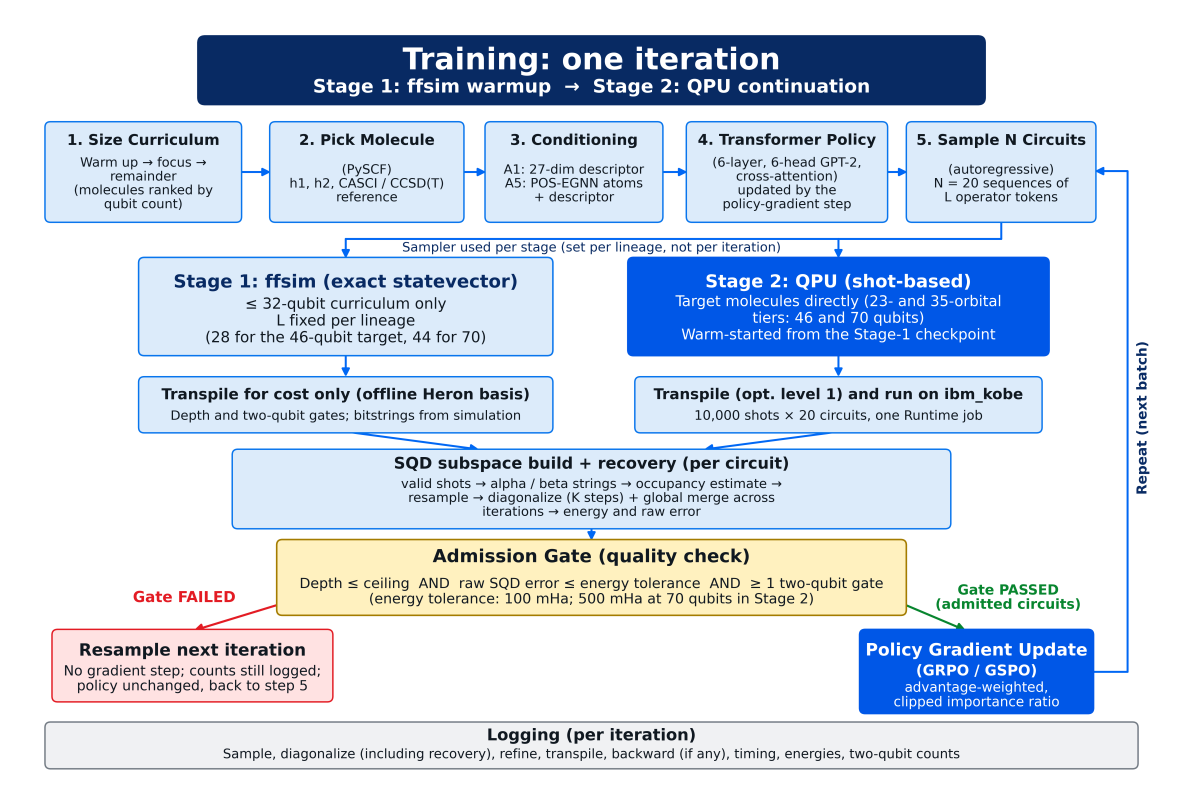
A collaboration between IBM Quantum, Mitsubishi Chemical, Keio University, and NVIDIA has published a new preprint describing an end‑to‑end training framework that runs directly on a 70‑qubit subset of IBM’s 156‑qubit Heron processor (named ibm_kobe). The approach uses an autoregressive transformer to generate quantum circuits for the Generative Quantum Eigensolver (GQE), which are then evaluated on‑hardware and refined via reinforcement learning.
In‑the‑Loop Training Architecture
- Two‑stage curriculum: pre‑training on a noiseless simulator, followed by on‑hardware reinforcement learning across 46‑ and 70‑qubit active spaces.
- Sample‑based Quantum Diagonalization (SQD): the quantum processor samples a limited set of bit‑strings; a classical GPU stack reconstructs the active subspace and diagonalizes the molecular Hamiltonian.
- Reward shaping: a penalty term prevents the policy from collapsing to the Hartree–Fock state, encouraging exploration of more expressive circuits.
- Hardware usage: the training loop consumed roughly 120 million physical shots spread over 600 calibration jobs.
Performance on Organotin Molecules
The trained policies were applied zero‑shot to simulate organotin photoresist molecules relevant to extreme‑ultraviolet (EUV) lithography. Across 11 active‑space tiers (32–70 qubits), the GQE‑SQD approach achieved:
- DMRG agreement in 27 of 28 runs within 15 mHa (median deviation 4.5 mHa).
- Gate counts ranging from 64 to 160 two‑qubit gates (circuit depth 44–134 layers) compared with conventional LUCJ ansätze requiring 4,248–6,952 gates (depth 428–536 layers).
These results suggest that hardware‑trained generative policies can produce compact, high‑fidelity circuits that outperform traditional hand‑crafted ansätze on near‑term devices.
Practical Implications
- Reduced circuit depth lowers decoherence risk on noisy superconducting qubits.
- Zero‑shot transfer means a single trained policy can be reused for multiple molecules without additional quantum runtime.
- Scalable workflow integrates quantum sampling with classical GPU‑accelerated post‑processing, offering a template for future quantum‑classical hybrid pipelines.
Outlook
The study demonstrates that reinforcement‑learning‑driven circuit synthesis can be executed directly on mid‑scale quantum hardware, opening a path toward more automated quantum chemistry workflows. While the results are currently limited to a preprint and internal datasets, the methodology could be extended to larger active spaces as hardware improves and error mitigation techniques mature.
--- The full preprint, code repository, and datasets are referenced in the original article.
Hype check
PartlyThe preprint reports a novel hardware‑in‑the‑loop training result, but it is not peer‑reviewed and lacks independent verification.
- Peer-reviewed paper, or press release only?Press release only — Only a preprint on arXiv is mentioned.
- Error-corrected (logical) qubits, or physical qubits only?Physical only — The 70‑qubit count refers to physical qubits.
- A new milestone, or a rebrand / restatement?New — First demonstration of on‑hardware training for GQE policies.
- Independent confirmation?Not yet — No external replication or third‑party confirmation cited.
- Does the headline claim match what the source shows?Matches — Headline accurately reflects the 70‑qubit hardware training claim.
An editorial assessment of the claim as reported, not a judgment of the company or researchers. How we rate hype →
Source
Read original sourceWhy we picked this
Accepted from curated QuantumUnzipped source (relevance scoring disabled).