IBM, NVIDIA and Fermilab Plan Modular Quantum Computing Platform
IBM, NVIDIA, and Fermilab announced a joint effort to build a modular quantum‑classical co‑design platform.
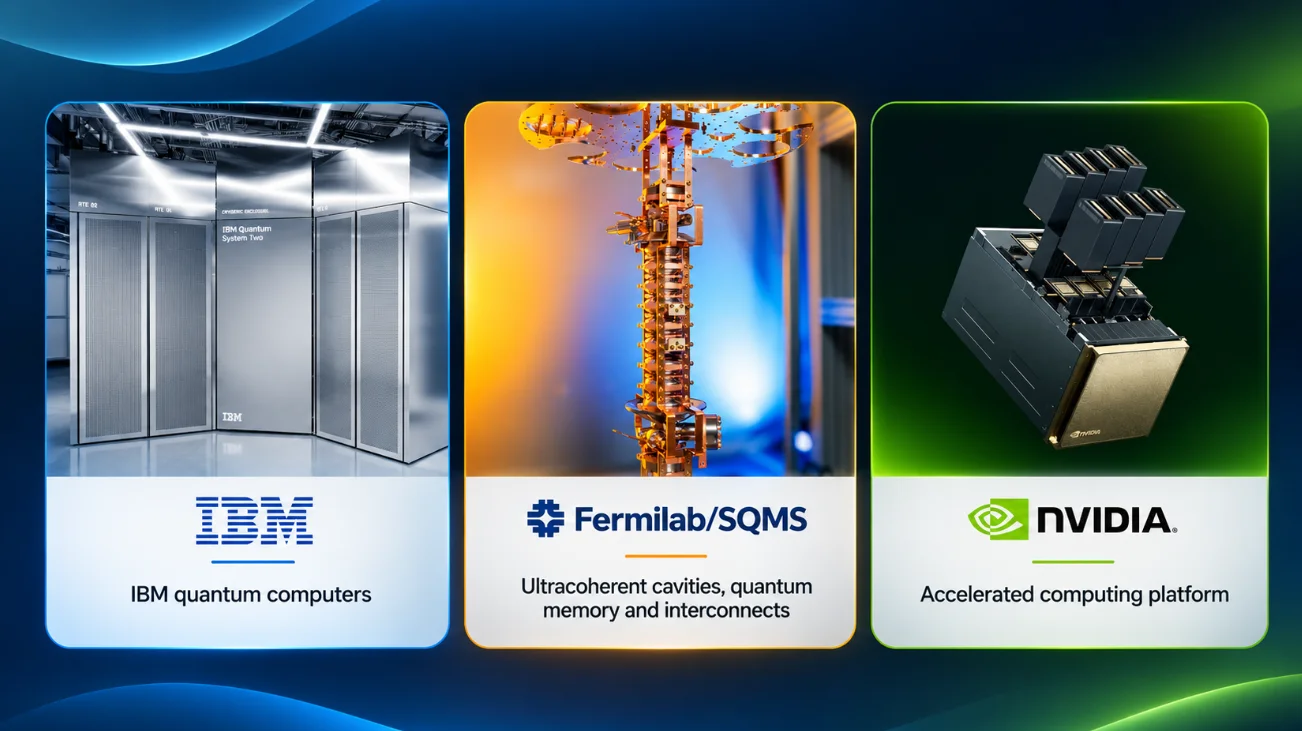
IBM, NVIDIA, and Fermilab Join Forces on a Modular Quantum‑Classical Platform
IBM, NVIDIA, and the U.S. Department of Energy’s Fermilab have unveiled a collaborative plan to create a modular co‑design platform that tightly integrates quantum processors with high‑performance classical computing resources. The effort aims to accelerate scientific discovery by allowing researchers to run hybrid quantum‑HPC workflows on a shared infrastructure.
A Shared Architecture for Quantum and Classical Workloads
The proposed platform will colocate NVIDIA DGX B200 GPU systems with IBM’s quantum hardware, including the IBM Quantum Nighthawk processor. Nighthawk is described as IBM’s most powerful quantum chip to date, capable of executing circuits of up to 7,500 two‑qubit operations on a 120‑qubit device and delivering up to 100,000 samples per second. By coupling these QPUs with NVIDIA’s accelerated computing stack, the partnership hopes to enable seamless data movement between quantum and classical layers, reducing latency and simplifying job scheduling.
Integrating Quantum Resources into Existing HPC Schedulers
A key technical component of the initiative is the Quantum Resource Management Interface (QRMI), an open‑source, vendor‑agnostic layer that plugs quantum processors into the Slurm workload manager. QRMI leverages Slurm’s Hierarchical Resources (HRES) model, allowing QPUs to be treated like any other shared resource (e.g., GPUs). This means that users can request quantum time within a standard Slurm job script, eliminating the need for separate queues or custom login procedures. The integration is being developed in collaboration with the open‑source community and Pasqal, a neutral‑atom quantum‑computing company.
Early Scientific Demonstrations
The announcement also highlights recent research by IBM, RIKEN, and NVIDIA that combined quantum circuits with NVIDIA GPUs to simulate an iron‑sulfur cluster (Fe₄S₄). The team ran circuits on 72 qubits with up to 4,000 two‑qubit gates, collecting five million samples. By feeding the quantum results into GPU‑accelerated post‑processing, they achieved a 79‑fold improvement in accuracy compared with earlier quantum‑only runs, reaching within 4.3 milli‑hartree of the benchmark density‑matrix renormalization group (DMRG) method. While this work showcases the potential of hybrid workflows, it remains a research demonstration rather than a production‑level capability.
Outlook and Community Impact
Beyond the technical work, the collaboration is positioned as a stepping stone toward a future DOE quantum‑computing user facility. Fermilab’s Superconducting Quantum Materials and Systems (SQMS) Center will contribute expertise in ultra‑coherent qubit hardware, while IBM and NVIDIA bring quantum‑processor design and accelerated‑computing know‑how, respectively. The joint platform is expected to serve high‑energy and nuclear physics applications—such as lattice gauge theory, neutrino interaction modeling, and nuclear simulations—that are currently out of reach for classical supercomputers alone.
What to watch next
- Development of QRMI and its adoption across national labs and university HPC centers.
- Benchmarks that quantify end‑to‑end latency and throughput for quantum‑classical pipelines.
- Expansion of the platform to support additional QPU vendors, fostering a truly interoperable ecosystem.
The initiative underscores a broader industry shift: quantum hardware is no longer a stand‑alone curiosity but a component that must be woven into the fabric of existing HPC environments. As the modular platform matures, it could become a testbed for the fault‑tolerant architectures that will define the next generation of quantum computers.
--- This article is based on the press release and accompanying description of the IBM‑NVIDIA‑Fermilab collaboration.
Hype check
Not a research claimThe story reports a partnership and platform plan; there is no performance claim to evaluate, so it is a straightforward news announcement.
We rate research and technical results only. How we rate hype →
Source
Read original sourceWhy we picked this
Accepted from curated QuantumUnzipped source (relevance scoring disabled).