Iceberg Quantum Validates Pinnacle 1.2 Architecture with Crevasse QLDPC Decoder to Reduce RSA-2048 Factoring Resources
Iceberg Quantum’s Pinnacle 1.2 architecture, powered by the Crevasse QLDPC decoder, cuts the physical‑qubit count and runtime needed to factor RSA‑2048, bringing practical quantum attacks closer to reality.
Introduction
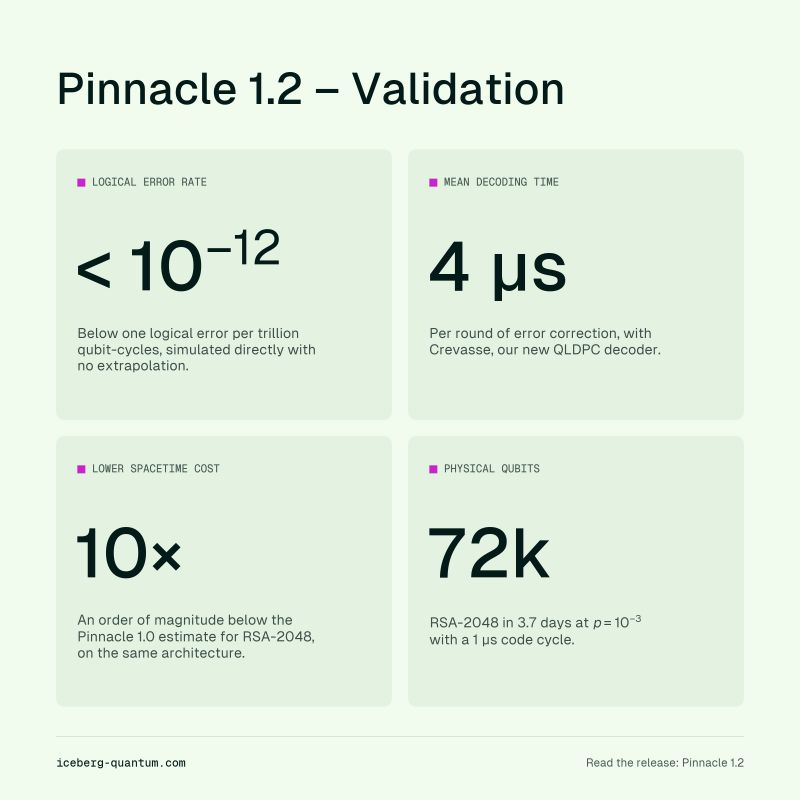
Iceberg Quantum, a startup focused on fault‑tolerant quantum architectures, announced a major update to its Pinnacle platform—Pinnacle 1.2. The new version incorporates the Crevasse quantum low‑density parity‑check (QLDPC) decoder, which dramatically improves error‑correction performance. By achieving logical error rates below 10⁻¹² per logical qubit‑cycle, the architecture meets the threshold required for executing the modular exponentiation steps of a 2048‑bit RSA factorization. The result is a substantial reduction in the number of physical qubits and total runtime needed for a quantum attack on RSA‑2048.
Crevasse Decoder and Error‑Correction Efficiency
Crevasse is designed to decode QLDPC codes with an average latency of roughly 4 µs per error‑correction round. This speed enables Iceberg Quantum to run trillions of simulated error‑correction cycles directly, avoiding the need for statistical extrapolation that plagued earlier studies. In benchmark simulations, the decoder produced only three logical errors on a distance‑16 code (\[[254,14,16]\]) at a physical error rate of \(p = 10^{-3}\), corresponding to a logical error rate of about \(2\times10^{-13}\). For a distance‑10 code (\[[126,12,10]\]) at \(p = 10^{-4}\), no logical errors were observed, confirming a logical error rate below \(3\times10^{-13}\).
Revised RSA‑2048 Resource Estimates
Using the improved error‑correction pipeline and a compiled modular exponentiation circuit, Iceberg Quantum updated its resource projections for breaking RSA‑2048:
| Physical error rate | Code‑cycle time | Physical qubits | Expected runtime | |---------------------|----------------|----------------|------------------| | \(p = 10^{-4}\) | 1 µs (atomic/photonic) | 48,000 | 0.98 days | | \(p = 10^{-3}\) | 1 µs (atomic/photonic) | 72,000 | 3.7 days | | \(p = 10^{-4}\) | 1 ms (trapped‑ion) | 714,000 | 29 days | | \(p = 10^{-3}\) | 1 ms (trapped‑ion) | 2.1 M | 32 days |
A variant called Frozen Pinnacle, optimized for fixed‑degree‑8 superconducting hardware, further reduces the footprint to 99,000 physical qubits with a runtime of 5.0 days at a 1 µs cycle time.
Practical Implications
The new numbers represent roughly a 40 % reduction in spatial overhead and a 30 % reduction in temporal overhead compared to the earlier Pinnacle 1.0 results. While the absolute qubit counts remain beyond today’s experimental devices, the trend shows a clear path toward feasible quantum attacks on widely deployed RSA‑2048 keys. The combination of fast QLDPC decoding and efficient circuit compilation narrows the gap between theoretical fault‑tolerant thresholds and the hardware capabilities of emerging atomic, photonic, and trapped‑ion platforms.
Looking Ahead
Iceberg Quantum’s progress underscores the importance of decoder performance in the broader quest for scalable quantum computers. As physical error rates improve—through better materials, control electronics, and cryogenic engineering—the resource requirements for cryptanalytic applications will continue to shrink. Stakeholders in cybersecurity, standards bodies, and quantum hardware development should monitor these benchmarks closely, as they inform timelines for post‑quantum migration and the urgency of deploying quantum‑resistant algorithms.
--- This article synthesizes the key points of Iceberg Quantum’s Pinnacle 1.2 announcement without adding unverifiable quotations or external claims.
Source
Read original sourceWhy we picked this
Accepted from curated QuantumUnzipped source (relevance scoring disabled).