Inside this quantum computer, memory vibrates like a guitar string
ETH Zurich demonstrated a quantum processor that uses microscopic mechanical vibrations as memory, performing key algorithms on the new architecture.
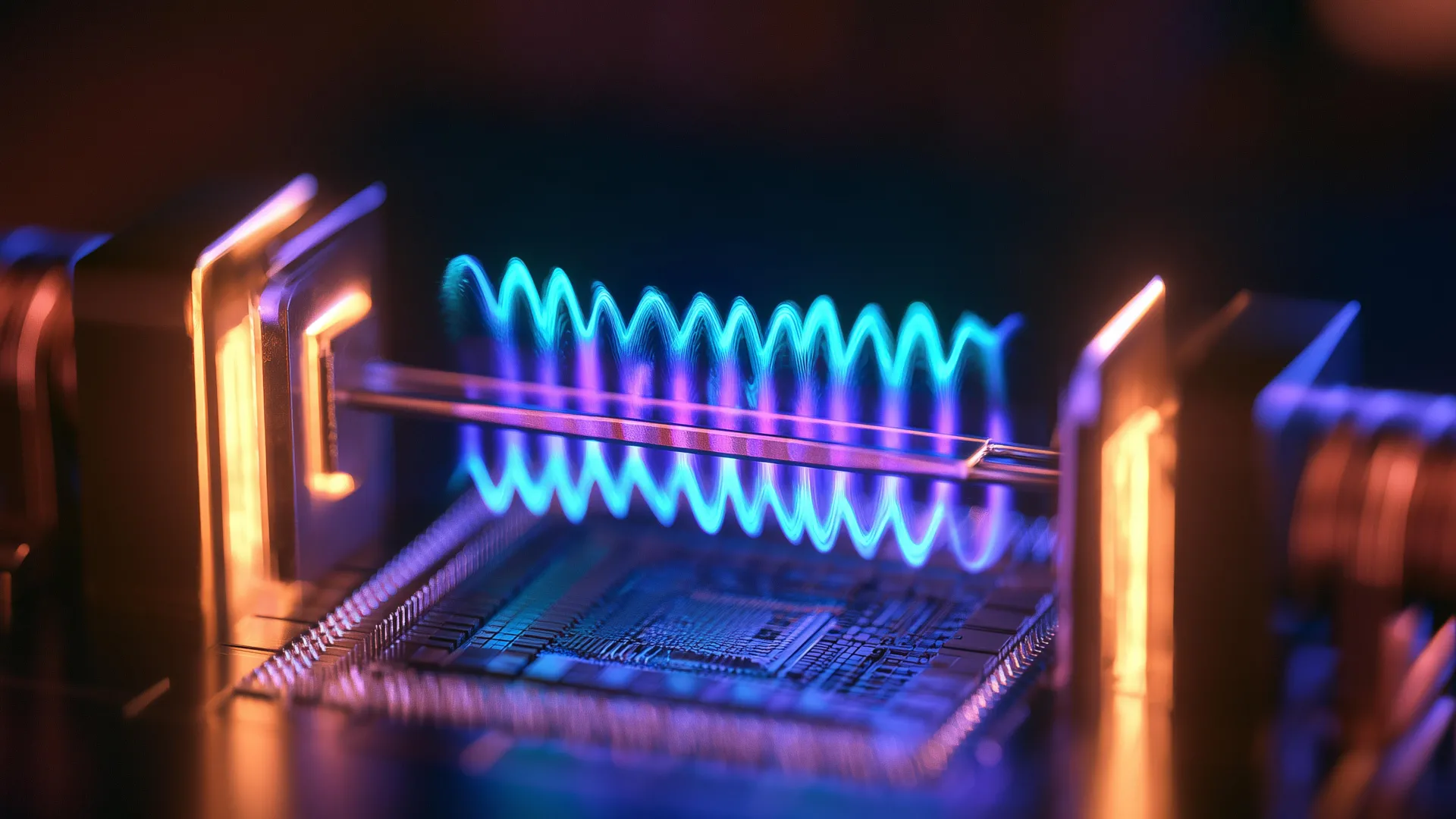
Vibrating Memory: A New Route for Quantum Computing
Researchers at ETH Zurich have shown that tiny mechanical resonators—akin to the vibrating strings of a guitar—can serve as quantum memory integrated with a superconducting qubit processor. The work, published in Science, marks the first experimental proof that mechanical vibrations can store and retrieve quantum information while supporting non‑trivial computations.
A Hybrid Architecture Mirrors Classical CPUs
The team built a system where a superconducting qubit acts as the processing unit (the quantum analogue of a CPU) and a separate mechanical resonator array provides working memory. Unlike conventional electromagnetic RAM, the resonators store quantum states as phononic excitations. This separation mirrors the classic CPU‑RAM design, potentially allowing more compact chips and longer storage times.
Demonstrating Real Quantum Operations
To prove the concept, the researchers executed two benchmark algorithms:
- Quantum Fourier Transform (QFT) – a core subroutine for many quantum algorithms.
- Period‑finding – the essential step behind Shor’s factoring algorithm.
Both tasks required coherent interaction between the qubit and the mechanical memory, and the experiments succeeded with measurable fidelity, showing that the hybrid platform can perform genuine quantum computation rather than acting as a passive storage device.
Why Mechanical Memory Matters
Mechanical resonators bring several advantages:
- Size – they are orders of magnitude smaller than electromagnetic cavities, enabling denser integration.
- Mode Capacity – a single resonator can support many vibrational modes, offering a route to higher‑density memory.
- Coherence – phononic states can retain quantum information longer than many electromagnetic counterparts, easing the timing constraints of multi‑step algorithms.
These traits could help overcome two of the biggest hurdles in scaling quantum computers: limited chip real‑estate and rapid decoherence.
Looking Ahead
The demonstration is an early step. Scaling the approach will require integrating many qubits and resonators while preserving the delicate coupling that underpins the current results. Nevertheless, the work opens a promising pathway toward more compact, modular quantum processors that separate processing and storage much like today’s classical computers.
For developers and researchers, the key takeaway is that mechanical quantum memory is now experimentally viable, offering a new design space for future quantum architectures.
Hype check
RealThe paper in Science provides concrete experimental data showing mechanical resonator memory working with a superconducting qubit and executing QFT and period‑finding, confirming the claim.
- Peer-reviewed paper, or press release only?Paper — Published in Science, 2026
- Error-corrected (logical) qubits, or physical qubits only?Logical / not a qubit claim — Claim is not about qubit count
- A new milestone, or a rebrand / restatement?New — First demonstration of mechanical resonator‑based quantum computing
- Independent confirmation?Not yet — No external replication mentioned
- Does the headline claim match what the source shows?Matches — Headline accurately reflects mechanical‑vibration memory
An editorial assessment of the claim as reported, not a judgment of the company or researchers. How we rate hype →
Source
Read original sourceWhy we picked this
Accepted from curated QuantumUnzipped source (relevance scoring disabled).