Interactive proofs for verifying (quantum) learning and testing
Interactive proofs can let memory‑limited quantum learners verify complex tasks, but only when quantum communication is allowed; classical interaction alone offers no advantage.
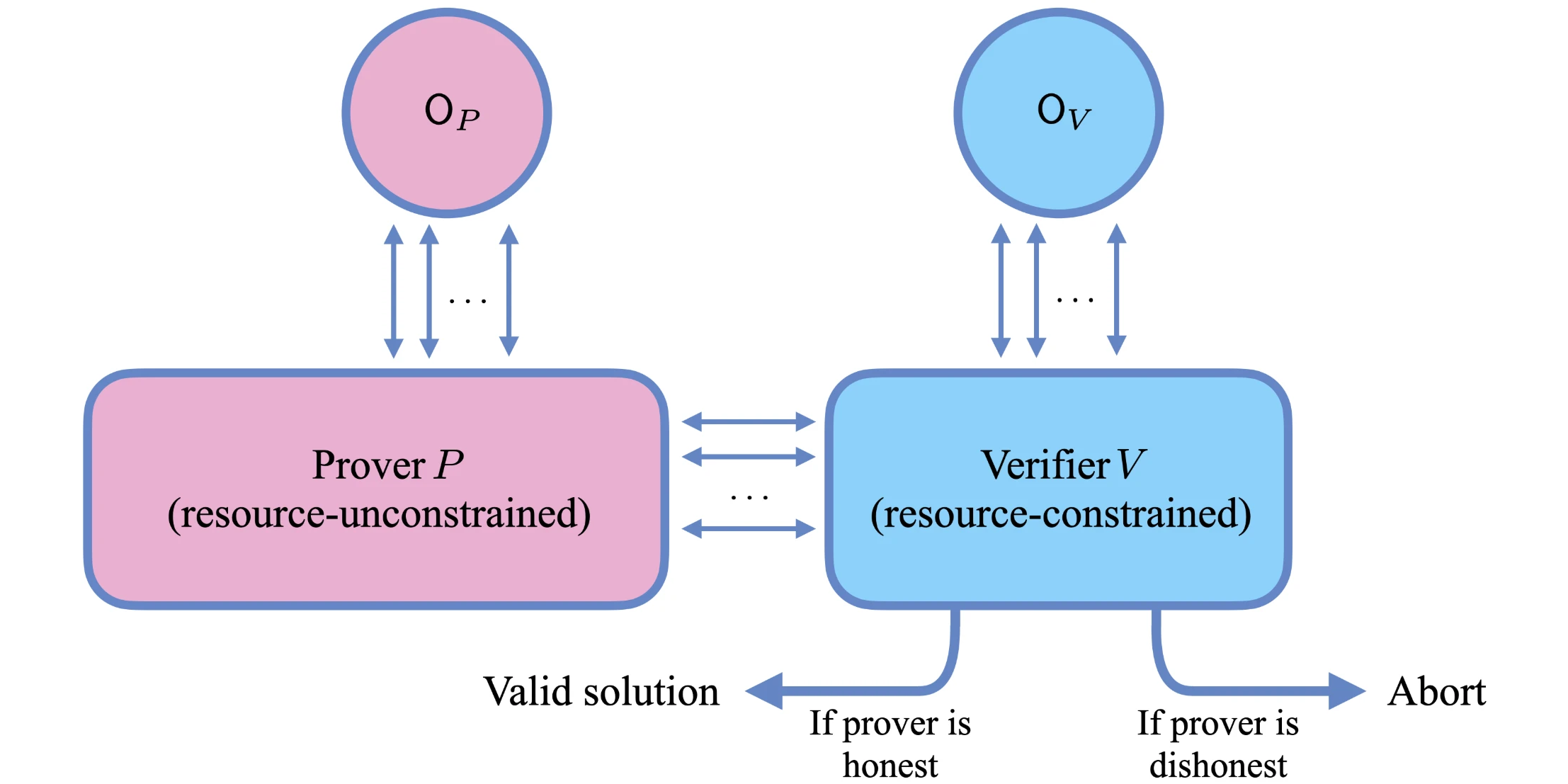
Interactive Proofs for Verifying (Quantum) Learning and Testing
Why it matters – As quantum computing moves toward a few large, fault‑tolerant data centres, users will increasingly rely on remote providers for heavy‑weight quantum processing. For learning and testing tasks that involve quantum data—such as state tomography, property testing, or quantum‑enhanced classification—clients may have only modest quantum resources (e.g., a single‑copy processor or limited memory). The central question is whether a resource‑constrained client can delegate these tasks to an untrusted, resource‑rich prover and still verify the answer efficiently.
---
1. Classical interaction offers no leverage for memory‑constrained learners
The authors first establish a broad impossibility result. For a wide class of learning and testing problems, if the client’s computational model is strictly weaker than the prover’s—specifically when the client lacks sufficient quantum memory—then any protocol that uses only classical communication cannot improve the client’s performance. The proof builds on classic interactive‑proof techniques (e.g., algebraic methods, PSPACE completeness) and adapts them to the quantum‑learning setting. The key insight is that classical messages cannot convey the extra copies of quantum data that the prover can exploit, so the client cannot benefit from delegation without additional quantum resources.
---
2. Quantum communication unlocks delegation power
When the communication channel itself is quantum, the landscape changes dramatically. The paper presents several interactive‑proof constructions that let a memory‑limited quantum verifier obtain the copy‑complexity advantages of a multi‑copy prover. Typical scenarios include:
- Quantum state tomography: A verifier that can only process one copy at a time can, via a quantum channel, receive encoded information from a prover that has performed multi‑copy measurements, enabling the verifier to reconstruct the state with far fewer resources.
- Property testing: For tasks such as testing whether a quantum channel belongs to a particular class, the verifier can delegate the heavy sampling to the prover and verify the result using a small number of quantum messages.
- Learning stabilizer states: By exchanging quantum fingerprints, the verifier can confirm that the prover’s hypothesis matches the target state, despite the verifier’s limited memory.
These protocols rely on quantum authentication and blind‑computation ideas to ensure that a dishonest prover cannot cheat without being detected. The communication overhead remains modest (often a constant number of qubits per round), making the schemes realistic for near‑term quantum networks.
---
3. Implications for a quantum‑centric cloud ecosystem
The results paint a nuanced picture of future quantum cloud services:
- When only classical links are available, clients cannot hope to verify sophisticated learning or testing tasks beyond what their own hardware permits. This limitation mirrors classical streaming interactive proofs, where the verifier’s space bound cannot be circumvented by a prover without additional communication power.
- With a quantum internet, even a modest client can harness the full power of a large quantum server. The quantum channel acts as a resource‑amplifier, turning a weak verifier into an effective participant in complex learning protocols.
- Security considerations remain central. The protocols assume an untrusted prover, so verification must be unconditional (information‑theoretic) rather than computational. The authors’ constructions satisfy this requirement, extending the toolbox of verified quantum computation to the domain of data‑driven tasks.
---
4. Outlook and open directions
The work opens several avenues for further research:
- Tightness of impossibility bounds – Determining whether there exist intermediate models (e.g., limited quantum communication or bounded‑depth circuits) that can partially bridge the gap between classical and fully quantum interaction.
- Resource‑optimal protocols – Minimizing the number of qubits exchanged while preserving verification guarantees, which is crucial for noisy quantum networks.
- Application‑specific designs – Tailoring interactive proofs to concrete machine‑learning pipelines, such as quantum‑enhanced reinforcement learning or quantum generative models.
- Experimental validation – Implementing the proposed protocols on existing quantum hardware (e.g., superconducting qubits linked by photonic interconnects) to assess practical overheads.
---
Takeaway – Interactive proofs reveal a sharp dichotomy: classical interaction cannot compensate for a client’s quantum‑memory deficit, but quantum communication can. As quantum computing consolidates into a few powerful hubs, establishing reliable quantum channels will be essential for enabling modest users to delegate and verify sophisticated learning and testing tasks.
Source
Read original sourceWhy we picked this
Accepted from curated QuantumUnzipped source (relevance scoring disabled).