IQM and AMD Demonstrate Reproducible Hybrid QPU-GPU Chemistry Workflow Using ROCm
IQM and AMD have built and open‑sourced a reproducible hybrid quantum‑classical workflow for small‑molecule chemistry using a 20‑qubit superconducting processor and AMD GPUs.
Hybrid Quantum‑Classical Chemistry Made Reproducible
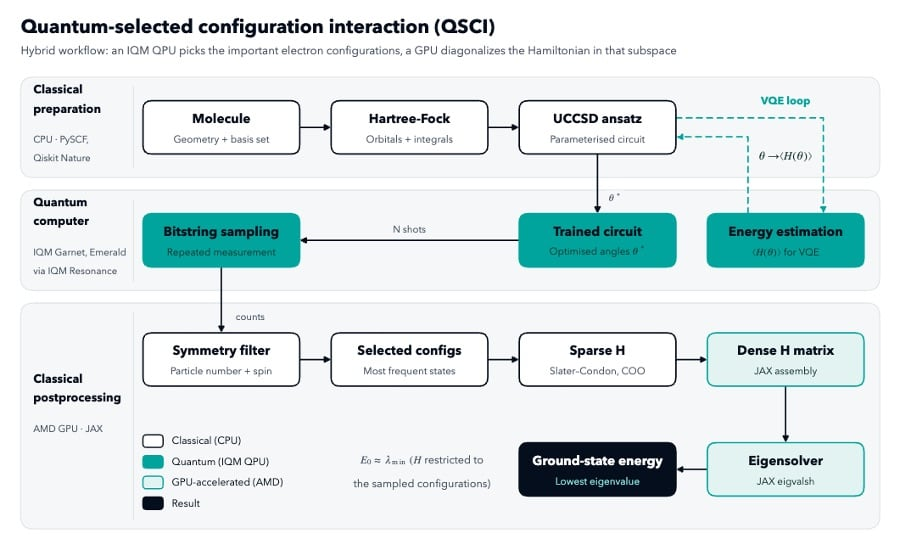
IQM Quantum Computers and AMD have teamed up to showcase an end‑to‑end workflow that couples IQM’s 20‑qubit superconducting processor, Garnet, with AMD Instinct GPUs running the open‑source ROCm stack. The joint effort targets computational chemistry problems that are hard for classical computers alone, but it is framed as an interoperability test rather than a claim of quantum advantage.
From Qubit to GPU: How the Pipeline Works
- Quantum preparation – Using IQM’s cloud‑based Resonance platform, a parameterized quantum circuit is executed on Garnet. The circuit samples bit‑strings that represent candidate electron configurations.
- Classical filtering – An AMD GPU receives the raw samples, discards unphysical configurations, and builds a projected subspace Hamiltonian.
- Diagonalization – The subspace Hamiltonian is diagonalized on the GPU with JAX, exploiting ROCm‑accelerated linear‑algebra kernels that scale cubically (O(N³)).
The workflow implements Quantum‑Selected Configuration Interaction (QSCI), a technique that sidesteps the exponential memory growth of exact diagonalization by focusing on the most relevant configurations identified by the quantum processor.
Demonstration on Molecular Hydrogen
The teams validated the complete pipeline on the simplest diatomic molecule, H₂, in the minimal STO‑3G basis set. They reproduced the full dissociation curve across 17 bond lengths, confirming that the hybrid approach yields chemically accurate energies when run on physical hardware. The experiment also uncovered practical integration issues, such as ROCm version‑pinning, which were resolved and documented in an open‑source Jupyter notebook hosted on the IQM Academy.
Why This Matters for Supercomputing Centers
- Multi‑vendor flexibility – The workflow shows that quantum processors from one vendor can be combined with classical accelerators from another, offering a path for existing HPC facilities to experiment with quantum‑enhanced workloads without committing to a single ecosystem.
- Open‑source accessibility – By releasing the notebook and the ROCm‑based code, IQM and AMD lower the barrier for other researchers to reproduce the results or extend the workflow to larger active spaces.
- Future scaling – The collaborators note that tighter physical interconnects and larger qubit counts (beyond the current eight‑qubit active space) are next on the roadmap, hinting at more chemically relevant simulations.
Practical Takeaways
- The hybrid workflow is reproducible on publicly available cloud resources, making it a useful teaching and benchmarking tool.
- At present, the demonstration is limited to very small molecules; scaling to chemically interesting systems will require both more qubits and improved error mitigation.
- Organizations interested in early‑stage quantum‑accelerated chemistry can adopt the notebook today, while keeping an eye on upcoming hardware upgrades from IQM.
Bottom line: IQM and AMD have delivered a concrete, open‑source example of how a superconducting QPU can be paired with ROCm‑enabled GPUs to perform quantum‑selected configuration interaction calculations, marking a practical step toward hybrid quantum‑classical HPC workflows.
Hype check
RealThe article documents a concrete, reproducible hybrid workflow validated on H2; the claim matches the evidence and is backed by a technical post, not a peer‑reviewed paper.
- Peer-reviewed paper, or press release only?Press release only — Only a technical blog post is referenced, no peer‑reviewed paper.
- Error-corrected (logical) qubits, or physical qubits only?Logical / not a qubit claim — The claim is not about qubit counts, so logical vs physical is irrelevant.
- A new milestone, or a rebrand / restatement?New — First demonstration of a reproducible QPU‑GPU chemistry workflow.
- Independent confirmation?Not yet — No external replication or third‑party verification mentioned.
- Does the headline claim match what the source shows?Matches — Headline accurately reflects the workflow demonstrated in the text.
An editorial assessment of the claim as reported, not a judgment of the company or researchers. How we rate hype →
Source
Read original sourceWhy we picked this
Accepted from curated QuantumUnzipped source (relevance scoring disabled).