IQM Verifies Full-Chip Entanglement Across 54-Qubit Emerald Superconducting Processor
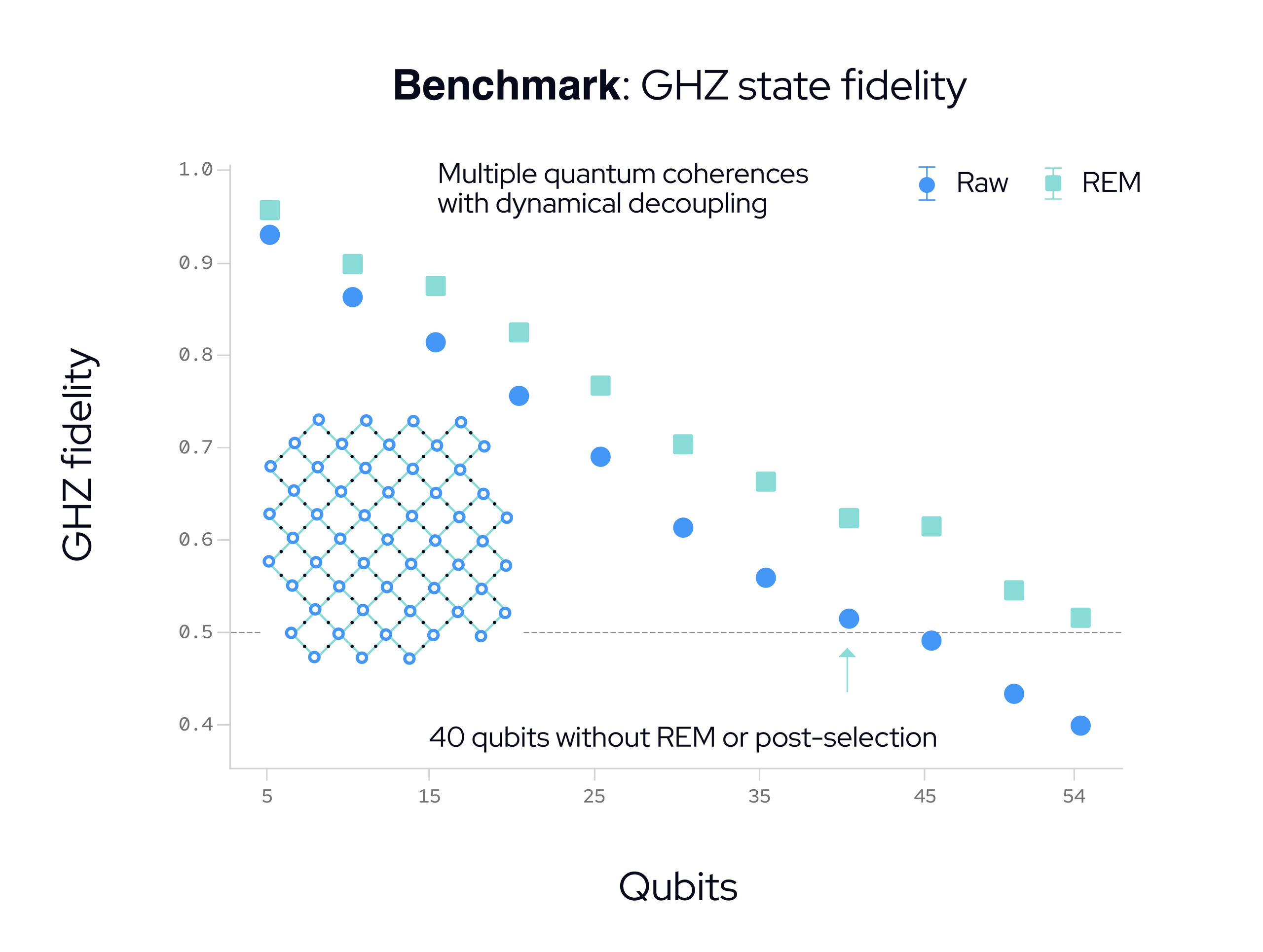
IQM has demonstrated full‑chip GHZ‑state entanglement across all 54 qubits of its Emerald superconducting processor, confirming genuine multipartite coherence on commercial hardware.
Introduction
IQM Quantum Computers announced that its cloud‑accessible Emerald processor has achieved simultaneous Greenberger–Horne–Zeilinger (GHZ) state entanglement across the entire 54‑qubit lattice. This marks the first demonstration of full‑chip multipartite entanglement on a commercial superconducting platform, extending beyond the ~30‑qubit active partitions that users previously accessed.
How the full‑chip entanglement was realized
The experiment relied on a combination of hardware and software advances:
- Square‑lattice topology of 54 transmon qubits with tunable couplers enabling native CZ gates.
- Automated scheduling compiler that optimizes the order of two‑qubit gates, balancing individual gate fidelity against idle‑time‑induced decoherence.
- Readout‑error mitigation (REM) and dynamical decoupling techniques that together cut the effective error rate by roughly half.
These tools allowed the preparation of a GHZ state spanning the whole chip, with a measured fidelity of 0.516 after mitigation—just above the 0.500 threshold that separates genuine multipartite entanglement from separable noise.
Significance and remaining challenges
Crossing the multipartite entanglement threshold on a 54‑qubit device demonstrates that large‑scale coherence is attainable on commercial hardware. It validates IQM’s autonomous calibration pipeline, which continuously tunes qubit frequencies and coupler settings to suppress cross‑talk and drift. However, the narrow fidelity margin underscores the scaling difficulty of deep quantum circuits on unencoded physical qubits. Maintaining full‑chip coherence will require:
- Faster, higher‑fidelity two‑qubit gates to reduce cumulative error.
- Ongoing calibration to counteract localized noise hotspots.
- Potential error‑mitigation or encoding strategies for algorithmic workloads that demand deeper circuits.
Outlook
IQM’s result provides a concrete benchmark for the quantum‑computing community, showing that full‑lattice entanglement is no longer a purely academic goal. As the company refines gate speeds and calibration routines, the Emerald processor could serve as a testbed for more demanding applications—such as variational quantum algorithms and small‑scale quantum simulations—while still operating within a cloud‑access model.
--- This article synthesizes publicly released information from IQM’s announcement and contextual analysis without adding unverified quotations or proprietary data.
Source
Read original sourceWhy we picked this
Accepted from curated QuantumUnzipped source (relevance scoring disabled).